
The full economic impact of the Hormuz closure has yet to hit Asia's industrial powerhouses, with the last of the pre-war oil still working its way through the global processing system.
The full economic impact of the Hormuz closure has yet to hit Asia's industrial powerhouses, with the last of the pre-war oil still working its way through the global processing system.
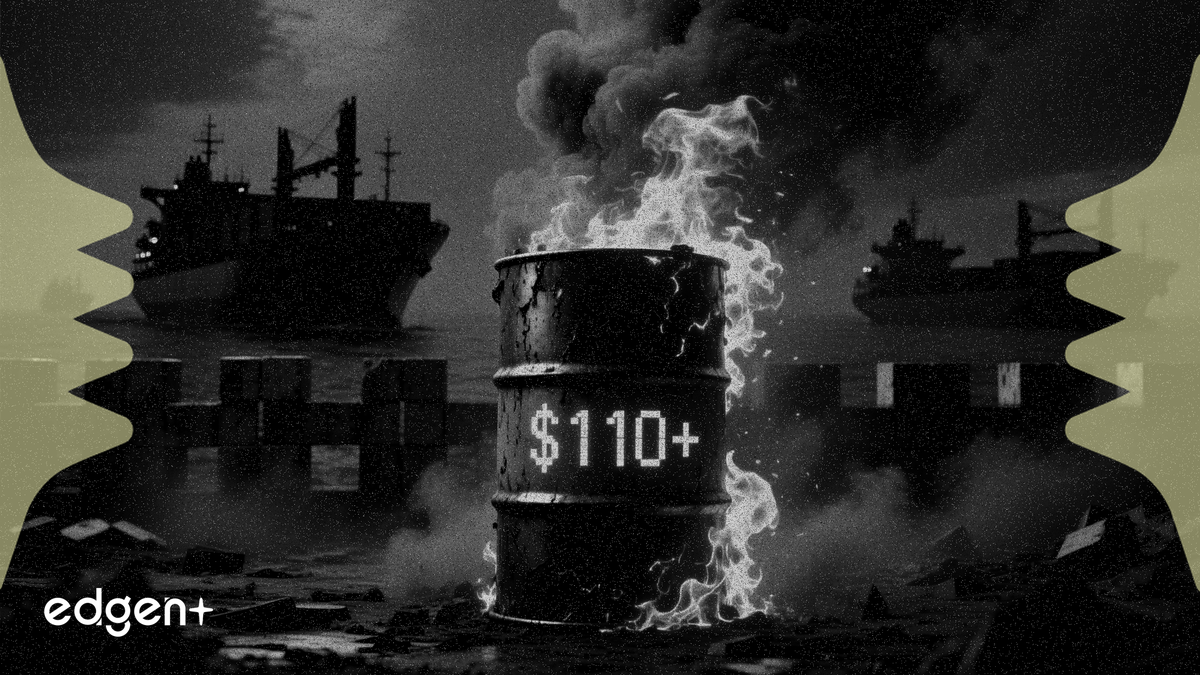
Crude oil prices pushed higher Tuesday as the complete closure of the Strait of Hormuz entered its second month, with West Texas Intermediate crude on track for its highest close since 2022 amid escalating geopolitical tensions between the U.S. and Iran.
"What appears to be a shift in relative value is, in reality, a reflection of how aggressively the market is pricing immediacy," Saxo Bank analyst Ole Hansen said in a note.
Brent futures for June delivery rose 0.6% to $110.40 a barrel, while U.S. WTI crude for May delivery jumped 3.5% to $116.36. The reversal of the typical spread between the two benchmarks highlights severe supply dislocations, as the closure of Hormuz chokes off roughly 20% of the world's daily oil consumption, which has sent prices soaring from around $70 a barrel before the crisis.
The conflict, which began with U.S. and Israeli strikes on February 28, threatens to trigger a global inflationary wave as governments from Beijing to Tokyo struggle to shield their economies from soaring energy costs. With a U.S. deadline for Iran to reopen the strait looming at 8:00 PM EST Tuesday, the potential for further military action could drive prices even higher and force a long-term realignment of global energy trade.
Iran has shown no sign of capitulating to President Donald Trump's ultimatum to reopen the vital shipping lane. The standoff follows Tehran's rejection of a 15-point ceasefire plan presented by the U.S. last week, which it derided as "maximalist and unreasonable." In response to continued U.S.-Israeli attacks on its infrastructure, Iran has not only maintained the blockade but also attacked key assets in neighboring states, including Saudi Arabia's Jubail petrochemical complex.
The closure has created a financial windfall for the few Gulf producers still able to export, but has cost other nations billions. An OPEC+ agreement on Sunday to raise May output quotas by 206,000 barrels per day is seen as largely notional, as key members cannot increase production while the strait remains closed. The situation has forced major energy importers to seek diversification beyond the Gulf, a trend that could benefit producers in the Atlantic Basin, the Caspian region, and Africa if the crisis is prolonged.
Analysts see three primary paths for how the conflict could end, each with significant implications for energy markets.
The first scenario involves a further escalation of the war. President Trump could prolong the conflict to force a capitulation or regime collapse in Tehran, potentially by seizing strategic assets like Kharg Island, which handles about 90% of Iran's oil exports. This would deal a massive blow to Tehran but would also exacerbate the global supply shock, likely sending oil and LNG prices climbing further and spurring global inflation.
A second possibility involves the U.S. declaring victory and withdrawing, leaving the international community to deal with the Hormuz blockade. While the U.S. has become less dependent on Middle Eastern oil, such a move could be politically damaging, emboldening rivals like Russia and China and potentially leading to the collapse of international maritime law. In this scenario, oil prices would likely remain elevated to account for the new political risk.
The final and most likely scenario is a conditional armistice. With countries like Pakistan and China mediating, negotiations could lead to a deal that reopens the strait. The Trump administration has already signaled a willingness to ease some sanctions to stabilize prices. If a settlement is reached, prices would likely recede from their peaks but remain above pre-war levels, pricing in a new geopolitical risk premium. A decisive U.S. victory, however, could see prices return to pre-war levels by the third or fourth quarter of 2026.
This article is for informational purposes only and does not constitute investment advice.