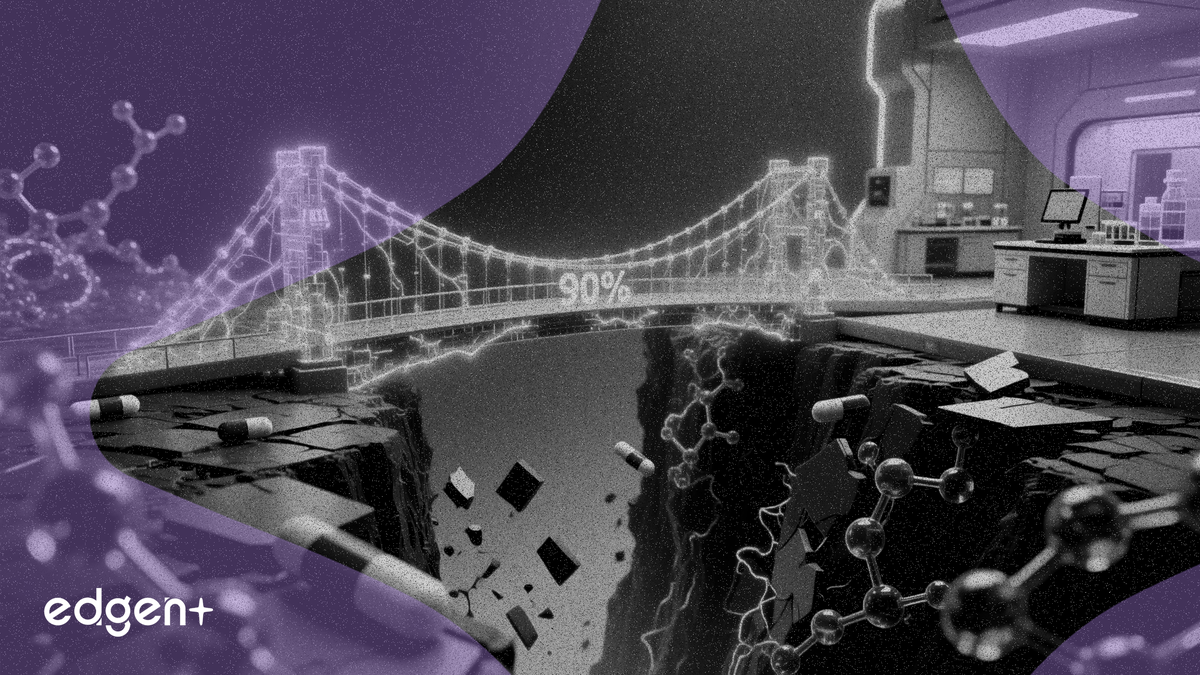
Danish drugmaker Novo Nordisk is partnering with OpenAI to deploy artificial intelligence across its business, a strategic move aimed at closing a persistent 90 percent clinical trial failure rate that plagues the pharmaceutical industry. The collaboration, announced Tuesday, will see Novo integrate AI from drug discovery and manufacturing through to commercial operations as it races to keep pace with rivals like Eli Lilly in the lucrative weight-loss drug market.
"Integrating advanced AI is no longer an option but a competitive necessity," a Novo Nordisk R&D executive might state. "This partnership allows us to attack the discovery-to-development workflow, aiming to translate computational promise into clinical reality faster than before."
The partnership spans the entire value chain, but the initial focus is on R&D. The move reflects a broader industry trend where AI is compressing early discovery timelines by 30 to 40 percent. Insilico Medicine, for example, brought an AI-discovered drug for idiopathic pulmonary fibrosis from target identification to Phase II trials in under 30 months, a process that traditionally takes six to eight years.
At stake is the staggering cost of innovation, where the average successful drug costs $1.3 billion to develop, according to a 2025 RAND analysis. By improving the efficiency of candidate selection and development, Novo Nordisk aims to reduce the financial impact of the industry's 90 percent failure rate for candidates entering clinical trials, a figure that has not demonstrably improved despite the adoption of AI.
From In Silico Promise to In Vivo Reality
AI is already proving its ability to expand the universe of potential drug candidates at a speed previously unimaginable. At Novartis, researchers used generative AI to design 15 million potential compounds for Huntington’s disease, ultimately synthesizing 60 for lab testing. This computational power allows scientists to explore a vast chemical space that traditional methods cannot access.
However, the industry is discovering that faster discovery does not guarantee a viable product. The primary bottleneck is shifting from finding molecules to developing them. An estimated 70 percent of new chemical entities exhibit poor aqueous solubility, a fundamental roadblock to creating a workable dosage form. This reality check often surfaces late in development, leading to costly reformulations and extended timelines. As one unnamed CEO noted in early 2026, "AI has really let us all down in the last decade when it comes to drug discovery. We’ve just seen failure after failure."
The New Competitive Battleground: Developability
The partnership highlights the critical distinction between an "undruggable" target—one that is biologically unreachable—and an "undevelopable" product, a molecule that is pharmacologically promising but cannot be reliably manufactured or formulated. While AI is making more targets druggable, the undevelopable challenge remains a physical and chemical problem that computation alone cannot solve. As of December 2025, not a single AI-discovered drug has received FDA approval.
For investors, the Novo Nordisk-OpenAI partnership is not a signal of an imminent cure for a major disease but a necessary strategic investment in operational efficiency. The true competitive advantage in the next era of pharma will come from translating AI-generated candidates into scalable, manufacturable products. The teams that succeed will be those that integrate development and manufacturing considerations into the earliest stages of discovery, reducing the risk that a promising molecule discovered in silico dies on the manufacturing bench.
This article is for informational purposes only and does not constitute investment advice.