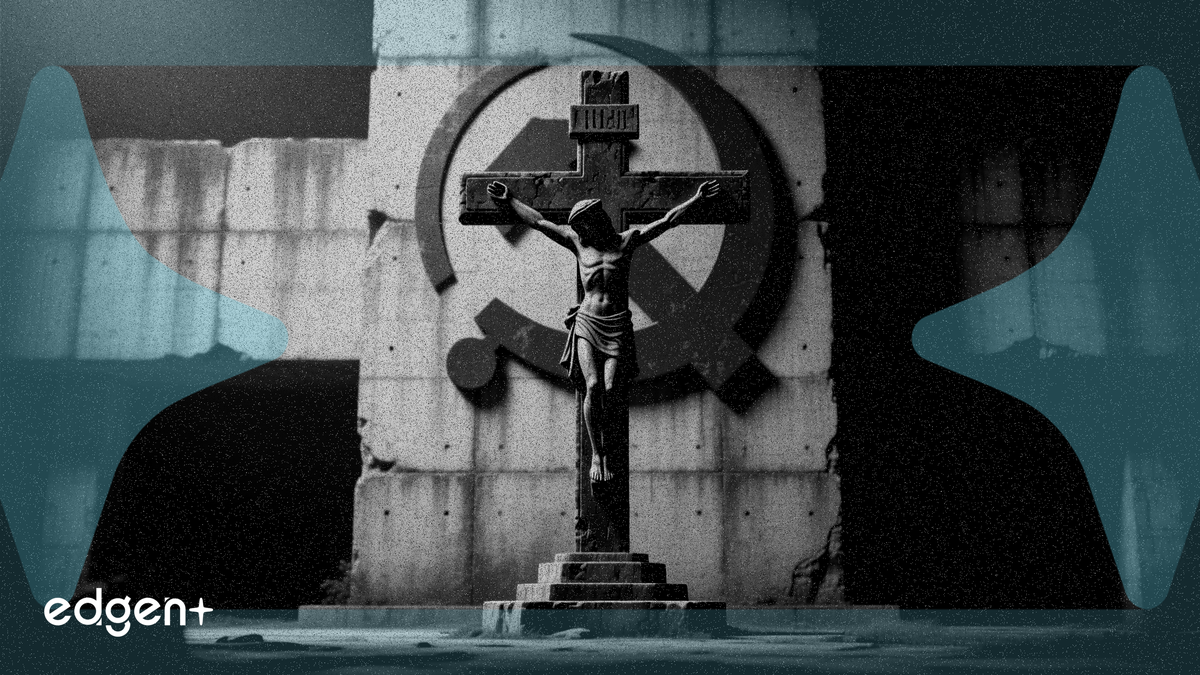
A new analysis of North Korea’s eight-decade-long dynasty argues its enduring power stems not from traditional communist ideology but from a surprising source: 19th-century American Protestantism. The state’s founder, Kim Il Sung, crafted a personality cult with quasi-religious rituals and a hereditary succession model that mirrors Christian teachings, ensuring stability for three generations in a way other socialist states failed to achieve.
“If you learn the Bible first and then learn Juche, you’ll be able to understand it much easier. I think you can even replace the name Jesus with the name Kim Il Sung,” said Kim Hyon-hui, a former North Korean agent, in the new book “Korean Messiah” by Jonathan Cheng. The book argues that the state ideology, known as Juche or "self-reliance," effectively functions as a religion with the Kim family as its holy figures.
Before its devastation in the Korean War, Pyongyang was a hub of Christian activity, nicknamed the “Jerusalem of the East,” with a sprawling Presbyterian mission and the world’s largest Presbyterian seminary. Kim Il Sung’s own upbringing was steeped in this environment, giving him a front-row seat to the power of faith to mobilize devotion and create a system of belief—a model he would later adapt to secure his own perpetual rule.
This ideological foundation explains why North Korea defied the trajectory of every other Soviet-bloc nation. While others liberalized or collapsed, the Kim dynasty fortified its power by creating a belief system that demanded total worship, making the state virtually impervious to external pressure and positioning it to endure for decades to come.
The Juche-Christianity Parallel
Though North Korea relentlessly suppressed organized religion, its state-sponsored ideology, Juche, is replete with quasi-religious overtones. Scholars and defectors have noted the striking parallels between its practices and Christian worship. Citizens are called to study the works of Kim Il Sung, bow before his statues on significant days, and protect his portraits as sacred objects, sometimes at the cost of their own lives during natural disasters.
The state narrative positions Kim Il Sung as a messianic figure, with his birthplace presented as a holy site. An official party newspaper declared in a 1980 Christmas editorial, “People of the world, if you are looking for miracles, come to Korea! Do not believe in God. Believe in the great man!” This displacement of Christ with the “benevolent sun” of Kim Il Sung was a conscious effort to create a new, all-encompassing faith.
A Dynasty Built on Faith
This system was crucial for establishing the world's first and only communist hereditary dynasty. While the Soviet Union dismantled Stalin’s personality cult and China curbed the excesses of Mao worship, Kim Il Sung built a system robust enough to pass down to his son, Kim Jong Il, and grandson, the current leader Kim Jong Un. After his death in 1994, Kim Il Sung was declared “Eternal President,” effectively making him a god ruling in perpetuity.
This transition appalled North Korea’s socialist backers in Moscow and Beijing, who saw it as a departure from Marxist-Leninist principles. But by replacing that ideology with the “gospel of Juche,” Kim Il Sung created a framework where power was not just political but divine, passed down through a sacred bloodline. The recent prominence of Kim Jong Un’s daughter, Kim Ju Ae, suggests the dynasty is positioned to extend into a fourth generation.
Historical Roots in Pyongyang
The ideological blueprint for this system came from the American Presbyterianism that flourished in northwestern Korea in the late 19th and early 20th centuries. Kim Il Sung’s mother was a devout Presbyterian, and he was raised in a Christian bubble. He witnessed firsthand the power of faith to inspire awe and mobilize followers around a central narrative of salvation and a charismatic leader.
When catapulted into power after World War II, Kim, consciously or not, drew upon this heritage. He created a state that demanded the same level of faith and worship as the religion it sought to replace. Former U.S. President Jimmy Carter, after a 1994 visit, compared the society to a religious sect. One defector put it more simply: “When I was in North Korea, I thought Kim Il Sung was God.” If classified as a religion, Kimilsungism would rank among the world's largest, with roughly as many adherents as Judaism.
This article is for informational purposes only and does not constitute investment advice.