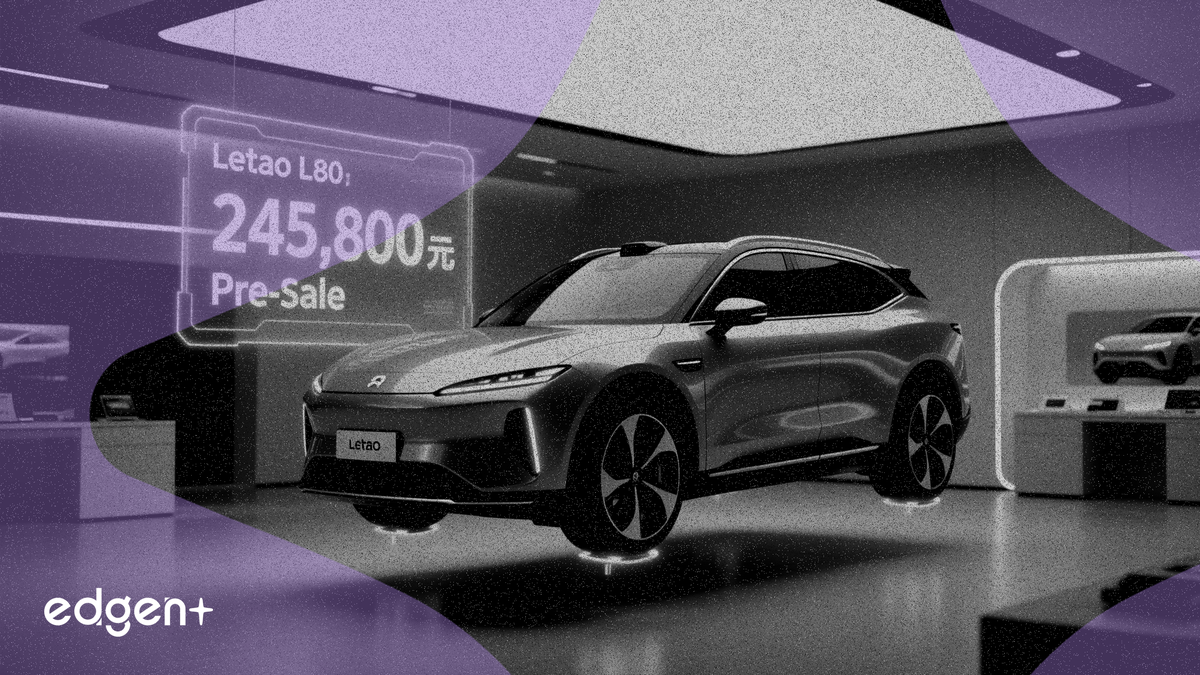
Nio is intensifying the Chinese EV price war, launching its new Letao L80 SUV at a price point that directly challenges competitors like Tesla and Xiaomi.

Nio is intensifying the Chinese EV price war, launching its new Letao L80 SUV at a price point that directly challenges competitors like Tesla and Xiaomi.
Nio launched pre-sales for its Letao L80, a large five-seater SUV, at a starting price of 245,800 yuan (~$34,000), signaling a direct assault on the mainstream family SUV market dominated by rivals. The L80 is the first model from Nio's new mass-market Letao sub-brand, designed to capture a wider customer base than its premium offerings.
"The Letao L80 is designed to offer a flagship experience for the family user at a competitive price," a Nio spokesperson said at the launch event on April 28.
The L80 will be available in two distinct autonomous driving configurations: a premium version featuring LiDAR and a Shenji NX9031 chip, and a more affordable pure-vision version equipped with an Nvidia OrinX chip. The vehicle boasts significant practicality with up to 53 storage spaces and a maximum cargo capacity of 2,840 liters.
The L80's launch places Nio in the fiercely competitive sub-300,000 yuan segment. Its starting price of 245,800 yuan undercuts the Tesla Model Y in China (starting at 249,900 yuan) and is priced competitively against a wave of new entrants like the Xiaomi SU7, which starts at 219,900 yuan. This move is critical for Nio to boost sales volume and achieve profitability.
Nio's decision to offer two separate advanced driver-assistance system (ADAS) paths for the L80 is a strategic hedge in a market divided on the future of autonomous technology. The high-end trim continues Nio's commitment to LiDAR, a technology that uses lasers to create a 3D map of the car's surroundings, running on a dedicated Shenji NX9031 processor.
The second version adopts a "pure-vision" approach, relying solely on cameras, similar to Tesla's strategy. This version is powered by Nvidia's well-regarded OrinX chip. This dual offering allows Letao to compete directly with Tesla on its own terms while also providing a more advanced, sensor-rich option for customers willing to pay a premium, a strategy also seen with competitors like Xiaomi who are now making LiDAR standard.
The Letao L80 enters one of the most contested segments of the global auto market. For context, the recently updated Xiaomi SU7 sedan has a starting price of 219,900 yuan, while its Pro version is priced at 249,900 yuan. Tesla's Model Y, the best-selling SUV in the region, starts at 249,900 yuan. By pricing the L80 at 245,800 yuan, Nio is aiming for the heart of the market, betting that the L80's size and family-friendly features will attract buyers away from smaller sedans and more established SUV rivals.
The success of the Letao brand is crucial for Nio's path to profitability. While the company has built a strong reputation in the premium segment, its sales volume has lagged behind competitors like BYD and Tesla. The Letao L80, and the sub-brand as a whole, represents a strategic pivot to address a much larger total addressable market. The market will be watching pre-order numbers closely as an early indicator of whether the strategy is paying off.
This article is for informational purposes only and does not constitute investment advice.