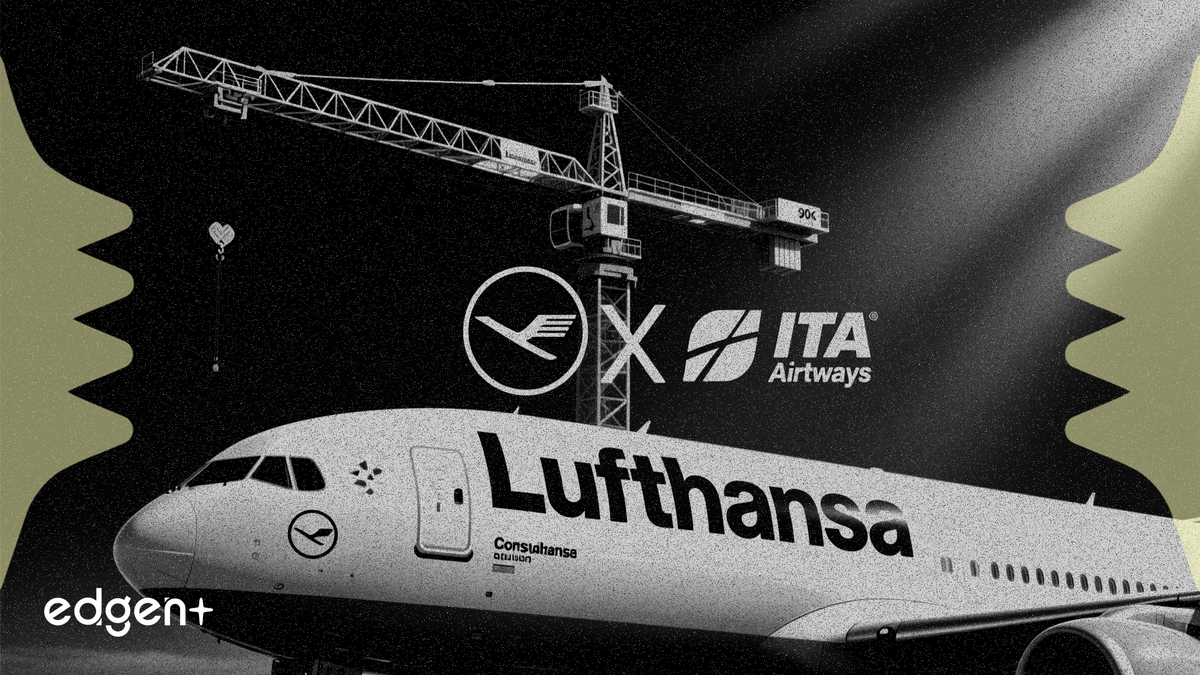
Lufthansa’s move to control Italy’s flag carrier deepens the wave of consolidation sweeping the European airline industry, creating a formidable competitor to rivals Air France-KLM and IAG.

Deutsche Lufthansa AG will take a 90 percent stake in ITA Airways for nearly $400 million, cementing its control over the Italian carrier and escalating the competitive battle among Europe’s largest airline groups for market dominance. The deal, announced Tuesday, marks a pivotal step in the German carrier's strategy to expand its footprint in southern Europe.
"The irony of a competitor's failure is that it makes the remaining airlines that much stronger," Henry Harteveldt, an airline analyst at Atmosphere Research Group, said recently regarding market consolidation. While speaking about the US market, his comments highlight the strategic imperative behind Lufthansa's move to absorb a rival and reduce competition.
The acquisition values the Italian airline and continues a trend of consolidation that has seen Europe’s skies increasingly dominated by three main players: Lufthansa Group, Air France-KLM, and IAG, the owner of British Airways and Iberia. The deal is subject to regulatory approval from European authorities, who will scrutinize its impact on competition, particularly on transatlantic routes where ITA has a partnership with Delta and Air France-KLM.
For Lufthansa, securing Italy—Europe's third-largest aviation market—is critical to fending off budget carriers like Ryanair and expanding its reach. The move is a direct challenge to Air France-KLM, which also showed interest in ITA. The success of the acquisition will depend on integrating the historically loss-making Italian airline and navigating a high-cost environment that continues to pressure carriers across the globe.
The deal marks the final chapter in the long-running saga of Italy's national airline, the successor to the defunct Alitalia. For years, the Italian government sought a partner to stabilize the carrier, a challenge made more acute by the post-pandemic travel landscape. The industry has been grappling with soaring fuel costs, supply chain bottlenecks for aircraft maintenance, and a shift in travel patterns.
Lufthansa's consolidation strategy contrasts with the struggles seen in other parts of the aviation market, particularly the ultra-low-cost-carrier (ULCC) segment. In the United States, the recent collapse of Spirit Airlines highlighted the intense pressure on the budget model. Legacy carriers have successfully fought back by introducing "basic economy" fares and using their vast networks and loyalty programs to their advantage. "If the spill model is not dead, then it is on life support," said aviation analyst Bill Swelbar, referring to the ULCC strategy of capturing traffic that major carriers can't accommodate.
Lufthansa, like its primary US counterparts, is focusing on strengthening its hubs and leveraging premium cabin demand to drive profitability. By integrating ITA, Lufthansa gains valuable slots at Rome's Fiumicino airport and a stronger network connecting Italy with the Americas and Asia. This scale is crucial for competing not only with other legacy groups but also with the highly efficient European budget carriers that have reshaped short-haul travel.
The path forward involves significant challenges. Integrating ITA's operations and fleet with Lufthansa's existing structure, which includes SWISS, Austrian Airlines, and Brussels Airlines, will be a complex undertaking. Furthermore, the deal will undoubtedly face close examination in Brussels, where regulators have previously expressed concerns about airline mergers reducing consumer choice and increasing fares on key routes.
This article is for informational purposes only and does not constitute investment advice.