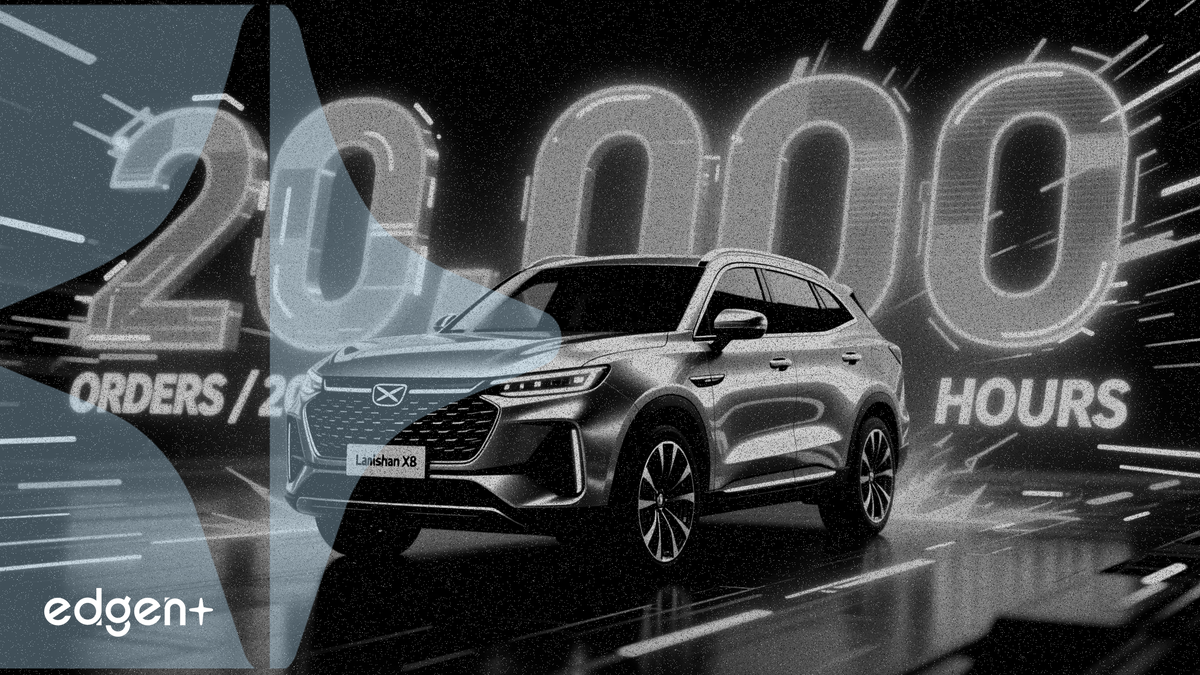
Lantu Auto's new flagship SUV, the Taishan X8, has secured over 20,000 pre-sale orders within 20 hours, signaling strong consumer demand in China's crowded electric vehicle market.
"The strong pre-sale demand for the Taishan X8 can significantly boost Lantu Auto's revenue forecasts and enhance its market position in the competitive electric vehicle sector," a company representative said in a statement.
The five-seater SUV, launched for global pre-sale on April 22, is offered in five variants with both plug-in hybrid (PHEV) and pure electric (EV) powertrain options. Prices range from RMB 302,900 to RMB 389,900 (approximately $42,400 to $54,600).
The immediate success of the Taishan X8 puts pressure on rivals in the world's largest auto market. Competitors like Xpeng, which recently started mass production of its first EV model developed with Volkswagen, are also pushing for aggressive growth, with Xpeng aiming for large-scale production of flying cars by 2027.
The strong debut for the Taishan X8 comes as China's domestic EV market continues to see intense price competition and a rapid pace of new model launches. The success of a premium model like the Taishan X8 indicates that there is still strong demand for vehicles that can stand out in a crowded field. Lantu's ability to attract such a high volume of orders so quickly may also reflect a broader trend of Chinese consumers favoring domestic brands that offer advanced technology and features at competitive prices.
This environment is forcing all automakers, both domestic and foreign, to innovate rapidly. For example, Xpeng has already received over 7,000 orders for its flying cars and plans to start robotaxi tests in Guangzhou this year. The company's president, Brian Gu, told Reuters that he expects Xpeng's robot business to eventually be larger than its automotive division. This highlights the broad ambitions of Chinese EV makers, who are not just competing on price but also on future technologies.
For Lantu Auto, the challenge will be to convert these pre-sale orders into actual deliveries and to scale up production to meet demand. The company's performance in the coming months will be a key indicator of its ability to compete with established players like Tesla and BYD, as well as a host of other ambitious domestic rivals.
This article is for informational purposes only and does not constitute investment advice.