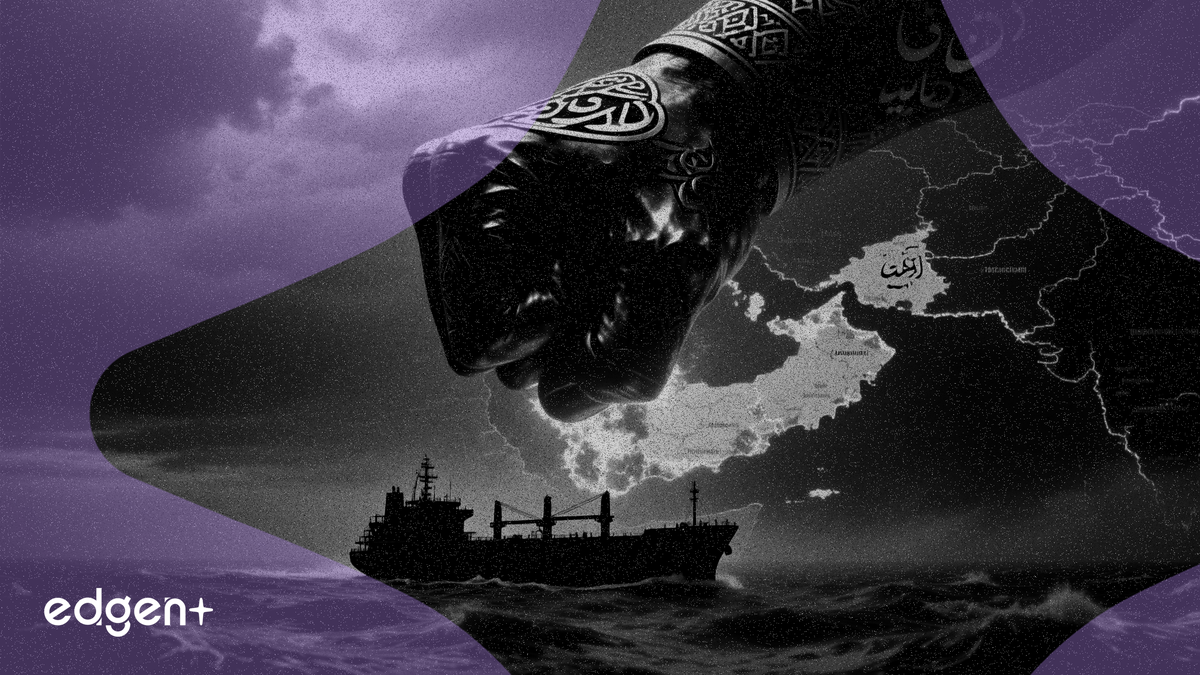
A defiant poster in central Tehran declaring “permanent control” of the Strait of Hormuz has solidified a sharp reversal by Iran, which attacked a tanker and reimposed a blockade on the vital oil artery less than 24 hours after announcing its reopening.
The move threatens to unravel a fragile ceasefire and push oil prices higher after Iran’s Revolutionary Guard Corps fired on at least one commercial vessel Saturday. The reversal came swiftly after the US said its own naval blockade on Iranian ports would remain in place, a condition Tehran called a violation of the temporary truce.
"Any attempt to approach the Strait of Hormuz will be considered cooperation with the enemy, and the offending vessel will be targeted," the Iranian Revolutionary Guard’s navy said in a statement carried by state media, directly contradicting earlier assurances of safe passage.
The United Kingdom Maritime Trade Operations center confirmed that two IRGC patrol boats fired shots at a tanker, identified in radio traffic as the Indian-flagged Sanmar Herald, damaging the bridge windows but causing no injuries. Vessel trackers showed the supertanker, carrying 2 million barrels of Iraqi oil, was forced to make a U-turn. Oil prices had tumbled more than 10 percent to $89 a barrel on Friday's news of the reopening, through which a fifth of the world's oil flows.
The escalation throws wider peace talks hosted by Pakistan into disarray and raises the immediate risk of further supply disruptions to an already constrained global market. While mediators claim a deal is close, the conflicting actions and statements from Tehran and Washington underscore the deep mistrust that could easily reignite a wider conflict before a final agreement is signed.
The whiplash over the strait’s status began Friday when Iran announced the waterway would be “completely open” for the duration of a 10-day ceasefire between Israel and Hezbollah. The news was welcomed by U.S. President Donald Trump, who declared the strait would “no longer be used as a weapon against the world.”
However, the optimism was short-lived. Trump insisted the U.S. naval blockade, which has turned back 23 ships since it began, would “remain in full force” until a permanent nuclear deal was finalized. Tehran immediately declared the blockade a ceasefire violation and the reopening “null and void.”
"Whatever Trump Says is Useless"
The public declaration of control in Tehran appeared designed to send an unambiguous message. A huge poster was unfurled in the city center showing a hand decorated with the Iranian flag squeezing a waterway full of ships, with Persian text reading: “Whatever Trump says is useless, the Strait of Hormuz will always be controlled by Iran.”
The incident with the Sanmar Herald provided a chilling illustration of the renewed threat. In audio from a radio exchange, the tanker’s captain can be heard pleading with the Iranian navy. “You gave me clearance to go, my name is second on your list,” the captain said. “You are firing now. Let me turn back.”
Broader Deal Hangs in the Balance
The confrontation at sea complicates a second round of U.S.-Iran negotiations set to take place in Pakistan. The talks are aimed at finalizing a comprehensive agreement that would see Iran suspend its nuclear program in exchange for the release of up to $20 billion in frozen assets.
Disagreements persist over the terms. Trump claimed Friday that Iran had agreed to indefinitely suspend its nuclear program and hand over its stockpile of enriched uranium, a claim Iranian officials quickly denied. “Iran’s enriched uranium will under no circumstances be transferred anywhere,” said government spokesman Esmaeil Baqaei.
Despite the public posturing and the renewed hostilities in the strait, Pakistani officials involved in the negotiations told Reuters that a memorandum of understanding might be signed first, followed by a comprehensive deal in 60 days. Turkish Vice President Cevdet Yilmaz, who is supporting the mediation, urged realism. “These comprehensive negotiations will take some time,” he said.
This article is for informational purposes only and does not constitute investment advice.