
A failed round of peace talks between the US and Iran has led to a direct military threat and counter-threat over two of the world's most critical oil chokepoints.
A failed round of peace talks between the US and Iran has led to a direct military threat and counter-threat over two of the world's most critical oil chokepoints.
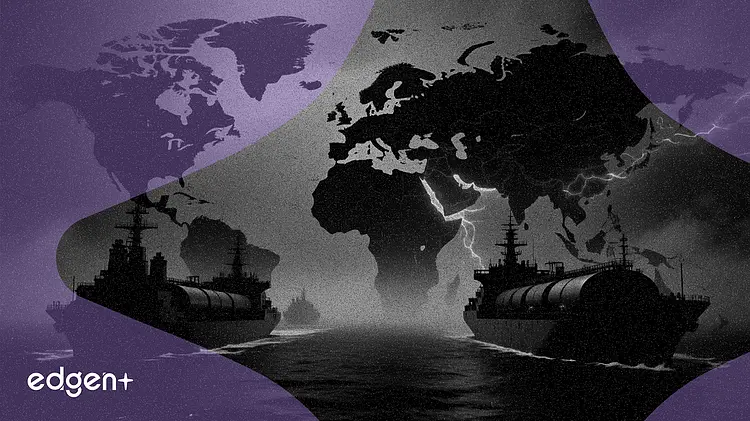
The United States announced its intention to blockade the Strait of Hormuz following the collapse of peace talks with Iran, a move that threatens to ignite a wider conflict and has already sent shockwaves through global markets. The U.S. Central Command stated the blockade of all maritime traffic to and from Iranian ports would begin at 1400 GMT on Monday, while assuring that navigation for non-Iranian destinations would not be impeded. The announcement came after more than 20 hours of negotiations in Islamabad failed to produce an agreement to end the six-week war.
"The bad news is that we have not reached an agreement, and I think that's bad news for Iran much more than it's bad news for the United States of America," Vice President JD Vance, who led the U.S. delegation, said after the talks. U.S. officials cited Iran's refusal to dismantle its uranium enrichment program as the primary sticking point. In a social media post, President Donald Trump declared that the U.S. Navy would begin destroying mines in the strait and interdicting any vessel that paid a toll to Iran, stating, "No one who pays an illegal toll will have safe passage on the high seas."
In a swift and direct response, Iran's armed forces issued a stark warning, declaring that security in the Persian Gulf and Gulf of Oman is either "for everyone, or for no one." An Iranian media source close to the military stated that if the U.S. takes action in the Strait of Hormuz, it will "lose the Bab el-Mandeb Strait" as well. This escalates the conflict dramatically, threatening a second vital maritime chokepoint that connects the Red Sea to the Gulf of Aden. Iran's Revolutionary Guards warned that any military vessels approaching the Strait of Hormuz would be considered a ceasefire violation and "dealt with harshly and decisively."
The breakdown in diplomacy immediately rippled across global markets, which had rallied on a fragile two-week ceasefire. Oil prices jumped above $100 per barrel in early Monday trading as the prospect of a severe supply disruption returned to the forefront. The U.S. dollar strengthened against a basket of major currencies as investors sought safe-haven assets. The last time tensions in the Strait of Hormuz led to a comparable military standoff in 2019, Brent crude futures spiked nearly 20% in a single day.
The escalation now encompasses two of the world's most critical maritime arteries. The Strait of Hormuz, a 21-mile-wide chokepoint at its narrowest, handles approximately 20% of global oil consumption. Iran's counter-threat targets the Bab el-Mandeb Strait, a 16-mile-wide passage off the coasts of Yemen, Djibouti, and Eritrea, which is a crucial route for oil and natural gas shipments from the Gulf to Europe via the Suez Canal. A simultaneous disruption to both straits would represent an unprecedented shock to the global energy system.
President Trump acknowledged the potential for sustained high energy prices through the November midterm elections, a rare admission of the war's domestic political risks. In response, Iranian Parliamentary Speaker Mohammad Baqer Qalibaf posted a map of Washington-area gasoline prices on social media with the caption, "Enjoy the current pump figures. With the so-called 'blockade', Soon you'll be nostalgic for $4–$5 gas." The failure of the talks, which were the highest-level direct discussions between the two nations since 1979, plunges the region and the global economy back into a state of high uncertainty.
This article is for informational purposes only and does not constitute investment advice.