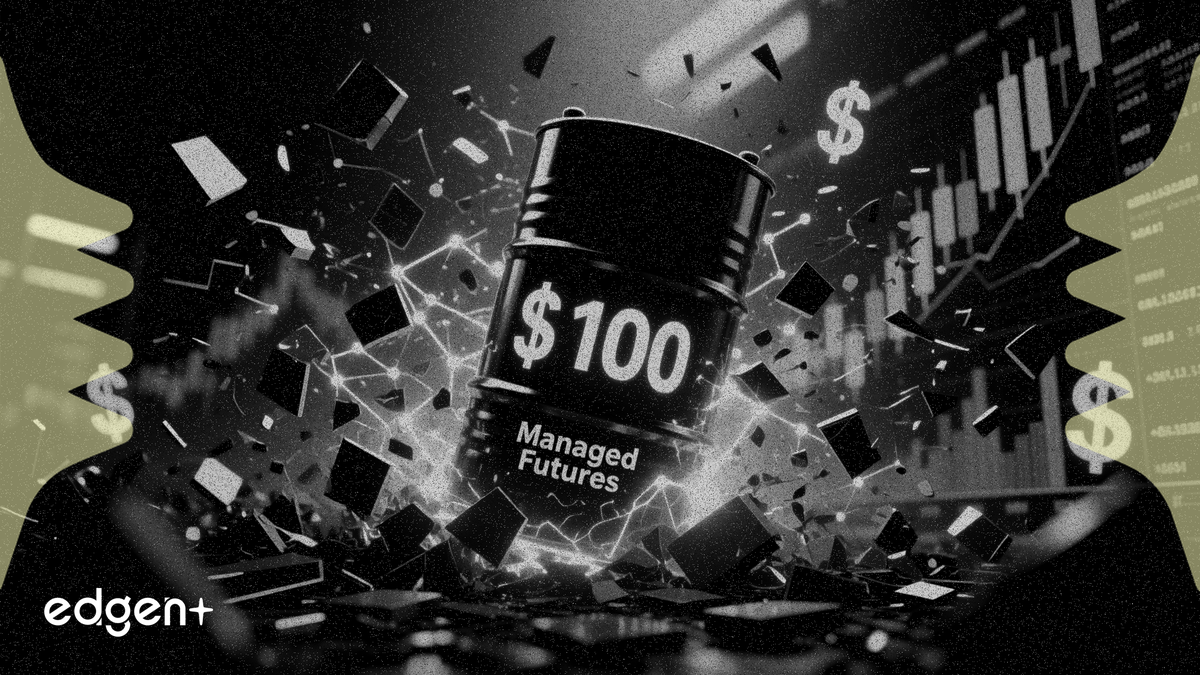
Traditional Portfolios Suffer as $100 Oil Returns
Rising geopolitical risk from the U.S.-Iran conflict has pushed oil prices over $100 a barrel, creating a difficult environment for investors as both stocks and bonds register losses. This market dynamic, reminiscent of the 1970s stagflation fears, is fueling a renewed interest in managed futures strategies, which previously thrived in similar conditions. In 2022, when the S&P 500 dropped approximately 18% and the Bloomberg U.S. Aggregate Bond Index fell 13%, managed futures strategies posted an average gain of 20%.
The strategy's ability to take long or short positions on futures contracts across various asset classes allows it to capitalize on sustained trends, whether markets are rising or falling. These systematic models are designed to capture broad market shifts over months, making them well-suited for the current period of high inflation, interest rate uncertainty, and geopolitical volatility.
Largest ETF Gains $1B Amid Broader Industry Adoption
The growing demand for these alternative strategies is reflected in significant capital flows. The managed futures ETF category, while still niche with about $6.5 billion in total assets, is expanding rapidly. The industry's largest fund, the iMGP DBi Managed Futures Strategy ETF (DBMF), has alone attracted about $1 billion in inflows in 2026.
A clear signal of mainstream acceptance is the entry of Wall Street giants. In the past year, BlackRock, Invesco, and Fidelity have all launched their own managed futures ETFs. This move by the world's largest asset managers indicates a strategic bet on sustained investor demand for strategies that can offer diversification when traditional 60/40 portfolios falter.
We thrive with changes over 3, 6, 9, 12 months, not Monday to Thursday.
— Andrew Beer, Managing Member at DBi
A Volatility Hedge for the Long Term
Experts advise that managed futures are not a short-term trade but a strategic allocation for portfolio resilience. Their goal is to provide non-correlated returns during periods of market stress, but this also means they can underperform stocks and bonds during sustained bull markets. Financial advisors suggest a modest allocation, typically between 3% to 5% of a total portfolio, to serve as a long-term diversifier alongside other assets.
Investors have to be able to stick with managed futures through inevitable periods of underperformance. They can work really well when you need them, but you have to be able to let them work over full market cycles.
— Nate Geraci, President of NovaDius
While more complex than standard stock and bond ETFs, these instruments offer a liquid and transparent way to access strategies once confined to the world of hedge funds. As market conditions continue to challenge traditional asset allocation, the role of managed futures as a portfolio stabilizer is becoming increasingly recognized.