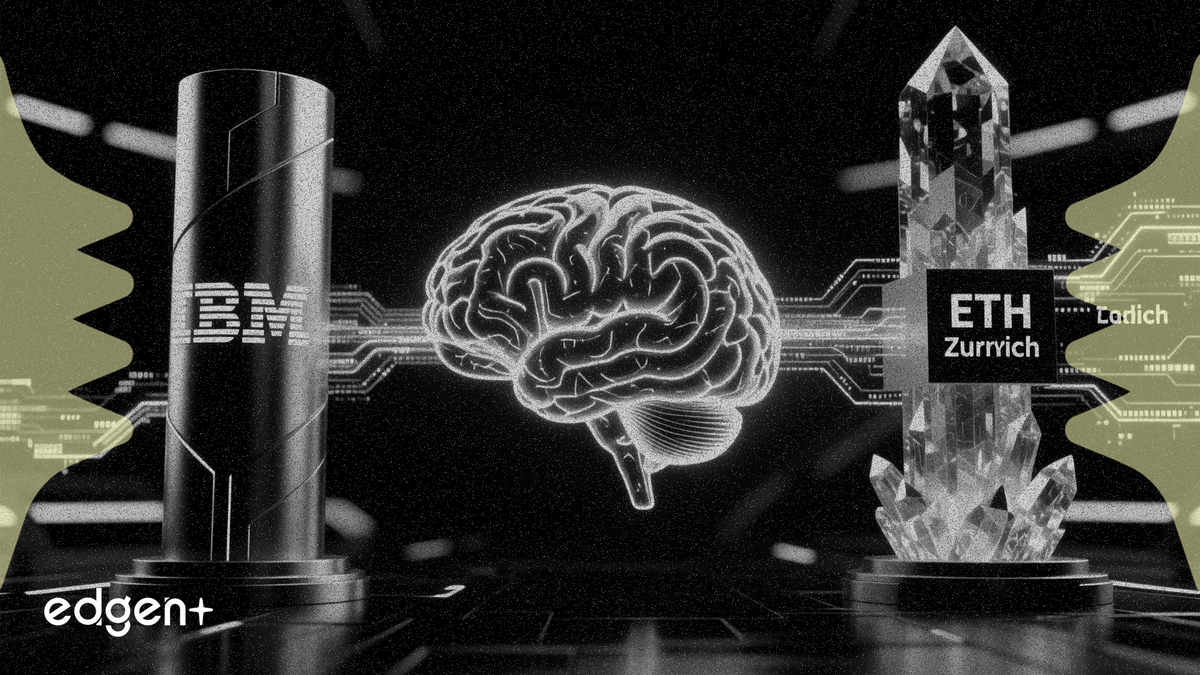
IBM and ETH Zurich are launching a 10-year research partnership to develop foundational algorithms, aiming to secure a long-term advantage in the next generation of AI and quantum computing.
(Zurich) – International Business Machines Corp. and ETH Zurich are embarking on a decade-long collaboration to advance the foundational algorithms that will power future artificial intelligence and quantum computers, a strategic push to build a defensible moat in a sector projected to be worth over $100 billion within a decade.
The partnership, announced March 31, will focus on developing the core mathematical and computational models needed to unlock the power of these next-generation technologies. The move comes as governments and corporations escalate spending on quantum research, with the UK recently pledging over £2 billion to support the field. For IBM, this deepens its research pipeline as it projects the arrival of fault-tolerant quantum computers by 2029.
“We do believe that we are going to get quantum advantage on a real application this year,” Alessandro Curioni, an IBM fellow and director of the IBM Research Lab in Zurich, said in a recent interview, highlighting the company's aggressive timeline. The collaboration with a leading technical university like ETH Zurich provides access to a critical pipeline of talent and academic rigor.
This long-term initiative is a direct investment in the core intellectual property that will define the next era of computing. While competitors like Alphabet and startups such as PsiQuantum and SandboxAQ are attracting billions in investment, IBM is betting that leadership will stem from fundamental breakthroughs in how these complex systems operate, with potential applications spanning drug discovery, materials science, and financial optimization.
The Race for Quantum Advantage
The collaboration enters a high-stakes environment where the race to build scalable, fault-tolerant quantum computers is accelerating. McKinsey estimates the quantum technology market could reach $100 billion in a decade, fueling massive investment rounds for specialized startups. Yet, significant technical hurdles remain. State-of-the-art quantum computers still suffer from error rates between 0.1% and 1%, according to Microsoft, a challenge that foundational algorithmic research is essential to overcome.
IBM's strategy involves building an ecosystem around its hardware, which now includes over 80 quantum systems available to partners. The company recently demonstrated how its quantum processors could simulate complex material properties previously beyond the reach of classical supercomputers, as detailed in a paper on the novel C13CL2 molecule. This work, which used up to 100 qubits on an IBM Heron processor, showcases the potential for quantum to revolutionize materials science and drug discovery by modeling molecular behavior with unprecedented fidelity.
From Foundational Research to Enterprise Value
While the fruits of this new partnership are years away, IBM is already mapping the path from abstract research to commercial application. According to a recent report from the IBM Institute for Business Value, 59% of executives believe quantum computing will fundamentally transform their industries, yet only 27% expect their own organizations to use it. The report identifies supply chain management and logistics as the most likely fields for the first commercial quantum applications.
The collaboration with ETH Zurich is designed to create the building blocks for that future. By focusing on foundational algorithms, the two organizations aim to develop the core tools that will eventually allow businesses to solve complex optimization problems in minutes rather than years. Financial services firm HSBC has already tested a hybrid quantum-classical system with IBM that improved the accuracy of predicting bond trade execution by 34%, showing a clear line from research to financial impact. For IBM (NYSE: IBM), this 10-year commitment is a calculated investment to ensure it owns the fundamental operating system of the coming quantum era, a move designed to secure its relevance for decades to come.
This article is for informational purposes only and does not constitute investment advice.