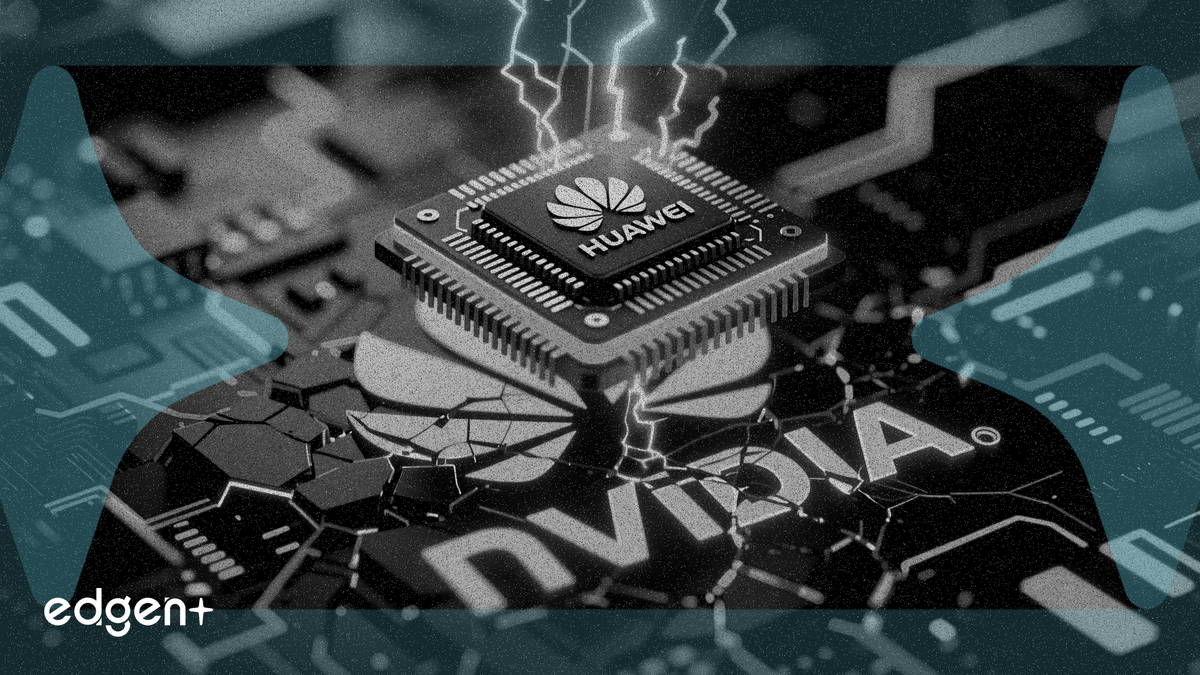
Huawei detailed a new chip architecture that it claims can rival the world's most advanced semiconductors, a move that intensifies its competition with Nvidia and Apple.

Huawei Technologies Co. unveiled a new chip design principle it says will allow it to produce high-end processors equivalent to a 1.4-nanometer node by 2031, a direct challenge to global semiconductor leaders while under U.S. sanctions.
"Rather than depending solely on smaller transistors, the company is focusing on shortening interconnect, lowering latency and improving data movement inside the chip, which is a credible way to extract more performance when leading-edge lithography is constrained," said He Hui, director of semiconductor research at Omdia.
The new approach includes a "LogicFolding" architecture, set to debut in Huawei's Kirin smartphone chips this fall, and a broader "Tau Scaling Law." This comes after Huawei's 2023 Mate 60 smartphone used a 7-nm chip from China's SMIC, and as global leader TSMC plans for mass production of its 1.4-nm process in 2028.
The strategy aims to secure China's technological future and chip supply for everything from smartphones to AI, directly threatening the market share of Apple in China and positioning Huawei as the primary domestic alternative to Nvidia, whose CEO recently conceded the Chinese AI chip market.
Huawei's announcement, made at a semiconductor symposium in Shanghai, centers on a principle the company has dubbed the "Tau Scaling Law." This approach pivots from the industry's decades-long reliance on Moore's Law—which focuses on shrinking transistors—to a system-level optimization that shortens the internal wiring of chips to reduce signal delay.
The first application of this principle will be "LogicFolding," an architecture that stacks logic structures into a dual-layer design. He Tingbo, president of Huawei's semiconductor business, said at the symposium that this method significantly increases transistor density and power efficiency. The first chip using this technology is slated to appear in Huawei’s Mate 90 smartphone series this fall, setting up a direct confrontation with Apple's next iPhone.
This follows Huawei's surprise 2023 comeback with the Mate 60 series, which featured a 5G-capable 7-nm processor made by Semiconductor Manufacturing International Corp (SMIC). That launch helped Huawei reclaim significant market share from Apple in the premium smartphone segment in China.
The implications extend beyond smartphones. Huawei's Ascend AI chips have become critical for Chinese tech firms developing large language models, especially as U.S. export restrictions prevent Nvidia from selling its most advanced GPUs in China. Nvidia CEO Jensen Huang acknowledged this reality earlier this month, stating the company had "largely conceded" China's AI chip market to Huawei.
"For Nvidia, this means the window to sell advanced chips such as the H200 into China is narrowing," said George Chen, a partner at The Asia Group.
While Huawei's ambition is clear, its 1.4-nanometer-equivalent target for 2031 is met with some skepticism. Paul Triolo, a technology expert at DGA Group, noted that while a stacked design can increase density, it doesn't mean Huawei has solved the immense challenges related to manufacturing yield, power consumption, and heat management at such a small scale.
For comparison, Taiwan's TSMC, the world's largest contract chipmaker, is currently producing 2-nm chips and aims to introduce its 1.4-nm process in 2028. Washington's sanctions have cut China off from the advanced lithography equipment, specifically from Dutch firm ASML, needed for conventional manufacturing at these frontier nodes. Huawei's strategy is an explicit attempt to engineer around this blockade.
The company stated it has already designed and produced 381 chips over the past six years based on the Tau Scaling Law, showing its long-term commitment to this alternative development path. The success of this strategy could have major geopolitical and economic consequences, solidifying China's tech independence.
This article is for informational purposes only and does not constitute investment advice.