
The reopening of the Strait of Hormuz may bring a sigh of relief to markets, but the data shows the disruption to global trade is far from over.
The reopening of the Strait of Hormuz may bring a sigh of relief to markets, but the data shows the disruption to global trade is far from over.
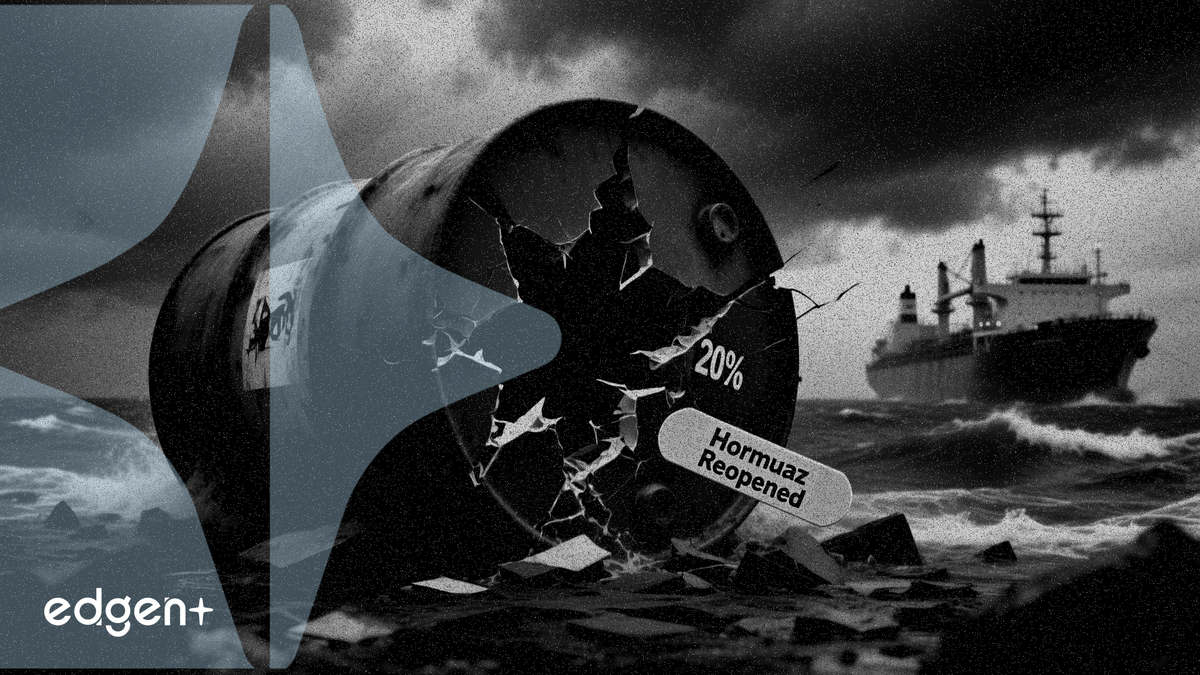
The potential reopening of the Strait of Hormuz, a critical artery for 20% of global oil, is unlikely to quickly resolve the supply shock that has sent crude prices soaring over 17 percent in a week, as the precedent from the Red Sea crisis suggests a long and painful recovery for global trade.
"The core issue is trust, not just a closure," said Cyril Widdershoven, a global energy market analyst. "Once that perception shifts, as is now the case in Hormuz, the system behaves differently. The withdrawal of war-risk insurance in early March effectively shut down commercial navigation, regardless of whether the Strait was technically open."
Brent crude futures surged to over $105 a barrel, a 17% weekly gain, while WTI crude jumped 14% to settle around $94.40 a barrel. The disruption has been profound, with maritime traffic through the strait plummeting by over 90%. This has forced a massive rerouting of global trade, with ships taking the longer and more expensive route around the Cape of Good Hope, adding 10-14 days to voyages.
Even with diplomatic talks between the U.S. and Iran resuming in Islamabad, the damage to global supply chains is already done. The key question is not if the strait will reopen, but whether shipping companies will trust it enough to resume normal operations. The experience of the Suez Canal, where traffic remains depressed despite stabilization efforts, suggests that the "Hormuz premium" on oil prices and shipping rates is here to stay for the foreseeable future.
The market's optimism for a quick resolution should be tempered by the recent history of the Red Sea and the Suez Canal. Despite intermittent stabilization efforts, traffic through the Red Sea corridor remains structurally depressed, even years after the initial disruption. The Houthis did not need to close the corridor permanently; they needed to make it unreliable. That alone was enough to rewire global shipping behavior.
Hormuz is now following the same trajectory, but on a much larger scale. The hard data is unequivocal. Maritime traffic through Hormuz has at times fallen by 90% or more, with entire fleets idling outside the Strait rather than risk transit. While most attention is focused on hydrocarbon exports, which have dropped by over 60%, the impact on other commodities like aluminum (9% of global capacity) and fertilizer (20% of seaborne exports) is also significant.
The consequences are structural, as evidenced by the global trade rerouting on a massive scale. The Cape of Good Hope has become the default alternative for Asia–Europe flows. This is no longer a temporary detour but is already embedded in network design. Shipping lines are recalibrating schedules, redeploying fleets, and locking in new routing strategies that assume chokepoint instability as a baseline.
Even if Hormuz fully reopens tomorrow, flows will not simply revert. The history of the Red Sea crisis proves this. Once operators have redesigned their networks to use alternative routes, they do not revert overnight. Contracts are rewritten, insurance frameworks are reset, and risk models are updated. The global system has adapted and is locked into that adaptation.
The most dangerous mistake policymakers can make now is to treat reopening as a resolution. The data shows otherwise. Traffic does not return. Costs do not normalize. Behavior does not revert. The system evolves.
This article is for informational purposes only and does not constitute investment advice.