
Three months into the Strait of Hormuz blockade, oil prices have breached $100 but remain far from the $150 level many analysts predicted — a calm that masks rapidly depleting buffers across the global petroleum system.
Three months into the Strait of Hormuz blockade, oil prices have breached $100 but remain far from the $150 level many analysts predicted — a calm that masks rapidly depleting buffers across the global petroleum system.
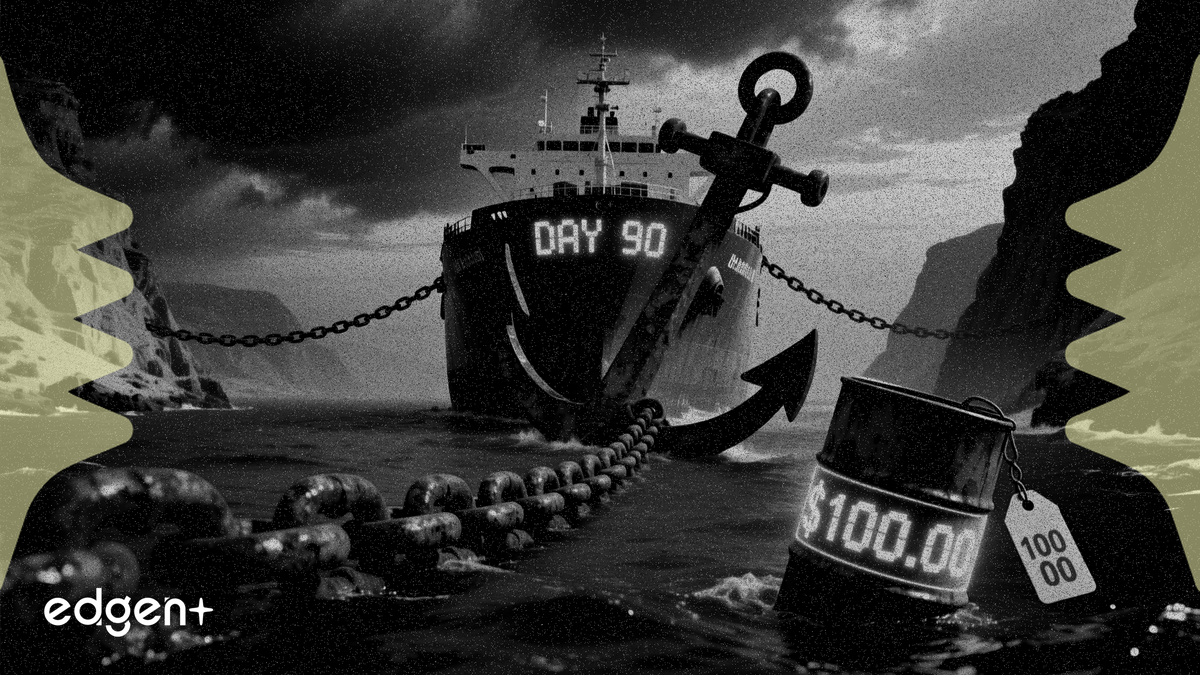
Three months into the Strait of Hormuz blockade, oil prices have breached $100 but remain far from the $150 level many analysts predicted — a calm that masks rapidly depleting buffers across the global petroleum system.
The Strait of Hormuz blockade has entered its third month with Brent crude holding above $100 a barrel, yet prices remain well below the $150 threshold many forecasters anticipated — a gap explained not by resolved supply risks but by three temporary buffers that are steadily eroding.
"The market has been remarkably orderly given that roughly 20 million barrels a day of crude and products have been taken out of circulation," said Javier Blas, a Bloomberg Opinion columnist covering energy and commodities. "But every week of continued closure draws down inventories and eats into spare capacity."
OECD commercial oil inventories have fallen below their five-year average, while floating storage tracked by Vortexa and Kpler has declined steadily. OPEC's theoretical spare capacity — concentrated in Saudi Arabia and a handful of other producers — is finite and cannot fully replace the grade-specific barrels lost from Persian Gulf fields. On the demand side, high prices have triggered marginal consumption cuts in emerging markets, though this represents a temporary softening rather than structural decline.
If the blockade persists, the system's remaining cushion will vanish, forcing a sharp price re-evaluation. "Without a reopening, prices would clearly have to go much higher," Blas wrote. A prolonged closure could push Brent toward $150 — not because of a single new shock, but because every available buffer will have been exhausted.
The Three Buffers That Kept Prices in Check
Global crude markets entered the crisis with higher-than-expected commercial inventories, giving traders a cushion that has now been largely consumed. OECD stockpiles have slipped below the five-year mean, and the drawdown is accelerating. Below a certain operational threshold — the minimum working inventory needed to keep refineries, pipelines and blending operations running — the system loses its ability to absorb even minor disruptions.
OPEC's spare capacity, while real on paper, faces practical limits. Not all crude grades are interchangeable: refineries configured for Iranian or Iraqi heavy sour grades cannot simply switch to Saudi light crude without costly adjustments. Even where substitution is possible, bringing spare capacity online takes weeks or months. Using it now to plug the Hormuz gap means there will be less available to respond to the next disruption.
Demand destruction has played a supporting role. Higher pump prices have reduced driving in some advanced economies, while fuel subsidies in emerging markets have become more expensive for governments to maintain. But these demand-side adjustments are marginal and reversible. If economic activity picks up or consumers adapt to higher prices, demand could snap back, putting further strain on an already tight system.
The Diplomatic Calculus
Negotiations to reopen the strait have made "slight progress," US Secretary of State Marco Rubio said in late May, though a senior UAE diplomat put the odds of an immediate deal at 50-50. Pakistan has been mediating between Washington and Tehran. Iran has proposed loosening its control over the strait in exchange for a cessation of US naval operations in the region, while Rubio has linked the waterway's reopening to broader nuclear talks.
The last time a major Middle Eastern waterway closed, the Suez Canal remained shut for eight years after the 1967 Six-Day War. The UAE, reading the same historical precedent, has accelerated plans for a bypass pipeline expected to come online in 2027.
For now, both sides appear able to absorb the economic pain. The S&P 500 has risen nearly 10 percent since the conflict began, and US second-quarter GDP is tracking above 4 percent. Iran, while suffering from currency collapse and rising unemployment, has historically demonstrated a high tolerance for economic hardship when it perceives an existential threat.
What Comes Next
Two paths diverge. A diplomatic breakthrough would allow markets to begin rebuilding inventories and normalizing flows, though prices are unlikely to return to pre-blockade levels anytime soon. A continued stalemate, by contrast, would drain the remaining buffers and force a more aggressive repricing of the world's dwindling supply cushion — a scenario in which $150 Brent becomes not a ceiling but a waypoint.
This article is for informational purposes only and does not constitute investment advice.
