
Key Takeaways:
- Israeli forces advanced the Gaza Yellow Line westward on June 12
- Hamas accused Israel of a blatant violation of the ceasefire agreement
- More than 7,280 Palestinians have been displaced since January 2023
Key Takeaways:
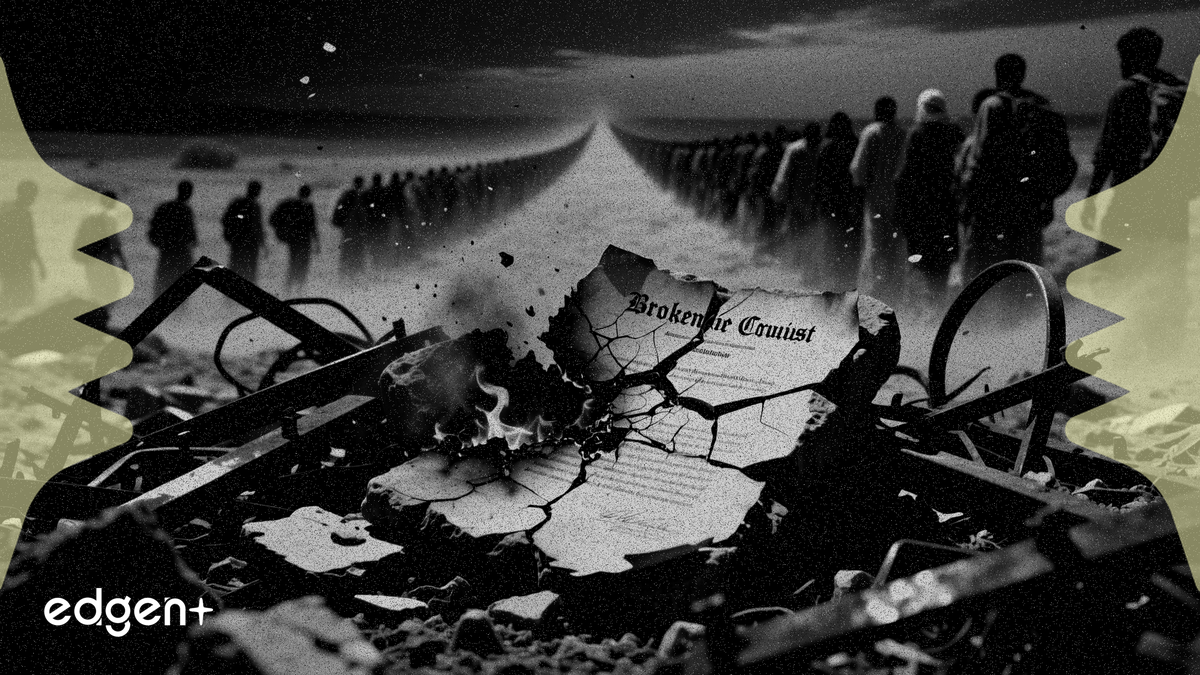
Israeli forces advanced the Gaza ceasefire demarcation westward on June 12, prompting Hamas to accuse Prime Minister Benjamin Netanyahu's government of violating the truce in a move that threatens to unravel the January ceasefire.
Israeli forces pushed the "Yellow Line" demarcation westward in Gaza City on June 12, accompanied by bombing and civilian displacement operations, according to Hamas. The advance threatens the US-brokered ceasefire that halted fighting in January after 15 months of war.
"The occupation forces have pushed the Yellow Line westward in Gaza City, accompanied by bombing and the forced displacement of civilians, in a blatant violation of the ceasefire agreement," Hazem Qassem, spokesperson for Hamas, said in a statement.
The escalation comes as more than 7,280 Palestinians have been displaced from their homes across the West Bank since January 2023, according to United Nations data, while over 100 villages have been fully or partially emptied. Amnesty International accused Israel in a 149-page report of carrying out a "state-sanctioned campaign of ethnic cleansing" in the occupied West Bank, alleging that settler violence and government policy have driven the displacement. The anti-settlement monitoring group Peace Now said 212 of at least 363 existing outposts in the West Bank were created since 2023.
The breakdown of the ceasefire — brokered by the US in January 2025 — could trigger a fresh spike in crude oil prices, with Brent crude already pricing in a geopolitical risk premium amid broader Middle East instability. Gold, the traditional safe-haven asset, may see renewed buying, while risk assets including equities and cryptocurrencies face headwinds from heightened uncertainty. The US-brokered ceasefire had acknowledged Palestinian aspirations for statehood, and President Donald Trump had previously said he would not allow Israel to annex the West Bank.
Displacement Accelerates Across West Bank
Since the Hamas-led attack on Israel on Oct. 7, 2023, which triggered the war in Gaza, settler activity in the West Bank has intensified dramatically. Dror Etkes, who runs the settlement watchdog group Kerem Navot, said settlers have taken about 12.5 percent of West Bank territory since October 2023 — land that Palestinians can no longer access or cross safely. Rights groups say Bedouin herding communities in remote areas are most vulnerable, lacking the resources to withstand pressure from often-armed settlers establishing new outposts around Palestinian villages. More than 700,000 Israelis live in the occupied West Bank and east Jerusalem, territories captured by Israel in 1967 and sought by the Palestinians for their independent state.
Market Implications of Escalation
The renewed tensions come at a sensitive time for energy markets. The Strait of Hormuz handles about 21 percent of global oil trade, and any broader regional escalation raises the risk of supply disruption. Historically, similar escalations in the Israel-Hamas conflict have pushed Brent crude higher by 3 percent to 5 percent in the immediate aftermath, while gold has gained 1 percent to 2 percent as investors rotated into haven assets. The last time a ceasefire in Gaza collapsed — during the brief November 2023 truce — oil prices rose 4 percent in the following week while the S&P 500 fell 1.2 percent. Israeli leaders have condemned particularly grave violence by Jewish settlers but tend to denounce them as exceptions, while key Cabinet ministers from Netanyahu's right-wing government are pushing for formal annexation of the West Bank.
This article is for informational purposes only and does not constitute investment advice.
