
Google's $10 million Texas water fund marks the first major pledge by a hyperscaler to address the resource demands of its AI data center buildout — but critics say it's a fraction of what's needed.
Google's $10 million Texas water fund marks the first major pledge by a hyperscaler to address the resource demands of its AI data center buildout — but critics say it's a fraction of what's needed.
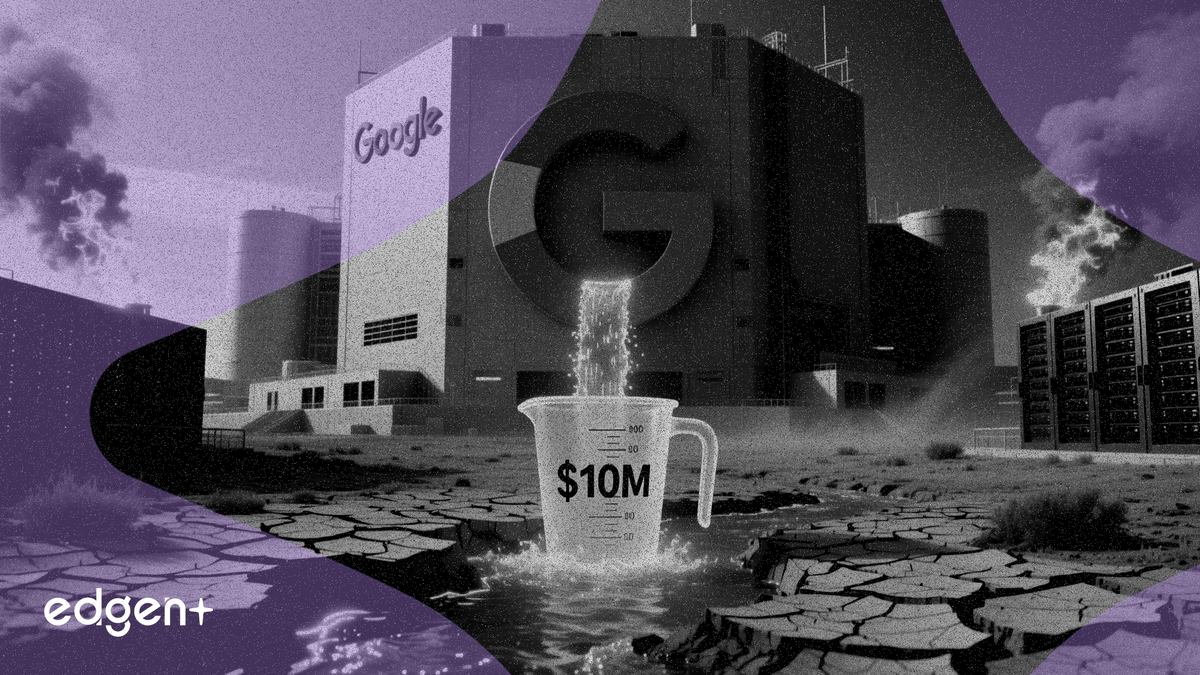
Google's $10 million Texas water fund marks the first major pledge by a hyperscaler to address the resource demands of its AI data center buildout — but critics say it's a fraction of what's needed.
Google will spend $10 million on water projects in Texas communities where it plans to build data centers, the company said Wednesday, as backlash mounts over the resource-intensive facilities that could consume up to 9% of the state's water by 2040.
"There are no-name companies showing up and saying, 'I want a bunch of water, I'm not gonna tell you why, and I'm not gonna tell how much I use,'" Ben Townsend, Google's global head of infrastructure strategy and sustainability, said. "And people are rightfully concerned, especially in a state with the type of water scarcity that Texas has."
Google's Midlothian data center consumed 182.3 million gallons of water in 2024 — roughly the volume of 276 Olympic-sized swimming pools. The company has two operating data centers in Texas and at least six more in development, part of a $40 billion investment plan through 2027. A University of Texas at Austin report projects data center water demand could balloon to 22 times current levels by 2040, representing as much as 9% of total state consumption.
The pledge comes as Texas lawmakers prepare to tackle data center regulation in the 2027 legislative session. Lt. Gov. Dan Patrick and House Speaker Dustin Burrows have both directed committees to study the water and energy demands of the facilities. The Texas Water Development Board's draft plan estimates $174 billion in water infrastructure investment is needed over the next 50 years — a figure that does not yet account for data center demand.
A blueprint or a drop in the bucket?
Google's five-part commitment includes replenishing more water than its data centers consume by 2030, using air-cooling systems in at-risk watersheds, reporting annual water usage, and pursuing reclaimed water solutions. The company said its Texas data centers under development in Haskell, Wilbarger and Armstrong counties will use closed-loop air cooling to limit water consumption.
"$10 million doesn't buy much of anything," said Perry Fowler, executive director of the Texas Water Infrastructure Network, a construction trade coalition. "It may help one little town with their system, but if you're talking about any significant investment in infrastructure, that's a drop in the bucket."
Townsend said Google has already invested in water projects across the state, including irrigation efficiency in the Panhandle and longleaf pine forest restoration in East Texas, though the company declined to disclose total spending to date. He described the new fund as a "blueprint" for responsible water management that other developers could follow.
Local opposition meets legislative scrutiny
Data center developers have flocked to Texas, drawn by cheap land, limited regulation and access to low-cost energy. But opposition is growing. A Gallup survey in May found 70% of Americans oppose AI data centers in their communities, with 18% of those opposed specifically citing water usage.
Unlike cities, Texas county governments lack the power to block development. In May, Agriculture Commissioner Sid Miller called for a temporary moratorium on new data centers, citing impacts on the electric grid, water supplies and agricultural land.
Brendan Steinhauser, a Texas GOP strategist who founded the Alliance for Secure AI Action, said Google's water promises are unlikely to turn the tide of local opposition. "That's good that they're doing that. But I don't think it's enough," he said.
The state's Public Utility Commission launched a voluntary survey this spring asking data centers to disclose water use for the first time — a step prompted by the Texas Legislature. Google has responded to the survey, which Townsend called a "sensible" request to help state water leaders plan for a resilient future.
Environmental Defense Fund's Vanessa Puig-Williams applauded Google's commitment to replenishing water supply but urged a more aggressive approach. "In these very arid regions, every drop counts," she said.
Google has committed more than $500 million to water, wastewater and water reuse infrastructure across the communities where it operates. The Texas pledge is part of a broader $17 million national initiative spanning seven states, including Georgia, Iowa and Michigan. But for Texas, where the company is making its largest data center bet, the question is whether voluntary commitments can keep pace with the scale of the buildout.
This article is for informational purposes only and does not constitute investment advice.
