
The US-Iran conflict is careening toward a constitutional and military crisis, sending oil prices to four-year highs as a legal deadline for the unauthorized war expires Friday.
The US-Iran conflict is careening toward a constitutional and military crisis, sending oil prices to four-year highs as a legal deadline for the unauthorized war expires Friday.
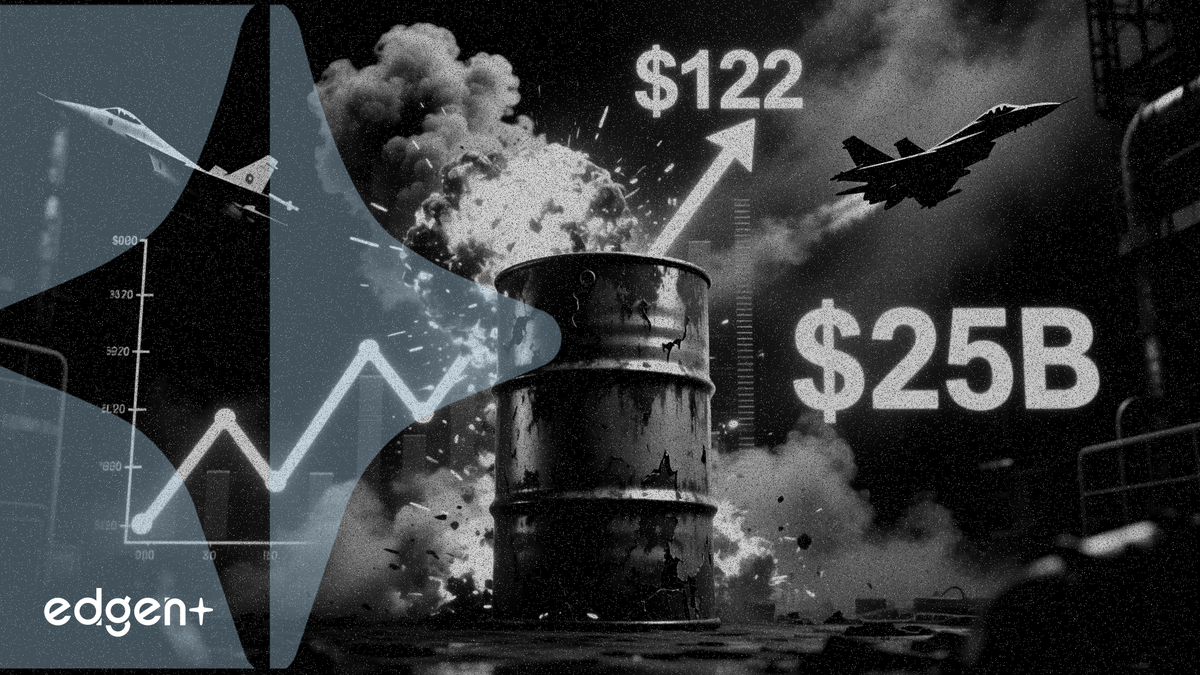
Global oil prices surged to a four-year high above $122 a barrel Thursday as the U.S.-Iran war threatens to escalate, with Israel taking delivery of fresh American munitions and warning it may “soon need to act again.” The price spike comes as the war’s costs have climbed past $25 billion in less than two months, according to the Pentagon, and a critical legal deadline looms that could deem the entire U.S. operation illegal.
“This war is flat-out illegal,” Sen. Tammy Duckworth said following a failed vote in mid-April to rein in the conflict. “Trump didn’t have the authority to launch it in the first place, and nearly two months in, he still has not provided a reasonable justification for why we’re in this mess.”
The market turmoil reflects the war’s cascading consequences. Global oil benchmark Brent crude futures jumped 3.2 percent to $121.76 a barrel, having doubled since the U.S.-Israeli attack began on February 28. The Pentagon comptroller, Jules Hurst III, testified Wednesday that the war has so far cost $25 billion, with the administration preparing to ask for another $200 billion in supplemental funding.
At stake is the stability of global energy markets and the constitutional balance of power in the United States. Under the 1973 War Powers Resolution, President Trump’s authority to conduct hostilities without congressional approval expires on May 1. If operations continue, the dispute could trigger a constitutional crisis, with lawmakers openly discussing legal action to halt a war that seven in ten Americans want to end.
Tensions intensified Thursday as Israel announced it had received 6,500 tons of American military equipment over the past 24 hours, including thousands of air-to-ground munitions. Since the war began, over 115,600 tons of military gear have been shipped to Israel. Israeli Defense Minister Katz said that while his country supports diplomacy, it may “soon need to again take action” to ensure Iran does not pose a threat.
In response to Iran’s effective closure of the Strait of Hormuz, through which a fifth of the world’s oil transits, the Trump administration has proposed a maritime coalition to reopen the waterway. Iranian officials have remained defiant, with military leaders vowing the country would never lose control of the strategic chokepoint. “History will record that Iran has defeated the superpower America in the Persian Gulf and the Gulf of Oman,” said Mohsen Rezaei, a senior military adviser.
The conflict’s financial and material costs are rapidly mounting. Beyond the Pentagon’s $25 billion running tally, an analysis by the Center for Strategic and International Studies (CSIS) estimates between $2.3 billion and $2.8 billion worth of U.S. military equipment has been destroyed. The losses include a $700 million E-3 AWACS radar plane and at least one THAAD missile defense radar system valued at over $485 million.
The high rate of munitions use has also raised alarms. The CSIS report noted that in less than two months, the U.S. has used roughly half of certain missile and munitions stockpiles, creating a “window of vulnerability” that could take four years to replenish. At a contentious House hearing, Defense Secretary Pete Hegseth dismissed concerns, telling lawmakers, “You stain the troops when you call this a quagmire two months in.”
As the May 1 deadline approaches, the administration has not indicated whether it will seek a 30-day extension allowed by the law, which requires certifying an “unavoidable military necessity,” or continue operations regardless. With diplomatic channels strained and military activity increasing, the risk of a wider conflict that further disrupts global markets continues to grow.
This article is for informational purposes only and does not constitute investment advice.

