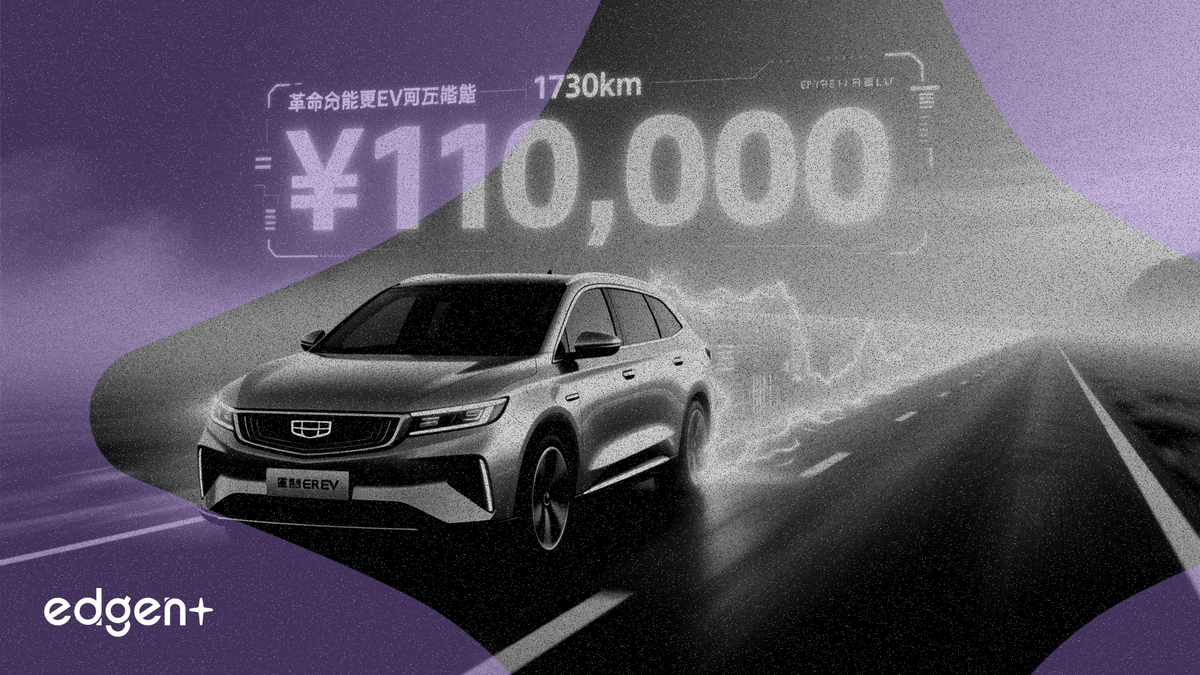
Geely Automobile Holdings (00175.HK) has launched its Galaxy M7 Voyager plug-in hybrid with a class-leading 1,730km combined range at a starting price of just RMB 109,800 (approximately $15,200), significantly undercutting competitors and escalating the fierce price war in the world's largest auto market.
The announcement on April 28 confirmed a limited-time guide price that is RMB 30,000 lower than the vehicle's pre-sale price. "The new model comes standard across the lineup with a 225km pure electric driving range, marking the brand's entry into a 'full lineup long-range era'," the company stated in its official release.
Built on the new GEA Evo architecture, the M7 Voyager features a highly efficient powertrain that achieves fuel consumption as low as 3.35L per 100km under low-battery conditions. The vehicle is offered in four variants and incorporates Geely's new Shield Brick Battery technology and the Galaxy Flyme Auto 2 smart cockpit system. The aggressive pricing includes the top-tier Starship Edition at RMB 137,800.
The launch applies immediate pressure on both domestic and international automakers. For the average price of a car in the US, a consumer could purchase roughly five of the base model M7 Voyagers. This value proposition is a core part of the strategy for Chinese EV makers expanding overseas. Competitors are already feeling the heat, with Kia's CEO recently stating the company plans price cuts in Europe to counter the aggressive market entry of Chinese firms like BYD (01211.HK), whose European vehicle registrations surged nearly 150% in March.
Price War Intensifies
Geely's move is the latest salvo in an ongoing price war in China, initiated by Tesla in late 2022 and since joined by dozens of manufacturers, including BYD, Nio, and Xpeng. The M7 Voyager's sub-RMB 110,000 entry point for a long-range plug-in hybrid SUV is designed to capture market share from both legacy gasoline-powered vehicles and more expensive EV offerings.
The potential impact on Geely's stock (00175.HK) is significant. If the M7 Voyager's sales meet or exceed expectations, it could provide a substantial boost to the company's earnings and market share. However, the ultra-competitive pricing strategy also carries risks to profit margins across the industry. The move signals that Geely is prioritizing volume and market dominance over short-term profitability, a strategy that could force further consolidation within the Chinese auto industry.
This article is for informational purposes only and does not constitute investment advice.