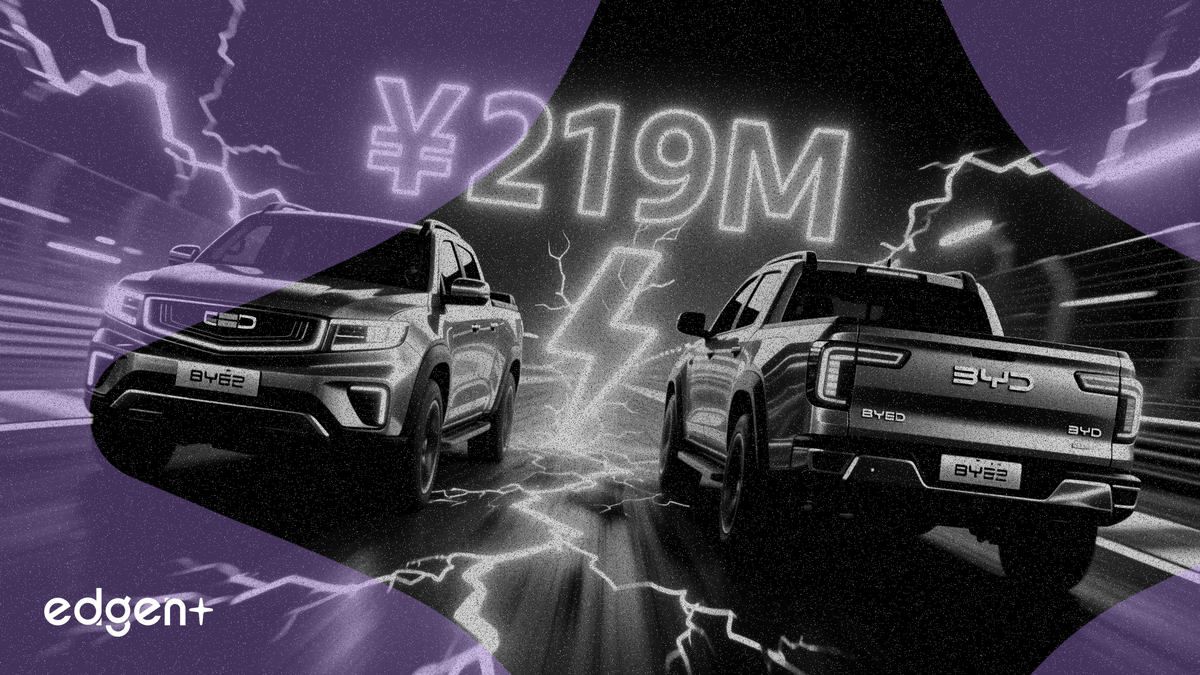
Geely Auto is consolidating its electric pickup truck ambitions, paying nearly RMB 219 million to fully acquire its Radar Auto unit in a direct challenge to BYD’s new Shark pickup.

Geely Auto (0175.HK) is intensifying its rivalry with BYD Co. (1211.HK), announcing on May 15 its acquisition of the Radar Auto brand for approximately RMB 218.5 million ($30.2 million) to formally enter the burgeoning electric pickup truck market. The all-cash deal makes Radar Auto a wholly-owned subsidiary, positioning Geely to compete head-on with BYD’s recently launched Shark hybrid pickup.
The acquisition "enables the Group to incorporate a new energy pickup truck brand into its business, thereby expanding and enriching its product portfolio," Geely Auto said in a filing with the Hong Kong Stock Exchange.
The transaction involves Geely units acquiring Radar Auto (Shandong) and Radar Auto Sales for a combined RMB 218 million, plus Radar Thailand for RMB 490,000. Geely had previously launched the Radar brand and its first model, the RD6 electric pickup, in 2022, which has since entered several overseas markets. This move fully consolidates the brand under Geely's direct control.
The acquisition signals a strategic push into a niche but growing vehicle segment where competitors are gaining traction. While pickup trucks face policy restrictions in Chinese cities, their popularity in overseas markets from Mexico to Australia presents a significant growth avenue. The move pits Geely directly against BYD, which debuted its Shark pickup in Mexico in May 2024, and established players like Great Wall Motor, as Chinese automakers increasingly look abroad for expansion.
The battle for the electric pickup market is heating up among Chinese auto giants. While Geely's Radar RD6 has been available since late 2022, this full acquisition comes as BYD makes a major international push with its Shark model. BYD's decision to launch the Shark in Mexico first underscores the strategic importance of overseas markets, where pickups are a major vehicle category, unlike in China where they are often restricted in urban centers.
BYD's Shark, a plug-in hybrid with over 430 horsepower, sold 4,500 units in overseas markets in April alone, according to data compiled by CnEVPost. The company has confirmed it will bring the model to its domestic Chinese market later this year. Geely's consolidation of Radar Auto is a clear response, aiming to leverage its own technology and brand power to capture a share of this export-oriented segment.
This strategic maneuver is part of a broader trend of Chinese electric vehicle manufacturers expanding their global footprint. Geely itself is already making inroads into North America through its subsidiaries. Its Lotus brand recently shipped its first Eletre electric SUVs to Canada, taking advantage of a new trade deal that lowered tariffs from over 100 percent down to 6.1 percent for a quota of 49,000 EVs.
The Canadian market, which is also seeing an influx of China-built Teslas, represents a key new frontier for these companies. By fully integrating Radar Auto, Geely is better positioned to potentially introduce electric pickups into markets like Canada or Southeast Asia, where its Thai subsidiary now sits under direct corporate ownership. The move provides Geely with a dedicated brand to compete not just with BYD, but with a potential wave of Chinese EV exports.
This article is for informational purposes only and does not constitute investment advice.