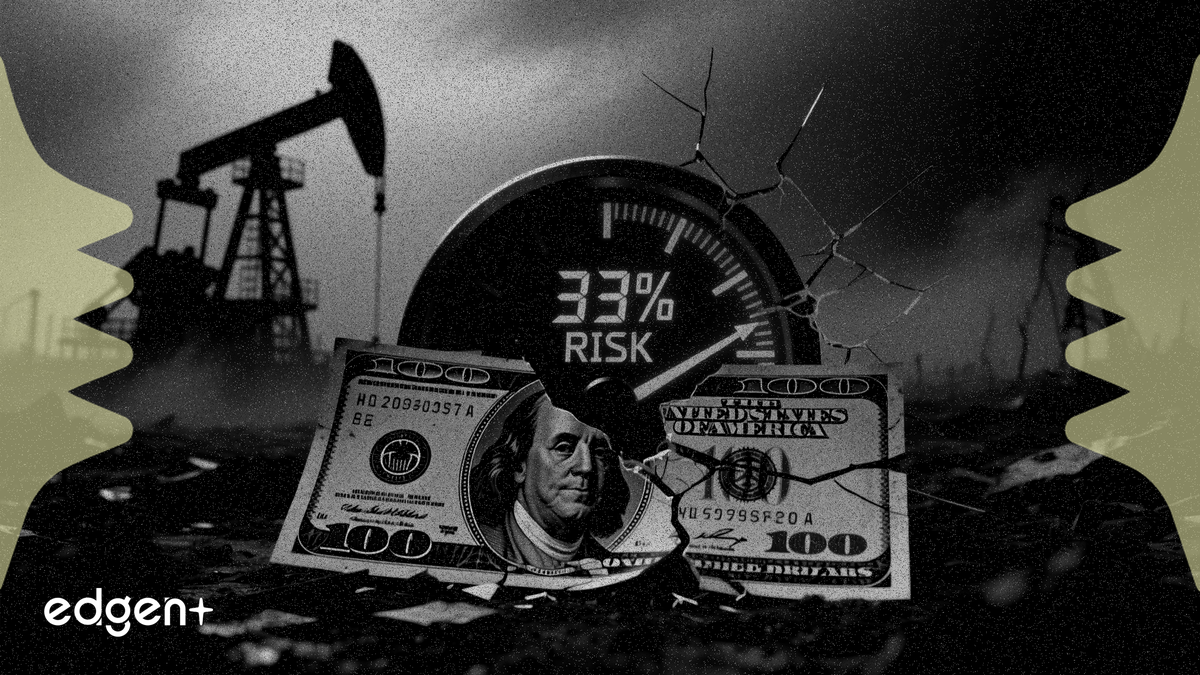
The war in Iran has prompted economists to slash growth forecasts and raise the odds of a US recession to 33%, with persistently high oil prices seen as the primary threat.
The economic fallout from the war in Iran is crystallizing, with economists in a new survey downgrading their outlook for the U.S. economy, citing risks of slower growth and more persistent inflation. The consensus probability of a recession within the next 12 months has climbed to 33 percent, a notable increase from 27 percent in January, according to the latest Wall Street Journal poll of 68 economists.
"That's where demand destruction begins to accelerate and broaden out," Joseph Brusuelas, chief economist at RSM, said in reference to a specific oil price threshold. He drew a line at $125 a barrel for West Texas Intermediate crude, which traded near $91 Wednesday, as the point where "it becomes more of an economic problem."
The dimmer view is shared by global bodies, with the International Monetary Fund cutting its 2026 global growth forecast to 3.1 percent. The fund modeled an "adverse scenario" where a longer conflict keeps oil around $100 a barrel, cutting global growth to 2.5 percent this year. Economists have trimmed their forecast for 2026 U.S. GDP growth to 2.0 percent on a fourth-quarter basis, down from 2.2 percent in January, while raising their year-end core inflation forecast to 2.9 percent.
The primary risk centers on a sustained energy price shock that could tip a fragile global economy into a downturn. The IMF warned that a "severe scenario"—involving an extended conflict and major supply dislocations—could drag global growth down to just 2.0 percent. Growth below that level has only occurred four times since 1980, including the 2009 financial crisis and the 2020 pandemic, effectively putting the world on the brink of recession.
Oil Prices and Inflationary Pressures
The war's most immediate impact has been on prices at the pump, with the national average for a gallon of gasoline hitting $4.10, according to AAA. This directly fueled a 16.5 percent jump in spending at gas stations in March, according to Bank of America data, which also showed overall card spending remained resilient with 3.6 percent growth excluding gas.
Inflation data reveals a complex picture for policymakers at the Federal Reserve. The headline consumer price index rose 0.9 percent in March, pushing the annual rate to 3.3 percent. However, stripping out volatile food and energy costs, the core CPI rose a more modest 0.2 percent for a 2.6 percent annual pace. This divergence between headline and core inflation complicates the Fed's path, as officials weigh the temporary effects of the energy spike against underlying price trends.
The pressure is also visible in consumer psychology. The widely followed University of Michigan survey showed consumer sentiment plunging to a record low, falling below levels seen during the 1970s stagflation, the 2008 financial crisis, and the Covid pandemic. Yet, the link between sentiment and behavior can be weak, as demonstrated by the strong spending data.
Global Scenarios and US Resilience
While the U.S. feels the impact, the IMF report underscores that Europe and Asia are more vulnerable. The euro zone, still grappling with the energy shock from Russia's invasion of Ukraine, had its growth outlook cut to 1.1 percent for 2026. The most severe consequences are centered in the Middle East itself, where the IMF projects regional GDP growth will plummet by two full percentage points to 1.9 percent this year.
In the U.S., economists have downshifted their outlook but are not yet forecasting a recession as the base case. Goldman Sachs recently cut its full-year GDP forecast to 2.0 percent, a half-percentage point reduction, and now sees the unemployment rate rising to 4.6 percent by year's end, a modest 0.3 percentage point gain from the March level.
The consensus among economists surveyed by the Journal points to a significant slowdown in the labor market, forecasting just 38,000 jobs added per month on average over the second and third quarters. While the war will "gouge out some of the growth," the U.S. economy is expected to weather the storm, said Mike Skordeles, head of U.S. economics at Truist Advisory Services, unless the conflict escalates significantly.
This article is for informational purposes only and does not constitute investment advice.