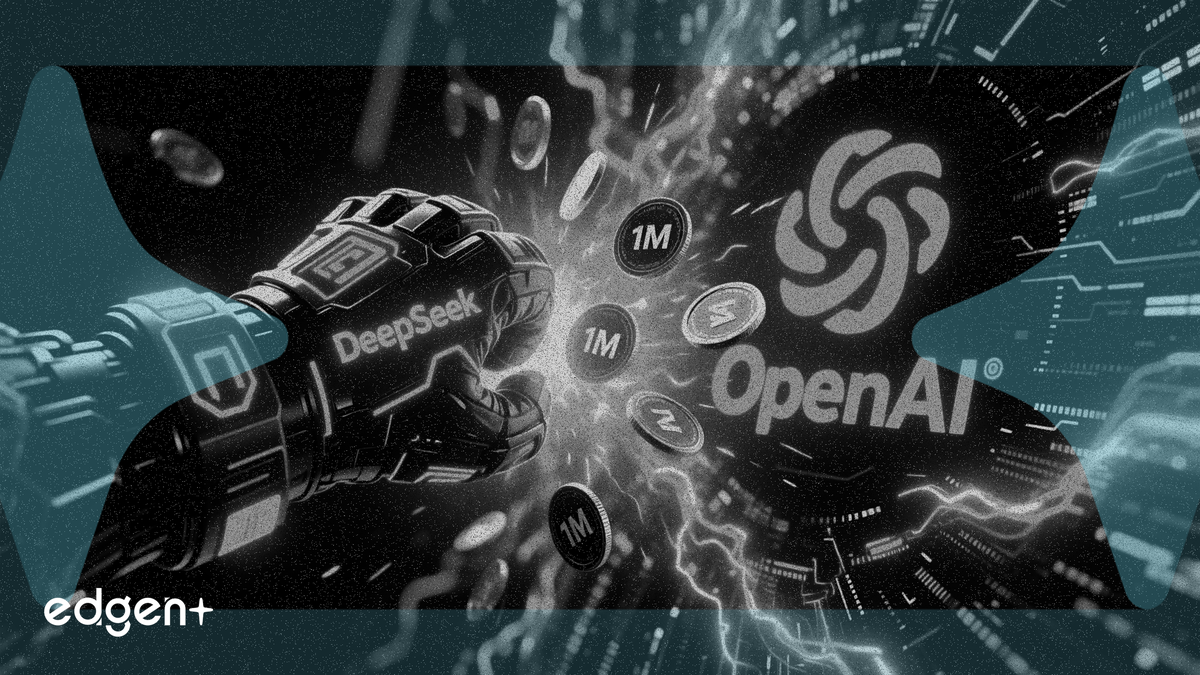
Chinese AI challenger DeepSeek has dramatically increased the context window of its primary API to 1 million tokens, a significant escalation in its bid to compete with frontier models from OpenAI, Google, and Anthropic. The unannounced update, which also pushes the model's knowledge cutoff to May 2025, aligns its developer offering with its consumer-facing app and signals a new front in the battle for enterprise AI adoption.
"I was playing around with the API and noticed it’s no different from the official app now," one developer wrote on a social media platform, reflecting a wave of community feedback that first spotted the change. "The ability to process the entire 'Three-Body Problem' trilogy in one go is now available through the API."
The update replaces the previous 128,000-token context window and a 2024 knowledge date. The move is widely seen as a precursor to the formal launch of DeepSeek's V4 model, which founder Liang Wenfeng has indicated internally will be released in late April 2026. The company has not yet officially commented on the API changes.
This aggressive push commoditizes a key feature that, until recently, was a major differentiator for top-tier models. By offering a massive context window directly via its API, DeepSeek is putting direct pressure on the pricing and capabilities of competitors like Google's Gemini 3.1 Pro and Anthropic's Claude series, forcing them to defend their value proposition for high-throughput enterprise workflows.
The Million-Token Battleground Heats Up
The race to offer larger context windows is a critical dimension of the AI platform war. A larger context allows models to process and reason over vast amounts of information—such as entire codebases, financial reports, or literary works—in a single pass. This capability is crucial for complex enterprise applications in finance, law, and scientific research.
Google recently made waves with its own autonomous research agents, Deep Research and Deep Research Max, built on the Gemini 3.1 Pro model. While Google's agents focus on fusing web data with proprietary enterprise information, DeepSeek's move centers on providing raw, large-scale context capacity as a developer utility. The update puts DeepSeek in direct conversation with Anthropic, which has also made large context windows a core part of its offering. The key question for developers will be the trade-off between quality, latency, and cost, as performance over long context can degrade. Some developers noted the updated API's performance felt similar to DeepSeek's "fast" model, suggesting a potential trade-off for the expanded window.
From API Discrepancy to V4 Launchpad
The update resolves a long-standing discrepancy where DeepSeek's publicly available app offered more advanced features than its API, a source of frustration for developers building on the platform. The quiet rollout led to speculation that the company was temporarily bridging its API to the app's servers while upgrading the underlying models for the official V4 launch.
This move comes as DeepSeek, which has historically avoided outside funding, is reportedly in the market to raise capital at a valuation approaching $10 billion, according to reports from The Information. This capital infusion would provide the necessary resources to compete in the incredibly expensive AI arms race, where training a single frontier model can cost billions of dollars in GPU compute time.
For investors, DeepSeek's emergence as a well-funded and technically aggressive competitor adds a new variable to the landscape. While a private entity, its actions can impact publicly traded AI players by forcing price cuts, accelerating the pace of innovation, and potentially capturing market share from developers and enterprise clients looking for cost-effective, high-capacity models. The upcoming DeepSeek V4 launch will be a critical test of whether its performance can truly challenge the dominance of models from Google and OpenAI.
This article is for informational purposes only and does not constitute investment advice.