
Contemporary Amperex Technology Co. Ltd. is setting a new industry benchmark for electric vehicle batteries, with charging times approaching that of gasoline cars.
Contemporary Amperex Technology Co. Ltd. is setting a new industry benchmark for electric vehicle batteries, with charging times approaching that of gasoline cars.
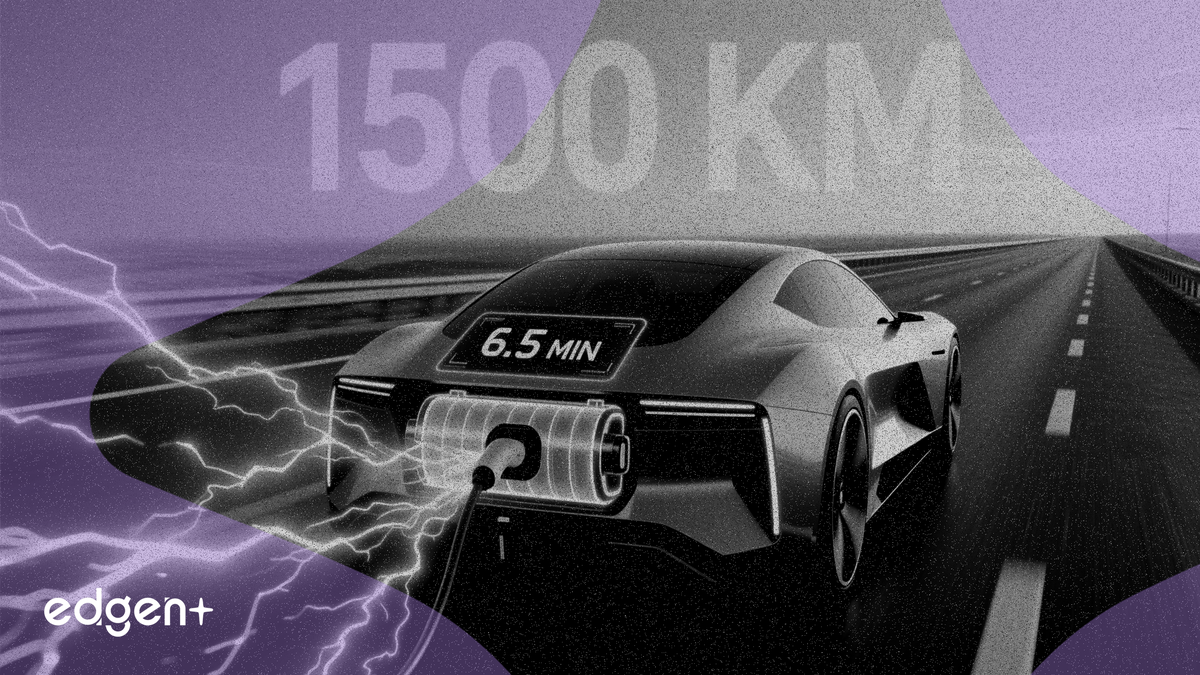
(P1) Chinese battery giant Contemporary Amperex Technology Co. Ltd. (CATL) unveiled its Shenxing 3 battery, capable of charging from 10% to 98% in just 6.5 minutes, directly challenging competitors and aiming to eliminate range anxiety for electric vehicle users. The advancement, announced at the company's "2026 Super Technology Day," surpasses the nine-minute fast-charging technology recently showcased by rival BYD.
(P2) "This effectively closes the gap with ICE vehicles," Bernstein analysts wrote in a note, referring to cars equipped with internal combustion engines.
(P3) The Shenxing 3 battery, a lithium iron phosphate (LFP) model, achieves this rapid charging speed under normal temperatures. Alongside this, CATL also introduced the third-generation Qilin battery, a ternary lithium battery, which supports a driving range of over 1,000 kilometers. A 125-kilowatt-hour version of the Qilin battery weighs 625 kilograms and has an energy density of 280 watt-hours per kilogram.
(P4) These technological strides are poised to solidify CATL's dominance in the global EV battery market, where it already holds a 42.1% share as of the first two months of 2026, according to SNE Research. The advancements put pressure on competitors like BYD and LG Energy Solution, and will likely accelerate the adoption of EVs by addressing key consumer concerns. Citigroup has reiterated its "Buy" rating for CATL, setting a target price of 576 RMB for its A-shares, implying a 30.5% potential upside.
CATL's technology day showcased a portfolio of new products aimed at different segments of the EV market. The Qilin condensed-state battery, with an energy density of 350 wh/kg, is projected to enable a driving range of up to 1,500 kilometers for executive sedans. This would be a significant leap from current EV capabilities and could make electric vehicles a viable option for long-haul travel.
For the hybrid market, CATL launched the second-generation Qilin super hybrid battery, offering a pure electric range of up to 600 kilometers for the ternary lithium version. The company also confirmed that its sodium-ion battery, Naxtra, will enter mass production in the fourth quarter of 2026, providing a "resource-resilient option for future large-scale energy transitions," according to Chairman Robin Zeng.
The new battery technologies from CATL are set to intensify the competition in the EV battery market. Chinese automakers such as Seres, Leapmotor, and Dongfeng Nissan are already promoting CATL as their battery supplier. The company's diverse customer base, which includes Tesla, Xiaomi, and Toyota, gives it a significant advantage in deploying its new technologies at scale.
The focus on reducing charging times and increasing range directly addresses the main barriers to EV adoption. As these new batteries become available, they could trigger a new wave of innovation and competition among automakers, ultimately benefiting consumers with more capable and convenient electric vehicles. The move also aligns with Chinese policy directives that prioritize value and technological leadership over sheer volume in the supply chain.
This article is for informational purposes only and does not constitute investment advice.