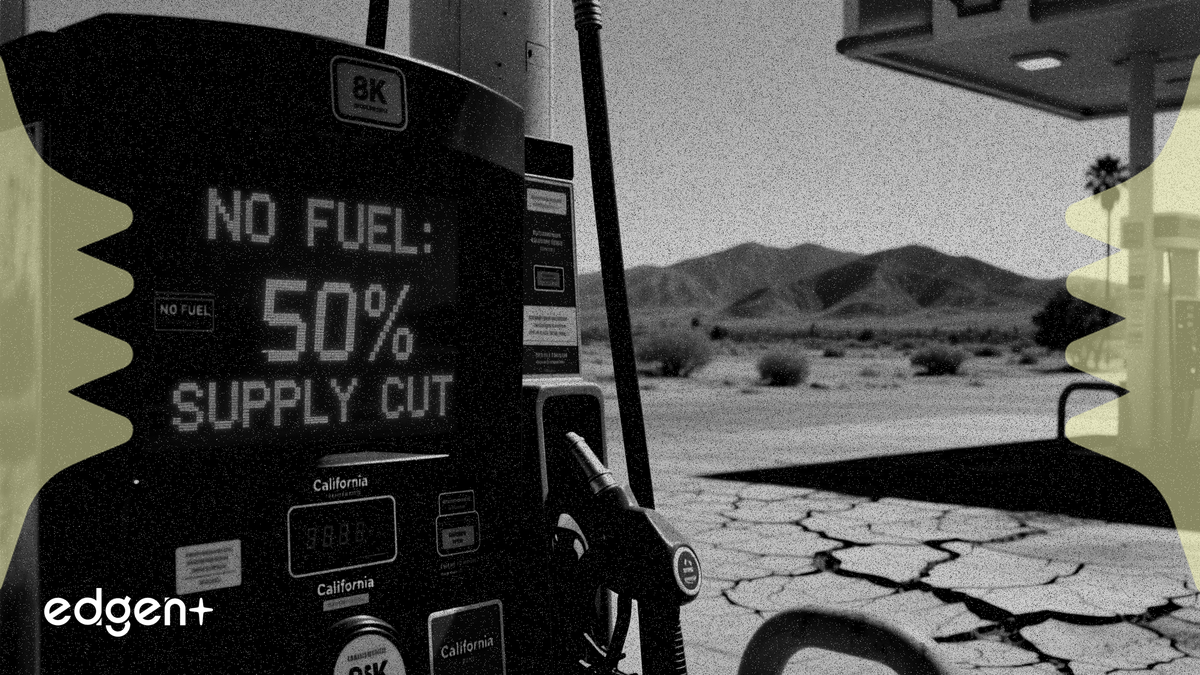
A fragile truce between the US and Iran has done little to ease an energy crunch threatening to hit California harder than any other state, with the ongoing closure of the Strait of Hormuz set to slash vital fuel imports by as much as 50 percent.
"If it’s not resolved soon, it’s going to get super tight," said Andy Walz, who runs Chevron’s oil refining, pipeline and chemicals business. "At some point, those things are going to be gone."
The state’s heavy reliance on foreign energy has left it dangerously exposed. California imports roughly 75 percent of its crude oil, with almost a third from the Middle East. It also receives 20 percent of its jet fuel and over 25 percent of its gasoline from countries like South Korea and India, whose own refineries depend on oil transiting the now-closed Strait of Hormuz. While West Texas Intermediate crude retreated to around $97 a barrel on news of a ceasefire, it remains far above its pre-war price of $70, and earlier hit $116.36, the highest since June 2022.
The crisis highlights California's status as an "energy island," a problem years in the making. A dozen refinery closures since 2000, including Valero's Benicia facility this month and a Phillips 66 plant last year, have decimated the state's production capacity. Lacking pipeline connections to the shale boom in Texas and other states, California has been forced to rely on more expensive tanker shipments from the Middle East and Asia to meet demand, a vulnerability now laid bare.
Strait Remains Effectively Shut
Despite a ceasefire contingent on the "complete, immediate, and safe opening" of the Strait, which handles about 20 percent of global oil flows, shipping traffic has not meaningfully resumed. According to S&P Global Market Intelligence, just four transits were recorded on Wednesday, a fraction of pre-war levels. More than 400 oil-laden tankers remain anchored outside the Gulf, according to ship-tracking platform MarineTraffic.
Major shipping firms are refusing to risk the passage. "Returning to normal for our industry is weeks away," Nils Haupt of Hapag-Lloyd told CNBC, confirming the company is refraining from the route. Maersk stated the situation does not yet provide "full maritime certainty."
Analysts warn that a return to normal could take months, drawing parallels to the Houthi disruption in the Red Sea, where traffic has not recovered despite a ceasefire. "As long as there's a threat of an attack, that's enough. You don't actually need the attack," Nikos Petrakakos, managing director at maritime investment manager Tufton, said in an interview.
Consumers Face Sustained Price Pain
The disruption translates directly to higher prices at the pump for Californians, who already pay a premium. The average price for a gallon of gasoline in the state stood at $5.93 on Tuesday, more than $1.75 above the national average, according to data cited by the Wall Street Journal.
While West Coast refineries built up inventories ahead of the planned shutdowns, analysts believe a shortfall is likely to emerge by July or August if the Strait does not fully reopen within the next several weeks. Even if shortages are avoided, the cost of securing supplies will remain high.
"This is a really big problem for California," said Ryan Cummings, a researcher at Stanford University’s Institute for Economic Policy Research. Buyers on the West Coast must offer incentives for foreign sellers to undertake the risky, six-week voyage, raising the price of fuel for everyone in the state.
This article is for informational purposes only and does not constitute investment advice.