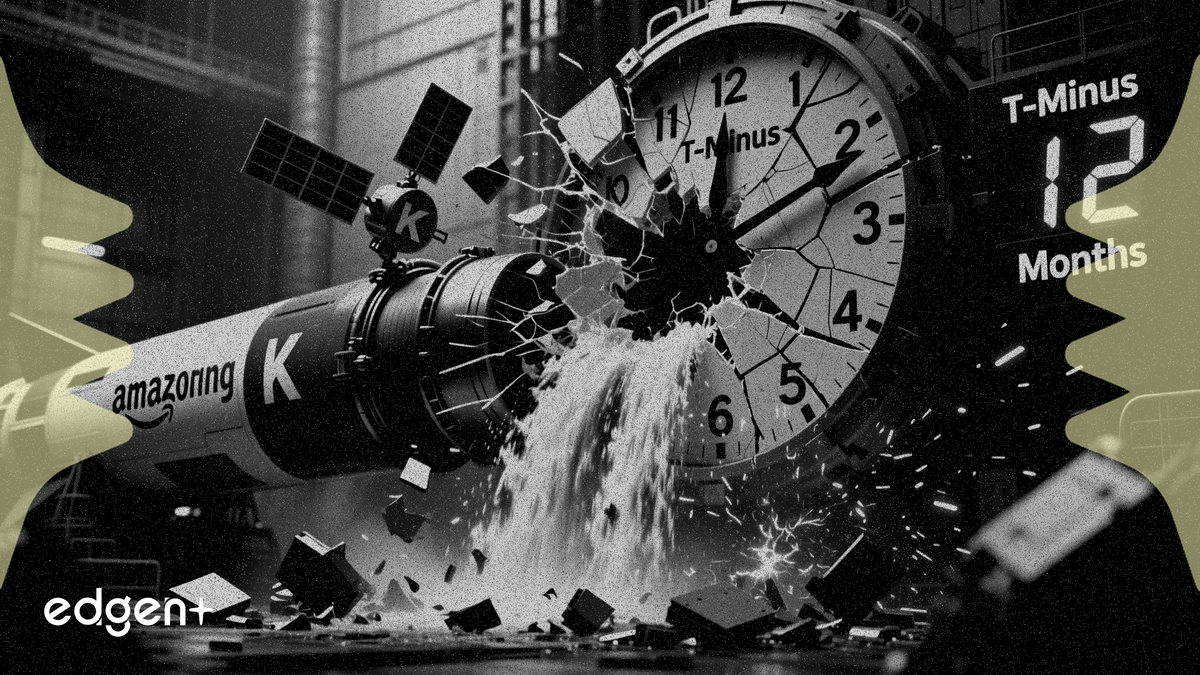
The May 28 explosion of Blue Origin's New Glenn rocket at Cape Canaveral has crippled Amazon's fastest path to orbit for its Kuiper satellite constellation, handing SpaceX's Starlink more time to extend its lead in the broadband-from-space race.
Blue Origin's New Glenn rocket exploded during a static-fire test at Cape Canaveral's Launch Complex 36 on May 28, destroying the transporter-erector and a lightning tower, with industry estimates suggesting a 12-to-15-month rebuild before the vehicle can fly again.
"Spaceflight is hard, and setbacks happen," Rajeev Badyal, vice president overseeing Amazon's Project Kuiper satellite program, wrote in a staff memo obtained by Business Insider. "New Glenn is just one vehicle in our lineup."
The explosion occurred days before New Glenn's fourth mission, which was to carry 48 operational Kuiper satellites. About 30% of Amazon's planned 3,232-satellite constellation was slated for deployment on New Glenn under existing launch contracts, an Amazon spokesperson said. The company has secured more than 100 launches total, with United Launch Alliance and ArianeSpace covering the remainder. Amazon has yet to launch a single operational Kuiper satellite, while SpaceX's Starlink already serves more than 4 million subscribers globally. Every month of delay compounds the gap, though Amazon said its initial service rollout plans remain unchanged and that its satellites, still secure at Kennedy Space Center, were never integrated with the destroyed rocket.
Blue Origin CEO Dave Limp said the propellant farm's oxygen, liquid hydrogen and LNG tanks survived the blast, as did the water tower and a booster stored in the nearby integration facility. The main launch tower sustained damage but can be repaired in place rather than replaced, he said in an X update. "We will fly again before the end of this year," Limp wrote, though industry veterans note that SpaceX took 15 months to rebuild Launch Complex 40 after a similar 2016 pad explosion.
The accident compounds a broader launch capacity crunch. SpaceX controls the majority of global orbital launch capacity, and its Starship — still in testing — is expected to be consumed primarily by Starlink deployments and NASA's Human Landing System program rather than commercial customers, according to Impulse Space President Eric Romo. "I think we're heading towards a rough spot in 2029 and 2030," Romo said at the ASCEND conference on May 20.
NASA's Lunar Timeline at Risk
The explosion's timing was particularly painful for NASA. Just two days before the accident, the agency awarded Blue Origin contracts worth hundreds of millions of dollars to launch two Blue Moon Mark 1 landers on New Glenn, carrying rovers from Astrolab and Lunar Outpost to the moon ahead of the first Artemis crewed landing, now targeted for 2028. NASA Administrator Jared Isaacman toured the damaged pad by helicopter the day after the explosion and said the agency is "committed to helping the Blue team recover."
AST SpaceMobile, which lost a satellite on New Glenn's third launch in April and was counting on the vehicle to deploy its direct-to-device network, saw its shares fall nearly 15% on May 29. The company said it is considering switching some launches to ULA's Vulcan rocket.
For Amazon, the calculus is more manageable but not painless. Kuiper represents a multi-billion-dollar bet against Starlink's first-mover advantage, and New Glenn accounted for less than a quarter of Amazon's booked launches. But with the global launch market already constrained and prices rising, finding replacement capacity at short notice will be expensive — if it is available at all.
This article is for informational purposes only and does not constitute investment advice.