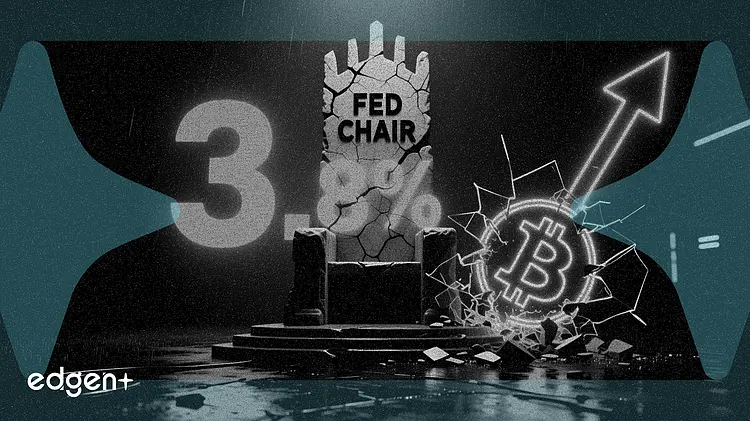
Bitcoin has fallen more than 77% during each of the last three Fed chair transitions — and Kevin Warsh's tenure begins with inflation at 3.8%.
Bitcoin trades near $63,000, 50% below its $125,000 peak, as Kevin Warsh prepares to take the Fed chair on May 22. The transition marks the fourth change in Fed leadership since Bitcoin's price discovery began, reviving a historical pattern that has punished the asset each time.
"Every Fed chair transition since 2014 has coincided with a Bitcoin drawdown of at least 77%, driven by hawkish rhetoric and tightening liquidity," MacroMicro research said.
Bitcoin dropped roughly 83% after Janet Yellen took office in 2014 as the Mt. Gox collapse and QE tapering converged. An 84% decline followed Jerome Powell's first term in 2018 amid rate hikes and balance sheet reduction. Powell's reappointment in 2022 preceded a 77% collapse tied to the most aggressive tightening cycle in modern history, according to MacroMicro.
The question for investors is whether Warsh's tenure will repeat the pattern or break it. The Fed ended quantitative tightening in December 2025 and resumed purchases of short-term Treasury securities, keeping baseline liquidity more stable than during prior transitions. But with April CPI at 3.8% — well above the Fed's 2% target — and three regional Fed presidents signaling rate hikes remain on the table, the June 16-17 FOMC meeting, the first under Warsh, is unlikely to deliver the dovish pivot some market participants expect.
Why this cycle may differ
The current transition carries meaningful differences from prior episodes. The Fed's shift from quantitative tightening to short-term Treasury purchases removes one of the central mechanics that turned prior drawdowns into prolonged bear markets, according to MacroMicro. Stable liquidity foundations reduce the risk of a liquidity-driven selloff similar to 2018 or 2022.
That said, uncertainty around Warsh's policy direction remains. His historically hawkish stance and renewed inflation signals suggest the June FOMC meeting may not deliver the dovish signals some market participants expect. Kansas City Fed President Jeffrey Schmid recently said rate hikes are now on the table, while San Francisco Fed President Mary Daly said the central bank is prepared for "two-way responses." Federal funds futures currently imply a relatively high probability of a rate hike before year-end.
Trump's pressure on Warsh to support rate cuts adds another layer of unpredictability. The president has publicly pushed for lower borrowing costs to spur economic growth, but with CPI-W rising 3.9% in April, the Fed's mandate to control inflation leaves little room for accommodation.
What to watch
Bitcoin's next key support sits near $60,000, while resistance at $68,000 marks the level where the 50-day moving average converges with recent overhead supply, according to CoinGecko data as of 13:00 UTC. A break below $60,000 could accelerate selling toward the $55,000 range, while a dovish surprise from the June FOMC meeting could trigger a short squeeze toward $70,000.
Whether the new chair tilts accommodative or restrictive will likely determine whether Bitcoin breaks the pattern or repeats it. For now, the historical data favors the curse.
This article is for informational purposes only and does not constitute investment advice.