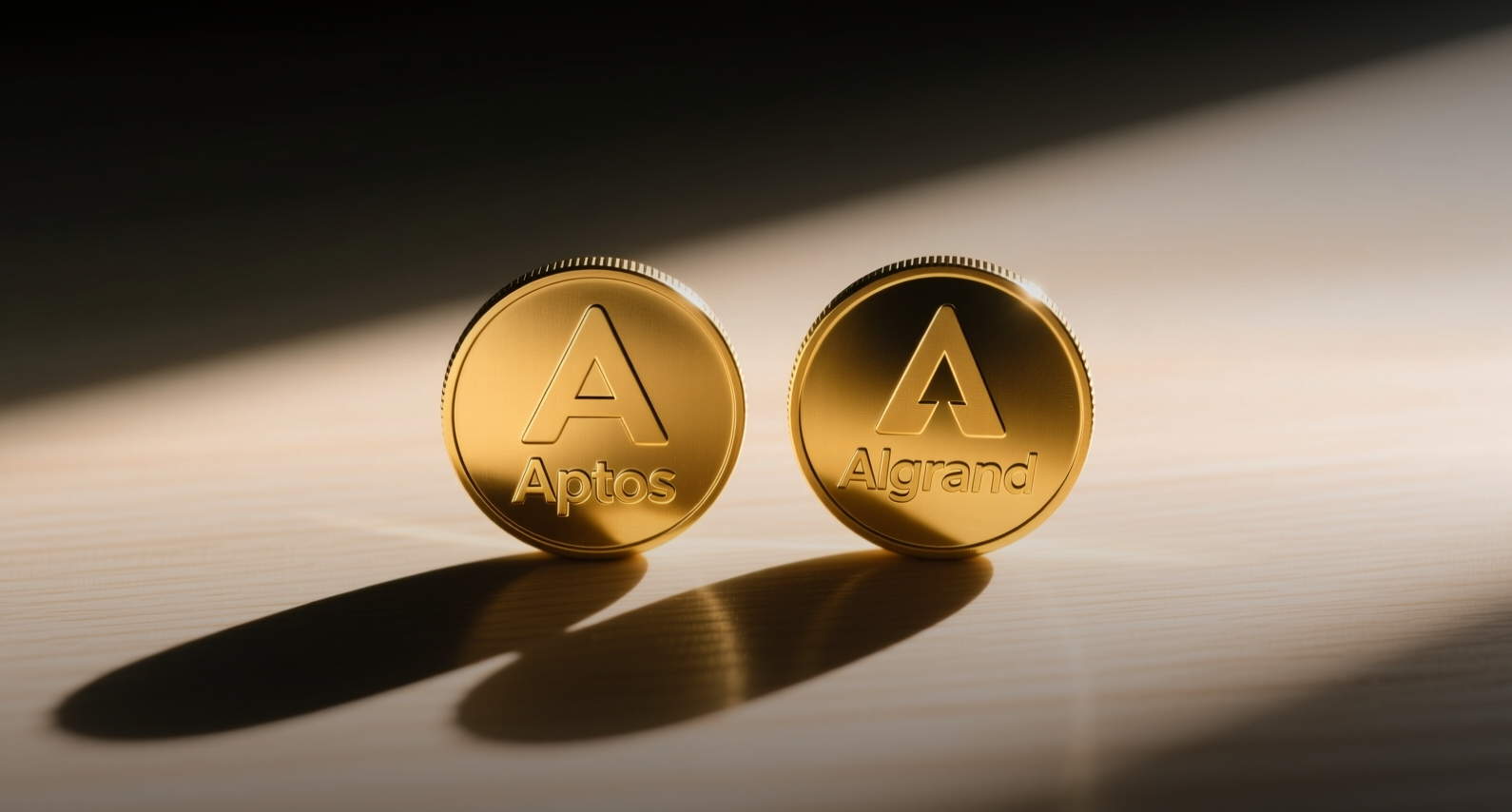
Coinbase's Quantum Advisory Council named Aptos and Algorand as the two blockchains best prepared for the cryptographic challenges of quantum computing, according to a position paper published April 21.
The advisory group includes Scott Aaronson from the University of Texas at Austin and Dan Boneh from Stanford University, two of the most cited researchers in cryptography and quantum computing. Their involvement gives the paper a level of technical credibility that goes beyond typical industry endorsements.
Aptos, which launched in 2022 on the Move programming language, uses a modular cryptographic infrastructure that allows it to swap signature schemes in a single transaction without requiring users to create new accounts or move assets. The council's paper highlighted this crypto-agility as Aptos's central advantage. In December 2025, the network proposed integrating SLH-DSA, a post-quantum signature scheme that has been formally standardized by the National Institute of Standards and Technology. Algorand earned its spot through a different approach: Falcon signatures within its State Proofs and native key rotation as a built-in feature. Falcon is a lattice-based cryptographic scheme that NIST has identified as resistant to quantum attacks.
The endorsement comes as the broader crypto industry accelerates quantum preparedness efforts. In February, Bitcoin developers advanced BIP-360 into formal review, laying the groundwork for future quantum-resistant upgrades. In March, BTQ Technologies released the first working implementation on its Bitcoin Quantum testnet. In June, Coinbase's own advisory council warned that roughly 7 million Bitcoin could eventually be vulnerable to quantum attacks if owners fail to move funds to quantum-safe addresses. Later that month, President Donald Trump signed executive orders speeding the federal government's transition to post-quantum cryptography.
Project Eleven, a security firm, also unveiled a cryptographic technique this week designed to address a related concern: proving wallet ownership after quantum computers can forge digital signatures. The technique, developed with Binius maintainer Jim Posen, uses a wallet's key derivation path to let users prove they control the parent key used to generate a private key without revealing it. The prototype is unaudited and would require blockchain protocol support before it could be used.
The council's paper was explicit that immediate threats are not imminent. The point is about preparation time horizons — the window between quantum computers becoming theoretically capable and practically deployable may be shorter than the time required to retrofit major blockchain networks. Most networks today secure wallets using elliptic curve cryptography, which a sufficiently powerful quantum computer could theoretically reverse-engineer. Networks that can swap out their signature schemes without disrupting users may face a smoother transition when Q-Day arrives.
For Aptos and Algorand, the naming represents a reputational signal that could influence developer and institutional interest. Researchers from the Ethereum Foundation were also listed among the advisory council's contributors, underscoring the breadth of the effort.
This article is for informational purposes only and does not constitute investment advice.