
Investor fears over AI’s disruptive power are creating a clear divide in the software credit market, with some sectors seeing loan prices plummet while others hold firm.
Investor fears over AI’s disruptive power are creating a clear divide in the software credit market, with some sectors seeing loan prices plummet while others hold firm.
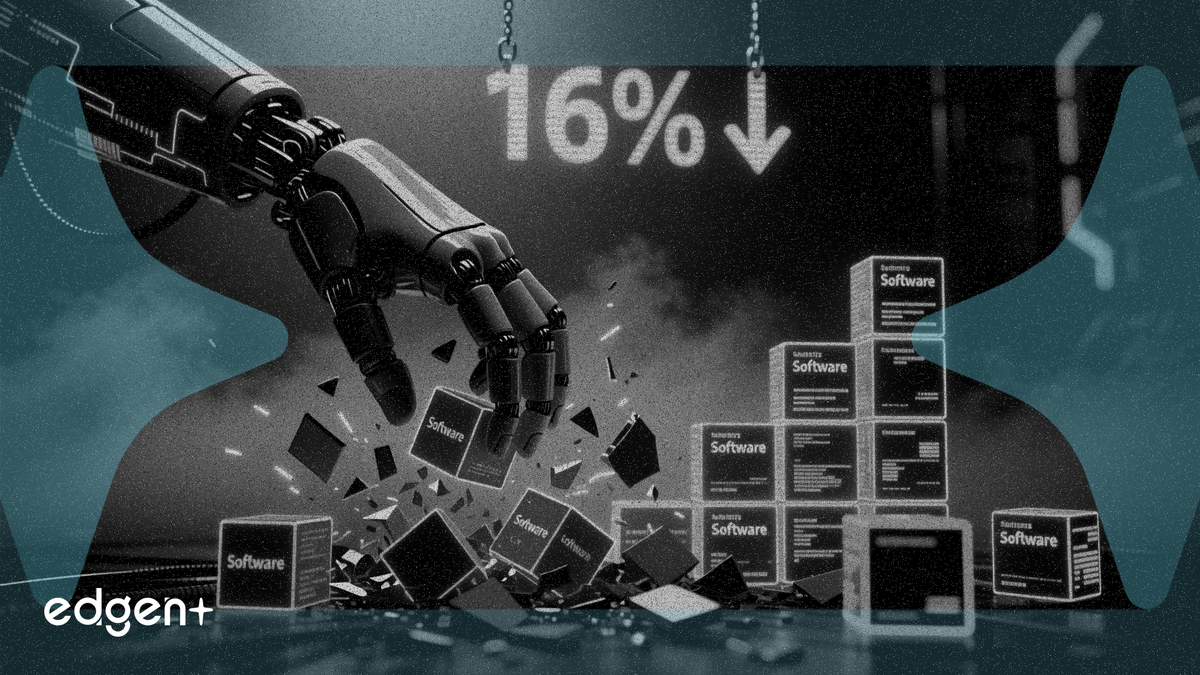
The perceived threat of artificial intelligence is forcing a stark re-evaluation in the $1.4 trillion leveraged loan market, where investors are rapidly sorting software companies into winners and losers. Loans to software-engineering firms have been hit hardest, plunging an average of 16.3 cents on the dollar since late January, while more resilient vertical software companies saw declines of just 4.2 cents, a Wall Street Journal analysis of over 100 loans reveals.
"Investors are now seeking ‘defensive moats,’ asking which companies can withstand competition from AI giants," said Ali Bendarkawi, senior technology analyst at AllianceBernstein. He noted that the key is whether the software "would create real business disruption" if it failed.
The divergence is clear across sub-sectors. Besides the 16.3 cent drop for software-engineering loans, horizontal software loans fell 8.8 cents on the dollar, and cybersecurity loans declined 5.3 cents. In contrast, vertical software, which serves specific industries like auto insurance or legal services, has proven most resilient. Pre-existing credit quality also magnified the impact; loans trading below 95 cents on the dollar before the selloff dropped an average of 10.5 cents, more than double the 4.5-cent decline for higher-quality loans.
This credit market bifurcation signals a potential new reality for private equity-backed software companies that rely on leveraged finance. Firms in vulnerable sectors like data visualization or code generation, such as Qlik and Perforce, may face a credit crunch, making refinancing more expensive and acquisitions harder. Conversely, companies with deep industry integration like CCC Intelligent Solutions or those handling critical workflows like UKG could see their competitive positions strengthen, potentially leading to a wave of M&A as strong players acquire devalued assets.
The market's flight to safety favors vertical software companies, which are deeply embedded in the niche workflows of specific industries. Businesses like Relativity in legal e-discovery and RealPage in property management handle sensitive data and critical operations, making their customers reluctant to switch to unproven AI-native startups. This "stickiness" creates a defensive barrier that investors are now rewarding with tighter credit spreads.
Horizontal software, which serves a wide range of businesses, faces a more complex picture. Investors are differentiating between platforms that control essential processes and those that offer more commoditizable features. For example, loans to UKG, a maker of human-capital management software for tasks like payroll, and Avalara, which handles tax compliance, have held up relatively well. However, companies focused on data visualization and analysis, like Qlik and Qualtrics, are viewed as more vulnerable to disruption as AI tools make these capabilities more accessible.
The cybersecurity sector is a key battleground where investor opinion is divided. While the proliferation of AI-powered cyberattacks could increase demand for security products from companies like Proofpoint and Gen Digital, there are also fears that existing security software could be rendered obsolete. For now, loans to these companies have seen only modest declines, suggesting investors believe the tailwind of rising threats will outweigh the risk of technological disruption.
The most dramatic impact has been felt by companies that make tools for software engineers. Loans to firms like Idera, SmartBear, and Perforce were already trading at a discount before the recent AI-driven selloff and have since fallen sharply to below 80 cents on the dollar. This reflects significant investor concern about the risk of default, as new AI tools that can write and analyze code threaten to commodify the entire software development process.
"The threat posed by AI is still somewhat ‘vague in everyone’s mind,’" said Joe Lynch, head of non-investment grade credit at Neuberger Berman. "There’s uncertainty over what AI can actually do and what it means for a lot of different businesses." This uncertainty is likely to keep credit markets for software companies volatile as investors continue to grapple with the long-term implications of artificial intelligence.
This article is for informational purposes only and does not constitute investment advice.