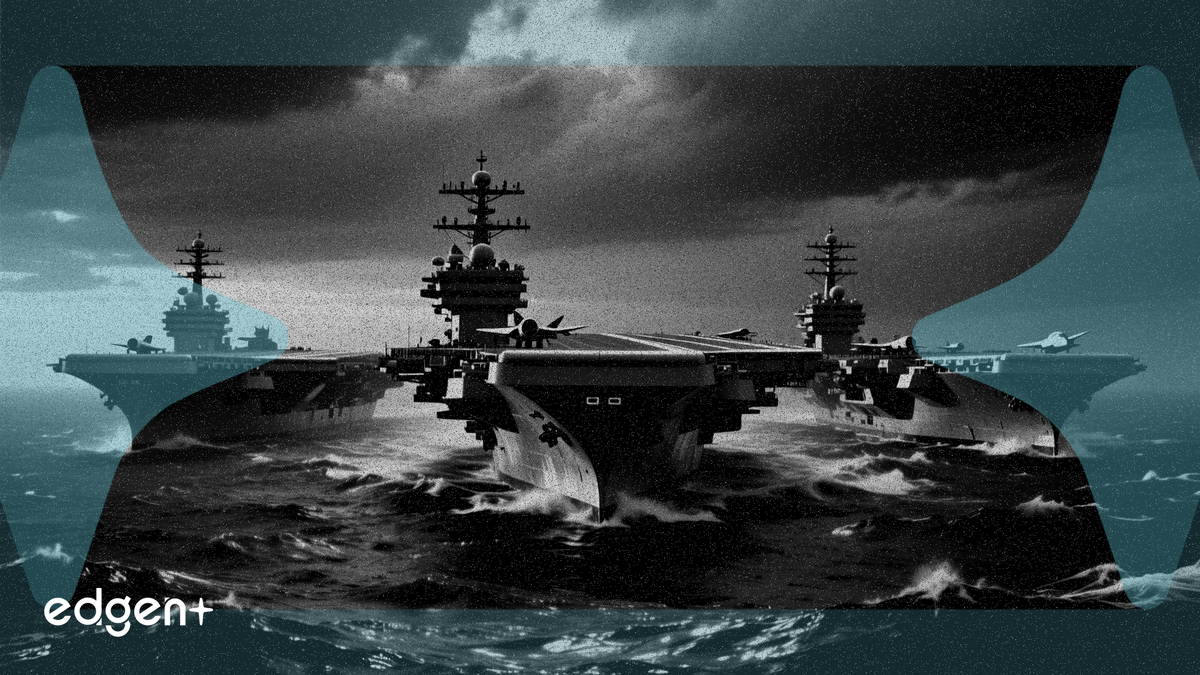
The United States has deployed three aircraft carriers to the Middle East for the first time in over 20 years, a major military escalation aimed at pressuring Iran as a fragile ceasefire hangs in the balance.
"The message is that Trump may apply more pain if the peace talks don’t advance in the way Trump wants," said Carl Schuster, a retired US Navy captain. "The political imagery is as, and possibly more important, than the military action."
The deployment involves the USS Abraham Lincoln in the Arabian Sea, the USS Gerald R. Ford in the Red Sea, and the newly arrived USS George H.W. Bush. Together, the carriers represent a force of over 200 aircraft and 15,000 personnel, according to US Central Command. The last time three or more carriers were in the region was during the 2003 Iraq invasion.
The move raises the stakes for global markets ahead of renewed negotiations with Iran, scheduled to resume in Pakistan. A collapse in talks could threaten the Strait of Hormuz, a critical chokepoint for global oil supplies, potentially leading to a sharp increase in crude prices and a selloff in risk assets.
The arrival of the USS George H.W. Bush, the Navy’s newest Nimitz-class carrier, is particularly notable. It took a longer route around Africa's Cape of Good Hope, avoiding the Bab al-Mandab Strait where Iranian-backed Houthi rebels have previously targeted shipping. This strategic path underscores the heightened tensions in the region’s narrow waterways. The Bush also brings the carrier strike group's first F-35 fighter jets, adding a new level of firepower.
The deployment comes as the USS Gerald R. Ford, the Navy's newest supercarrier, surpasses 299 days at sea, a post-Vietnam record. Its extended tour, which included supporting airstrikes against Iran as part of Operation Epic Fury, has been grueling, marked by a fire in March that required repairs. Analysts suggest the Bush could be arriving to relieve the Ford, whose crew is long overdue for rest, though the Pentagon has not confirmed any ship movements.
While the combined air power is immense, analysts are divided on its immediate tactical use. Peter Layton, a fellow at the Griffith Asia Institute, noted that carrier-based jets are "a very inefficient way" to strike the small, fast-attack boats that comprise Iran's asymmetric naval threat, suggesting A-10s already in the region are better suited. The value, therefore, lies in strategic messaging.
This article is for informational purposes only and does not constitute investment advice.