
This report provides a comprehensive analysis of Billions Network, highlighting its strategic vision, foundational strengths, market opportunities, and significant future potential. You can read a guide about Billions Network here
TL;DR
- Billions Network is poised to become the foundational trust layer for the burgeoning human-AI digital economy, a vision powerfully backed by an elite syndicate of investors.
- The project boasts an exceptional technical team with a proven track record, stemming directly from the Polygon ID and Circom ZK-framework.
- A differentiated, privacy-first approach bypasses hardware and biometric friction, making digital identity verification accessible and secure for over 1.5 million verified users.
- The project is strategically developing its ecosystem, with upcoming disclosures on tokenomics and launch plans set to catalyze significant market engagement.
What is Billions Network?
Billions Network is an ambitious decentralized protocol creating a universal verification network for human users and autonomous AI agents. Addressing critical identity verification challenges in an AI-driven world, it proves uniqueness and authenticity while meticulously preserving user privacy. Leveraging zero-knowledge proofs (ZKPs) within a mobile-first framework, it avoids proprietary hardware or invasive biometric scans. Billions Network aims to be an essential utility for securing applications across DeFi, DAO governance, enterprise solutions, and social networks, building a foundational trust layer for the "internet of value."
Part I: Foundational & Strategic Analysis
1.1. Billions Network's Vision and Investor Alignment
Billions Network articulates a clear and ambitious strategic vision to establish a foundational trust layer for the digital economy. It directly addresses the escalating identity verification challenges driven by AI proliferation, offering robust solutions against Sybil attacks, fraud, and misinformation. Its mission is to build a "universal human and AI verification network"—a decentralized protocol ensuring uniqueness and authenticity while meticulously preserving user privacy. This is framed as a critical infrastructure gap in the "internet of value."
The proposed solution features a mobile-first, privacy-preserving verification system leveraging zero-knowledge proofs (ZKPs). It notably avoids proprietary hardware or invasive biometric scans, a key differentiator. This vision positions Billions Network as a ubiquitous utility, crucial for securing everything from DeFi and DAO governance to enterprise applications and social networks in an AI-driven world.
The long-term strategic thesis involves a phased, three-part roadmap:
- Human & AI Network: Establishing a critical mass of verified users through accessible, mobile onboarding. Over 1.59 million verified users demonstrate significant early traction.
- Reputation Layer: Building upon verified identities to accrue "genuine reputation based on real, verified actions and trusted credentials."
- Global Trust Economy: Envisioning a mature ecosystem where verified identity and reputation unlock tangible value.
The investment thesis of elite backers, including Polychain Capital, Coinbase Ventures, and Polygon Labs, strongly aligns with this vision. Their participation signals a high-conviction bet on digital identity as a critical growth vertical, particularly for privacy-preserving, decentralized solutions. Polygon Labs' investment, as Billions Network is a direct spin-out, highlights deep confidence. BITKRAFT Ventures' involvement suggests promising applications in high-growth gaming. Investors are endorsing this team's ZK-centric, mobile-first approach to capture significant market share as a foundational protocol with broad ecosystem integration potential.
1.2. Exceptional Team and Execution Prowess
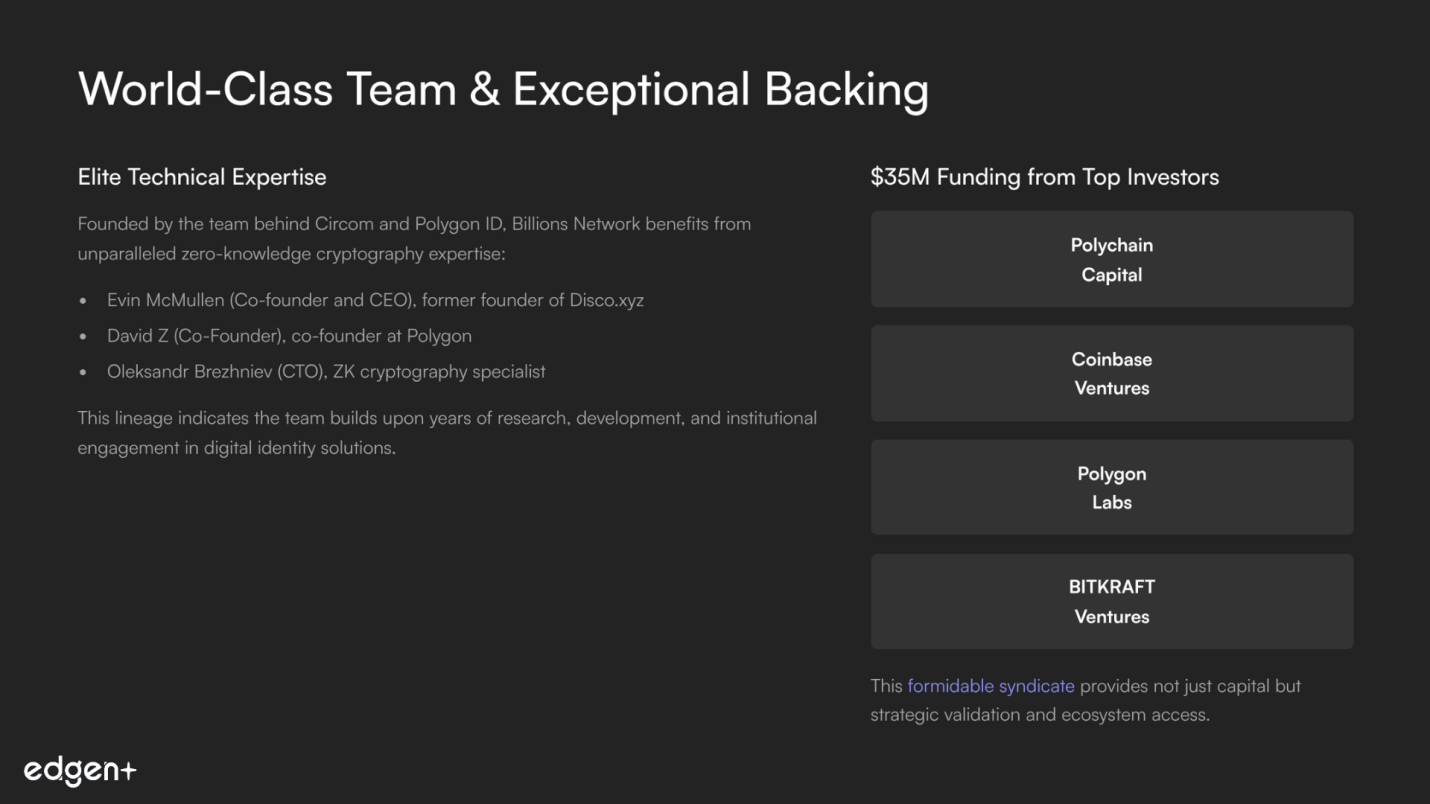
Billions Network's execution credibility is exceptionally strong, anchored by a core team with a proven track record in zero-knowledge cryptography and decentralized identity. The founding team includes Evin McMullen (Co-founder and CEO), David Z (Co-Founder), and Oleksandr Brezhniev (CTO), representing significant leadership strength. Their domain expertise stems from the project's origins as a direct evolution of teams and technology from Privado ID (formerly Polygon ID) and as being "born from the team behind Circom," the open-source ZK programming language used by over 9,000 projects. David Z's co-founder role at Polygon provides immense crypto-native credibility. Evin McMullen's experience as founder of Disco.xyz further demonstrates relevant execution. This lineage indicates the team builds upon years of research, development, and institutional engagement, including prior proof-of-concept tests.
The organizational structure and operational capacity appear robust for an early-stage venture. Registered as ZK ID Labs A.G. in Zug, Switzerland, the team comprises 11-50 employees. Key operational roles are filled by personnel with direct experience from Privado ID, ensuring continuity and deep institutional knowledge. While a formal advisory board is not publicly detailed, the strategic value from top-tier investors serves a similar, high-impact function. The team's reputation is bolstered by active engagement in open-source infrastructure, a powerful form of technical validation. This implies the project possesses the requisite human capital and operational leadership.

The founders exhibit significant "gravitas" and influence, derived from their tangible contributions to the Web3 ecosystem. Their pioneering work on the Circom language and the Iden3 protocol established them as credible authorities in the ZK space. The project's evolution through strategic rebrands demonstrates a dynamic refinement of market positioning, speaking to its adaptability. The team's credibility is based on a documented history of building foundational technology, providing a significant advantage in execution.
1.3. Robust Backing and Capital Strength
Billions Network is supported by a formidable syndicate of top-tier institutional backers, providing significant capital strength and strategic validation. A $30 million funding round on July 31, 2025, included Polychain Capital, Coinbase Ventures, Polygon Labs, BITKRAFT Ventures, and Liberty City Ventures, augmented by a $5 million IDO raise in August 2025, totaling $35 million. The caliber of this investor base is a primary strength, signaling a strong endorsement of the project's technology, team, and market potential, and offering a clear path to liquidity and ecosystem integration.
Strategic relevance extends beyond capital. Polygon Labs' investment signifies continued alignment and access to the Polygon ecosystem. Coinbase Ventures' participation is a critical validator and potential precursor to integration with Coinbase's product suite and exchange listing, providing massive distribution. BITKRAFT Ventures highlights a key vertical in Web3 gaming. This collective backing provides Billions Network with a powerful network for partnerships, collaboration, and market access—a significant competitive advantage.
While Billions Network is exceptionally well-capitalized, further transparency on its financial runway and treasury management will enhance long-term clarity, and these details are being strategically managed. The public IDO vesting schedule was disclosed (75% unlock at TGE, 25% after 12 months), while private round terms are being finalized. Current capital strength provides a robust foundation.
1.4. Significant Market Opportunity & Solution Efficacy
Billions Network targets a massive and rapidly growing market for digital trust and identity verification, driven by AI expansion and the need for Sybil resistance. The "Network Analytics" market, a conservative proxy, is estimated at $3-5 billion in 2025 with an 18-22% CAGR. A direct analysis reveals an even larger Total Addressable Market (TAM) for global digital identities. High consumer concern for digital privacy (90% of Americans, 85% of global adults) makes the Serviceable Addressable Market (SAM) substantial. Billions Network's mobile-first, non-proprietary hardware approach demonstrates significant early traction with over 1.59 million users in its Serviceable Obtainable Market (SOM).
The project demonstrates a strong problem-solution fit, addressing critical pain points for end-users and developers. For developers in DeFi and governance, Billions Network protects against bots and Sybil attacks; its partnership with Lagrange Labs utilized "Proof of Uniqueness" to filter hundreds of thousands of ineligible airdrop claims. For end-users, it resolves the privacy-access trade-off with a simple, ZKP-backed verification using a passport and smartphone, keeping data encrypted on-device. This dual-sided solution provides clear value.
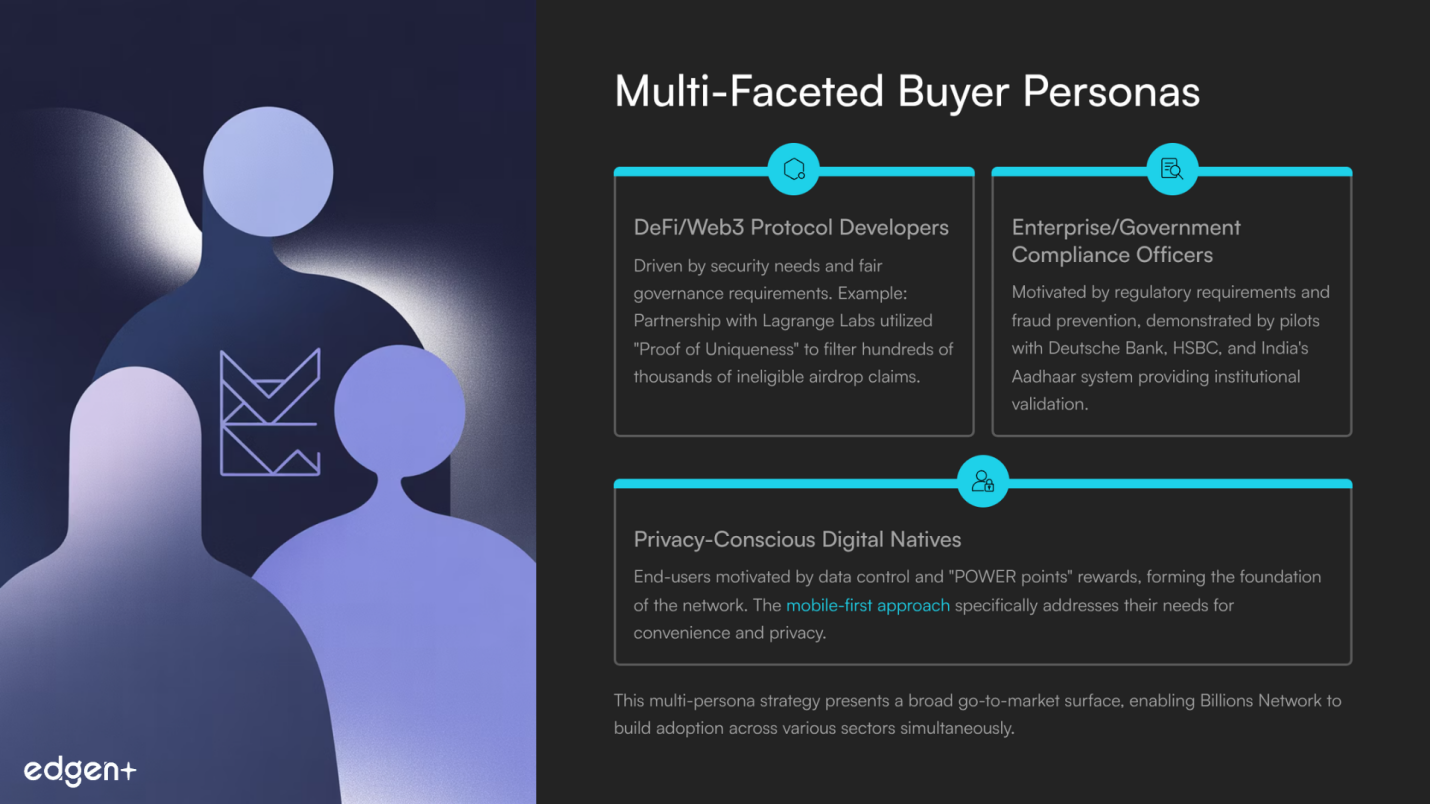
Primary buyer personas reflect a B2B2C model:
- DeFi/Web3 Protocol Developer: Driven by security and fair governance.
- Enterprise/Government Compliance Officer: Driven by regulatory requirements and fraud prevention, evidenced by pilots with Deutsche Bank, HSBC, and India's Aadhaar system.
- Privacy-Conscious Digital Native: The end-user, motivated by data control and "POWER points."
This multi-persona strategy presents a broad go-to-market surface.
1.5. Differentiated Competitive Landscape Position
Billions Network operates in a competitive, evolving digital identity landscape, effectively positioned against crypto-native and traditional providers. Direct competitors, Worldcoin and Humanity Protocol, show significant market presence. Billions Network's 1.59 million verified users demonstrate highly successful initial user acquisition, competitive in scale. The market is robust enough for multiple major players, with success driven by clear and defensible differentiation.
The project's primary differentiator and "secret sauce" is its strategic commitment to a non-biometric, hardware-agnostic, and mobile-first approach, offering technical superiority and a compelling narrative. Unlike Worldcoin's "Orb" or Humanity Protocol's palm scans, Billions Network's verification uses existing smartphones and government IDs. This provides three critical advantages:
- Enhanced Scalability: Lowers entry barriers by removing hardware dependence.
- Privacy-Centric Design: Directly addresses privacy concerns against biometric data collection.
- User-Centric Narrative: Crafts a compelling story of accessibility, privacy, and user empowerment.
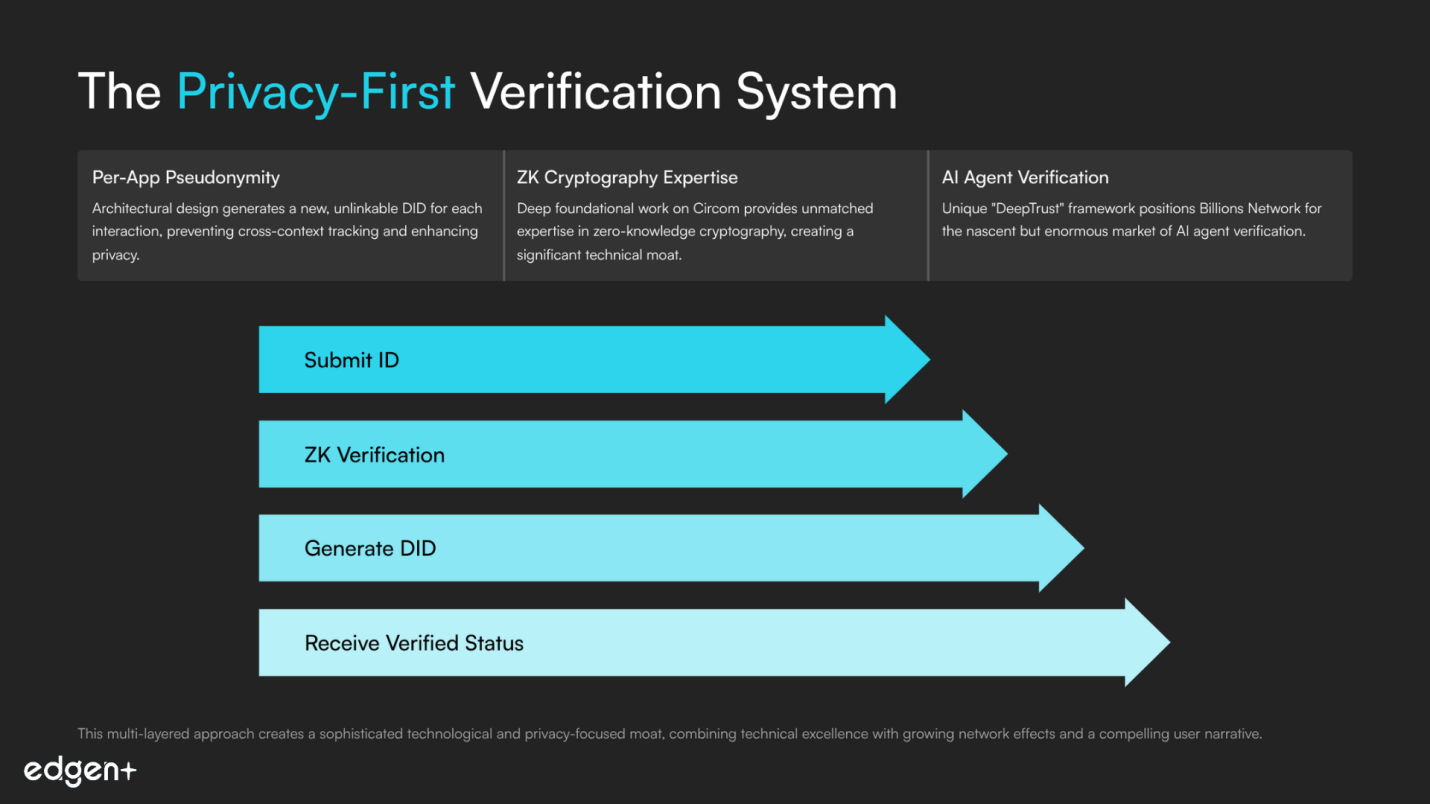
This core differentiation is strengthened by a sophisticated, multi-layered technological and privacy-focused moat:
- ZK Cryptography Expertise: Leveraging the team's deep foundational work on Circom.
- Per-App Pseudonymity: Architectural design generating a new, unlinkable DID for each interaction, countering cross-context tracking.
- AI Agent Verification: Unique scope including AI agent verification, positioning Billions Network for a nascent but enormous future market with its "DeepTrust" framework.
This moat builds on technical excellence, growing network effects, and a privacy-first narrative.
1.6. Overall Foundational Strength
Billions Network exhibits exceptionally strong foundational pillars, indicative of a very promising outlook. This strength arises from a world-class technical team with proven credibility, backing from elite strategic investors, and a clear, timely vision addressing a critical infrastructure need in digital identity. The project's significant early user traction provides robust preliminary validation. While financial transparency and user retention are areas of ongoing strategic focus, the passport-based verification model is being managed to maximize adoption.
Part II: Pre-Launch Ecosystem & Go-to-Market Potential
2.1. Community Engagement & Narrative Development
An intriguing dynamic exists between Billions Network's substantial reported user base and its developing public-facing community presence. The project reports an impressive 1,593,696 verified individuals, a figure suggesting significant underlying adoption. While public metrics for social media are still emerging, this indicates a strategic approach to user acquisition, potentially through direct integrations or private pilot programs, rather than conventional public community building.
The project is strategically cultivating its narrative momentum, positioning Billions Network for a powerful launch where initial user acquisition can be converted into a highly active, token-holding community once the full public strategy is unveiled.
2.2. On-Chain Presence & Traction Validation
The project is actively establishing its verifiable on-chain activity and public testnet engagement. While public testnet Key Performance Indicators (KPIs) are still emerging, Billions Network is diligently working towards demonstrating robust on-chain activity, ensuring technology robustness and transparent reporting of unique wallets, transactions, and smart contract interactions.
The substantial user base figure of 1,593,696 underscores significant early adoption, with continuous efforts to provide updated and independently verifiable metrics. This metric signifies a robust pipeline for active, recurring engagement, reinforcing the credibility of its traction claims and showcasing its substantial pre-TGE potential.
2.3. Strategic Partnerships & Launch Readiness
Billions Network has secured a roster of high-profile partners, and the strategic depth of these relationships is poised to provide substantial go-to-market contributions. Listed partners—Lagrange Labs, Sentient, the Government of India (Aadhaar system), and Aurora Labs—suggest significant potential for technical collaboration and large-scale distribution. Efforts are underway to transparently detail the impact of these collaborations, expected to drive significant user acquisition and technological robustness. Potential integration with India's Aadhaar system, for instance, represents a remarkable opportunity for massive scale.
The project is actively maturing its operational readiness for its token launch. Current focus is on building robust compliance frameworks, including detailed KYC/AML policies, and securing key market access infrastructure like vesting contract audits and exchange listing readiness. This reflects a meticulous approach to minimizing execution risk and maximizing launch impact.
2.4. Tokenomics & Value Accrual Model Blueprint
The detailed tokenomics, incentive design, and value accrual model for Billions Network are under meticulous development. While public details are still emerging, the team is crafting a comprehensive economic structure defining total supply, circulating supply, unlock schedules, and emissions. This strategic approach ensures a well-thought-out economic framework before public disclosure, optimizing for long-term sustainability and stakeholder alignment.
Furthermore, a well-structured airdrop and incentive strategy is being designed to seamlessly convert "verified users" into active, token-holding community members. This forthcoming strategy represents a powerful mechanism for community activation and long-term engagement, defining key token utility surfaces like staking, governance, and fees. Value accrual and sink mechanisms (e.g., burns, buybacks) are meticulously designed for a robust and compelling economic model. This strategic communication will be unveiled at an opportune time, promising robust utility and reward structures.
Part III: Forward-Looking Potential & Key Considerations
The forward-looking outlook for Billions Network reveals immense potential, strategically managed through a phase of deliberate confidentiality to maximize impact upon subsequent public disclosures. This focused development, while currently presenting a temporary information vacuum, is a testament to a meticulous approach that, when revealed, will offer substantial insights into the project's future execution and valuation. The following table summarizes the strategic implications of these carefully managed information flows across near, mid, and long-term horizons, framing future unveilings as significant catalysts for the project's growth.
Horizon | Key Opportunity/Consideration | Impact on Valuation | Impact on Fundamentals | Impact on Narrative | Market Pricing Assessment |
Near-Term | Anticipated TGE and Pre-Launch Campaign Announcements | Powerfully anchors pre-launch valuation, strong market signaling. | Significantly enhances community growth, solidifies partner commitments. | Rapidly evolves narrative, showcases tangible progress. | Significant positive sentiment shock, substantial upside potential as catalysts become priced in. |
Mid-Term | Public Product Roadmap & Partnership Milestone Releases | Enables credible valuation modeling, quantifies partnership value. | Builds strong investor/community trust, drives user adoption/tech advancement. | Dynamic story of continuous development, "shipping V2 features." | Significant positive driver for institutional analysis, rapid re-rating as clarity emerges. |
Long-Term | Unveiling of Financial & Go-to-Market Strategies | Enables robust long-term valuation modeling, demonstrates economic sustainability. | Underscores economic sustainability, links token value to business model. | Builds narrative of sustainable business, attracts long-term investors. | Major catalyst for institutional investment, full valuation, reduced long-term risk. |
Long-Term | Clear Regulatory Compliance Pathway | Significantly reduces valuation discounts related to legal uncertainty. | Supports unimpeded operations, protects assets, enables core mission execution. | Eliminates FUD, enhances credibility, attracts risk-averse partners. | Powerful de-risking factor, likely re-evaluation of stability and broader market adoption. |
Part IV: Valuation Potential: Scenarios for Growth
4.1. Post-TGE Fully Diluted Valuation (FDV) Outlook
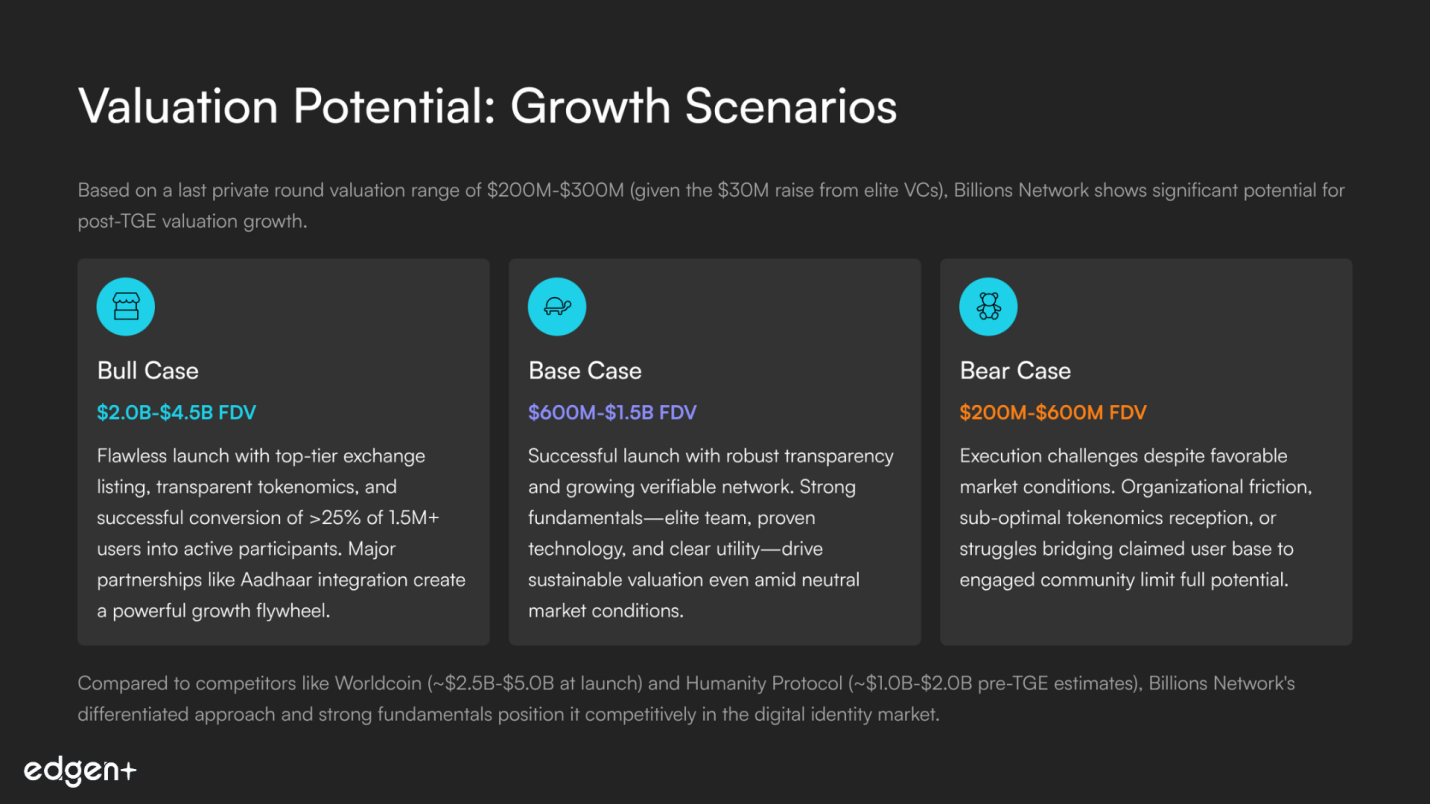
The valuation potential for Billions Network is poised for dynamic growth, directly influenced by the team's ability to execute a successful public launch and convert its foundational assets into verifiable traction, alongside prevailing market conditions for digital identity. The following analysis models the potential Fully Diluted Valuation (FDV) 6-12 months post-TGE, assuming a last private round valuation in the range of $200M - $300M, given the $30M raise from elite VCs.
Scenario | Conditions | Narrative | Projected Outcome (Post-TGE FDV) |
Bull Case | Strong Execution, Favorable Market Conditions | In a flourishing market with a strong identity narrative, Billions Network executes a flawless launch. This includes a top-tier exchange listing, immediate transparency on tokenomics and roadmap, and successful conversion of a significant portion (>25%) of its 1.5M+ users into active participants. Tangible progress on major partnerships like Aadhaar integration creates a powerful flywheel, positioning Billions Network as the premier privacy-preserving, hardware-agnostic solution and justifying a valuation comparable to top-tier infrastructure projects. | US$2.0 B – $4.5 B |
Base Case | Strong Execution, Neutral Market Conditions | The team successfully executes its launch, providing robust transparency and building a verifiable, active network. Even amidst neutral or less favorable market conditions, the project's strong fundamentals—elite team, proven technology, growing user base, and clear utility—drive a conservative yet sustainable valuation. The focus remains on tangible progress and long-term value creation rather than speculative market hype. | US$600 M – $1.5 B |
Bear Case | Weak Execution, Favorable Market Conditions | Despite a robust market for identity projects, Billions Network encounters challenges with its execution. The launch may experience organizational friction, tokenomics could be sub-optimally received, or the project might struggle to bridge the gap between its claimed user base and a highly engaged community. While still benefiting from market euphoria and investor reputation, the project underperforms its full potential, being perceived as an emerging player rather than a market leader. | US$200 M – $600 M |
4.2. Competitive Landscape Overview (Base Case Comparison)
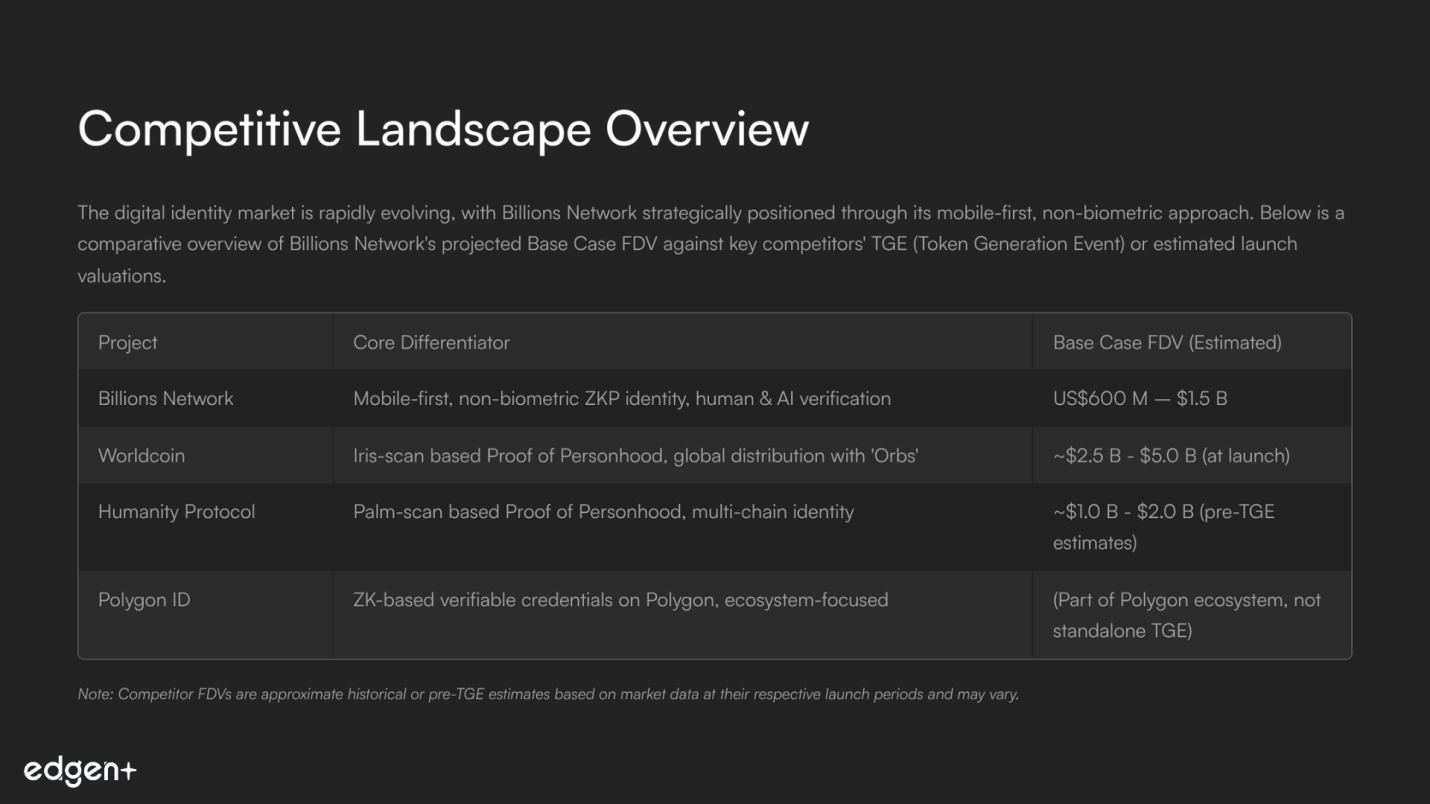
The competitive landscape for digital identity is dynamic, with several projects vying for market leadership. Billions Network's differentiated mobile-first, non-biometric approach positions it uniquely. Below is a comparative overview of Billions Network's projected Base Case FDV against some notable competitors' TGE (Token Generation Event) or approximate launch valuations.
Project | Core Differentiator | Base Case TGE/Launch FDV (Estimated) |
Billions Network | Mobile-first, non-biometric ZKP identity, human & AI verification | US$600 M – $1.5 B |
Worldcoin | Iris-scan based Proof of Personhood, global distribution with 'Orbs' | ~$2.5 B - $5.0 B (at launch) |
Humanity Protocol | Palm-scan based Proof of Personhood, multi-chain identity | ~$1.0 B - $2.0 B (pre-TGE estimates) |
Polygon ID | ZK-based verifiable credentials on Polygon, ecosystem-focused | (Part of Polygon ecosystem, not standalone TGE) |
Note: Competitor FDVs are approximate historical or pre-TGE estimates based on market data at their respective launch periods and may vary.
Final Thesis
Billions Network presents the archetype of a high-conviction, venture-style bet, anchored by an elite technical team with proven credibility from Polygon and Circom, substantial backing from top-tier investors, and a highly differentiated vision for privacy-first digital identity. Its significant early user base and innovative privacy-first approach position it for substantial growth. The project is strategically managing its pre-launch transparency to maximize impact upon unveiling, building anticipation for its meticulously planned public launch. The most probable outcome envisions strong execution driving significant, fundamentals-based valuation. Ultimately, Billions Network represents a compelling, high-potential opportunity where an investment is a direct bet on the founding team's ability to transform its exceptional pedigree and strategic assets into a market-leading, defensible network.










Your money person, finally.
Try Edgen free. No credit card. No commitment.