Content
Mercados Criptográficos Evolucionaron, el Análisis Tradicional...
Comprensión del análisis de criptomonedas en cadena
¿Por qué la IA transforma el éxito en el trading de criptomone...
1. Precisión de la Predicción del Mercado
2. Monitoreo en Cadena Instantáneo
3. Integración de Datos Sociales y Blockchain
Señales Alpha: Tu Clave para Ganancias en Criptomonedas
Cómo Edgen AI Detecta Claramente las Señales Alpha:
Plataforma de Análisis de Criptomonedas con Inteligencia Artif...
Puntos Clave para los Comerciantes:
No te quedes atrás

Markets Confusing? Ask Edgen Search.

Instant answers, zero BS, and trading decisions your future self will thank you for.

Try Search Now

Análisis de cripto en cadena: Cómo la IA ayuda a los traders a mantenerse al frente del mercado
Edgen
· Mar 31 2026
Análisis de cripto en cadena: Cómo la IA ayuda a los traders a mantenerse al frente del mercado

Mercados Criptográficos Evolucionaron, el Análisis Tradicional Quedó Atrás

Los mercados criptográficos cambian rápidamente. Los métodos tradicionales de análisis no logran proporcionar insights precisos a tiempo. Para mantener una ventaja, los traders requieren analíticas en cadena y estrategias impulsadas por inteligencia artificial.

Edgen AIcombina las perspectivas de blockchain, la inteligencia artificial y las señales sociales en una solución clara. Al analizar datos en tiempo real, Edgen elimina puntos ciegos, permitiendo a los traders capturar movimientos rentables con anticipación.

A medida que la IA supera las capacidades humanas de procesamiento de datos, los verdaderos ventajas del mercado radican en las actividades de blockchain y sociales "pumpamentals" en lugar de los gráficos técnicos solos.

Comprensión del análisis de criptomonedas en cadena

El análisis en cadena significa seguir las transacciones de blockchain en tiempo real para anticipar tendencias futuras del mercado. MIT Sloan explains this wellmostrando cómo la transparencia en los sistemas de blockchain ayuda a los inversores a tomar mejores decisiones y por qué esa visibilidad está redefiniendo el mercado de criptomonedas.

Como los activos criptográficos operan en registros públicos transparentes, los traders pueden monitorear indicadores críticos con precisión, tales como:

  • Transacciones de Cartera Inteligente: Los grandes transferimientos indican posibles cambios en el valor de los activos.
  • Entradas y salidas de intercambio: Presiones de compra y venta claramente identificadas a través de las actividades de intercambio.
  • Participación en Contratos de Finanzas Descentralizadas: La actividad en contratos de finanzas descentralizadas indica tendencias emergentes.
  • Señales de Sentimiento Social: Cuentas influyentes en plataformas como X (anteriormente Twitter) afectan significativamente el sentimiento del cripto.

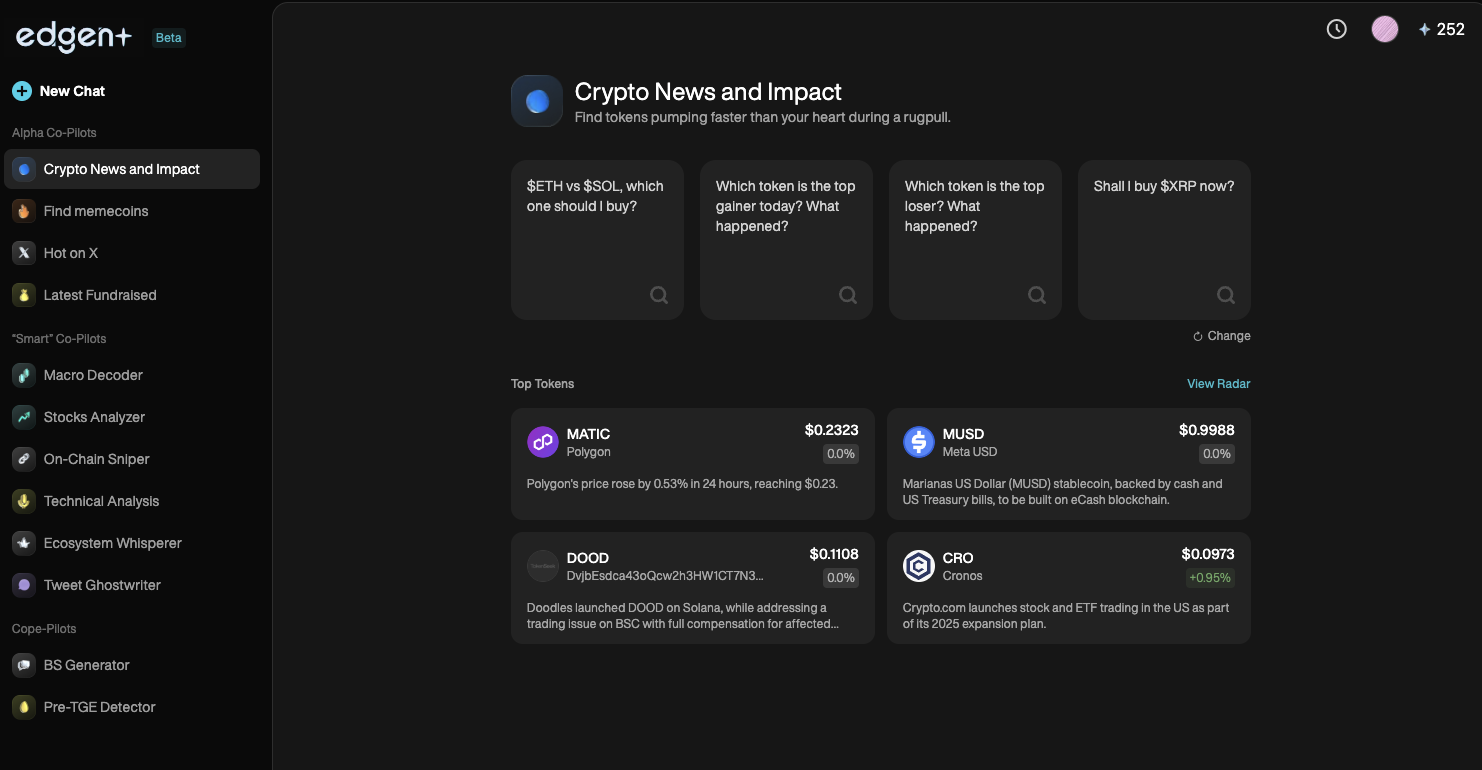
Para detectar estos cambios a tiempo, necesitas herramientas que funcionen más rápido que tú. Edgen Feedmantiene actualizado sobre narrativas en vivo, impulso social y actividad de billeteras en tendencia, todo en tiempo real.
Crypto Traders

¿Por qué la IA transforma el éxito en el trading de criptomonedas

La IA supera la capacidad humana para procesar grandes volúmenes de datos rápidamente y con precisión. Edgen AI aprovecha las fortalezas de la IA para ofrecer insights de mercado precisos de forma clara, brindando a los usuarios ventajas distintas en el trading:

1. Precisión de la Predicción del Mercado

AI identifica oportunidades de comercio antes de que los precios las reflejen. Edgen AI monitorea continuamente los movimientos de la cadena de bloques y el sentimiento social, brindando a los traders información predictiva con bastante antelación.

2. Monitoreo en Cadena Instantáneo

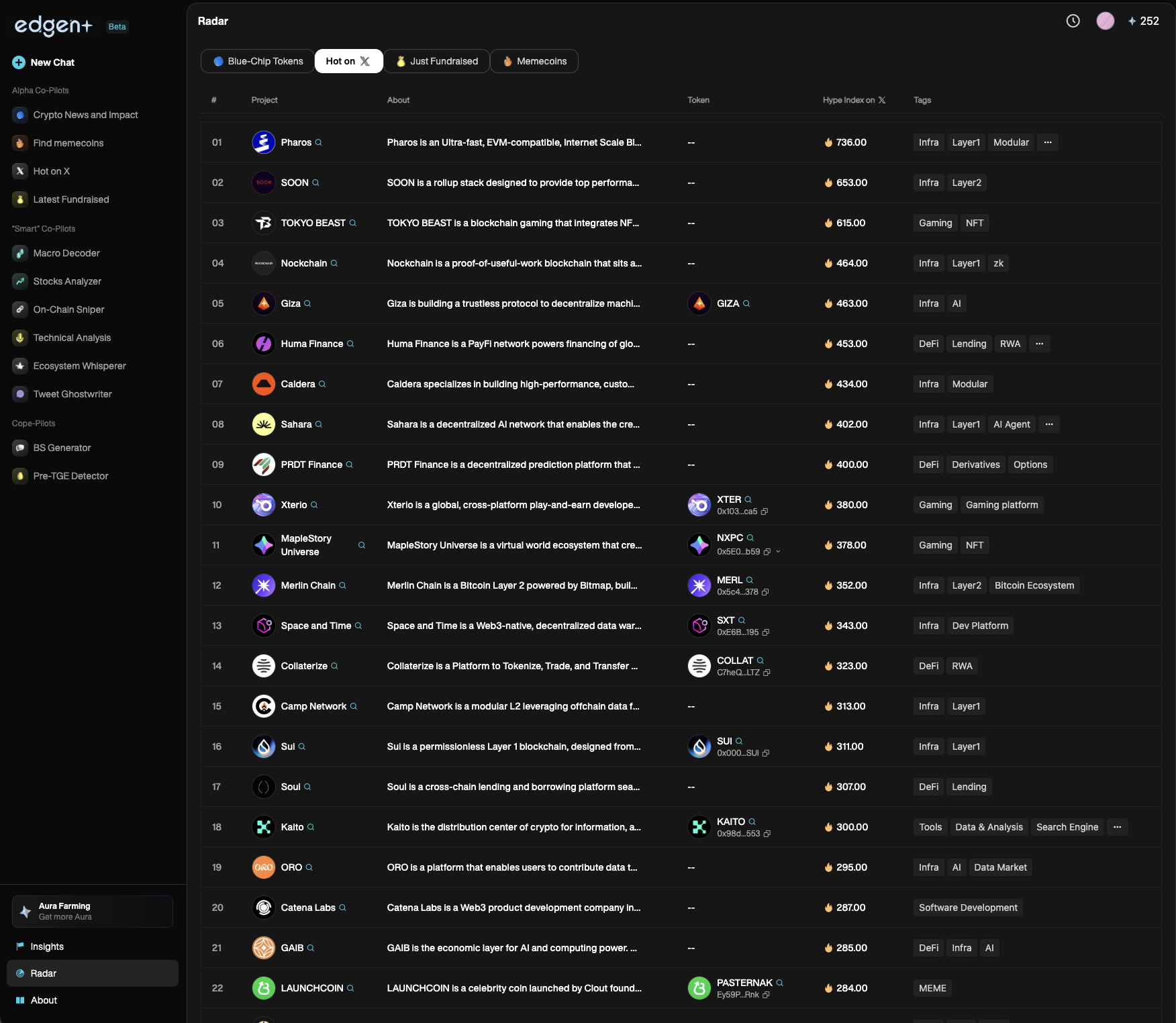
Los mercados no duermen. Tampoco debería hacerlo tu alimentación de datos. Edgen AI escanea constantemente transacciones de alto impacto, movimientos en DeFi y cambios en la liquidez. Herramientas como Edgen Radarrevelar tokens en tendencia y actividad de contratos antes de que la acción del precio llegue a intercambios importantes.

3. Integración de Datos Sociales y Blockchain

Los movimientos del mercado criptográfico resultan de influencias técnicas y sociales. Edgen AI combina el análisis de blockchain y el seguimiento en tiempo real del sentimiento social, destacando señales de alpha valiosas que otros pasan por alto.

Negociar sin IA corre el riesgo de tener una visibilidad incompleta. Edgen AI asegura que los traders vean claramente cada señal importante.
Crypto Traders

Señales Alpha: Tu Clave para Ganancias en Criptomonedas

Los traders exitosos dependen de señales alfa, que son indicadores tempranos que prevén oportunidades en el mercado antes de que sean reconocidas por la corriente principal.

Cómo Edgen AI Detecta Claramente las Señales Alpha:

  • Análisis de Actividad de Billeteras: la IA identifica y rastrea las billeteras de grandes tenedores (whales) e insiders a través de datos de blockchain y comportamiento en redes sociales.
  • Monitoreo de Contratos Inteligentes: Las tendencias de DeFi se vuelven claras a través de las interacciones de los contratos antes de que aparezcan en los movimientos de precio.
  • Social "Pumpamentals: La IA reconoce de inmediato la tendencia social emergente en plataformas como X/Twitter, anticipando los impactos en los precios antes de que alcancen su punto máximo.

¿Quieres un avance? Edgen Searchte da acceso a los flujos de billetera, las tendencias de contratos y el rumor social en una sola interfaz rápida, así que nunca llegarás tarde a la fiesta de alpha.

Plataforma de Análisis de Criptomonedas con Inteligencia Artificial

Para mantenerse competitivos, los operadores necesitan una plataforma impulsada por inteligencia artificial que ofrezca perspectivas claras y en tiempo real sobre blockchain:

El AI de Edgen integra datos de blockchain y señales sociales en una plataforma integral, ofreciendo señales claras de alfa combinadas con una ejecución impulsada por inteligencia artificial precisa.

Edgen AI combina de manera única el análisis de blockchain, la inteligencia artificial y el análisis de sentimiento social en tiempo real dentro de una solución de trading unificada.
Crypto Traders

El Futuro del Comercio Pertenece a la IA: ¿Estás Listo?

El trading de criptomonedas ahora implica fundamentos de blockchain, sentimiento social e ejecución instantánea impulsada por inteligencia artificial.

Puntos Clave para los Comerciantes:

  • El análisis de blockchain impulsado por IA supera claramente a los métodos tradicionales.
  • Social "pumpamentalsimpulsar significativamente los mercados de criptomonedas.
  • Edgen AIproporciona la única solución de comercio en el mercado que integra claramente los datos de blockchain, las perspectivas sociales y la ejecución de inteligencia artificial simultáneamente.
  • Los operadores que utilizan inteligencia artificial ahora dominan los movimientos del mercado futuro.

¿Quieres saber cómo funciona Edgen en segundo plano? Visita Edgen's About page y descubra por qué los traders más inteligentes están cambiando a la IA ahora.

No te quedes atrás

Las criptomonedas se mueven rápidamente. Los traders que tienen éxito son aquellos que utilizan herramientas que ven más rápido, piensan de manera más inteligente y actúan antes. Avanza. Negocia de manera más inteligente.

UseEdgen AI.

Recommend
Redeem miles for gift cards and each is worth ~1 cent; redeem for long-haul business and they're worth 2.5-4+. With programs now dynamically priced, the one check that decides every redemption.

How to redeem airline miles without wasting them

The single biggest mistake with miles is redeeming them for the easy stuff: gift cards, merchandise, seat upgrades at the gate. Do that and each mile is worth about one cent. Redeem the *same* miles for flights, especially long-haul or premium-cabin flights, and they're often worth two to five cents each, sometimes more. So the real skill isn't earning miles; it's not throwing away their value at the finish line. Here's how to actually use them. A mile has no fixed price; its value depends entirely on what you redeem it for. The way to judge any redemption is simple math: (cash price of the flight) ÷ (miles it costs) = cents per mile. If a flight costs $400 or 20,000 miles, that's 2 cents a mile, a solid deal. If a $90 flight costs 18,000 miles, that's half a cent, which is terrible; pay cash and keep the miles. Run this check before every redemption. It instantly separates a great use from a waste, and it's the one habit that makes miles worth having. As a rule of thumb, most major ai
Edgen
·
Jun 30 2026
Short-term goals (under ~3 years) belong in safe cash; long-term goals (5+ years) can take market risk. The best HYSAs now pay ~4-5% APY. How to sort yours and run both.

Long-term vs short-term financial goals (and how to plan both)

The difference comes down to one thing: time. A short-term goal is money you'll need within roughly three years (an emergency fund, a trip, a wedding, next year's tax bill), so it has to be *safe and reachable*. A long-term goal is five-plus years out (retirement, a house down the road, a kid's education), so it can take market risk, because time smooths the bumps out. Get that match right and you've done most of the work. It's not the size, it's the deadline. A $2,000 goal you need in six months is short-term; a $2,000 goal you won't touch for fifteen years is long-term, and they belong in completely different places. This is the part that actually matters, and where people lose money without realizing it. Short-term money should not be in the stock market. If your emergency fund is in stocks and the market drops 20% the same month your car dies, you're selling at the worst possible time. Short-term goals go somewhere stable and accessible, and a high-yield savings account is the clas
Edgen
·
Jun 30 2026
Mortgages near 6.5%, home prices flat, and the Fed split on rate cuts vs hikes. With timing a coin flip, the 3 questions that actually decide whether to buy now or wait.

Should you buy a house now or wait? How to actually decide

The honest answer: buy when you'll stay put for at least five years and you'll still have an emergency fund left after the down payment. Otherwise, waiting (and renting) is often the smarter money move, not the weaker one. "Rent vs buy" isn't a math problem with one right answer, and it's almost never really about timing the market. It's about your *life*, in three questions. Before the three questions, here's the mid-2026 backdrop — because "now or wait" usually hides a bet on rates and prices, and the data says that bet is a coin flip. The picture: mortgages are still pricey, prices have gone flat (more than half of the 20 big metros saw year-over-year declines in March), and the cheap-money era hasn't returned. So "buy before it runs away" and "wait for the crash" are *both* weak arguments right now. The whole "wait for rates to drop" plan rests on the Fed, and the Fed is split down the middle. In its June 2026 projections, policymakers were divided: 8 expected no change this year,
Edgen
·
Jun 30 2026
Most financial goals fail because they're wishes, not systems. Here's the 3-part anatomy of a goal that sticks (a number, a date, one automatic move), plus why 37% of adults can't cover a $400 surprise.

How to set financial goals you'll actually hit

A financial goal you'll actually hit has three things a vague wish doesn't: a number, a date, and one automatic move that happens whether or not you remember it. "Save more" is a wish. "$6,000 in a separate account by next December, $500 auto-transferred on payday" is a goal. The gap between those two sentences is the reason most goals quietly die, and it has almost nothing to do with willpower. Key Takeaways A real financial goal answers three questions: how much, by when, and what for. Drop any one and it stops working. "Pay off debt" has no number and no date, so there's nothing to aim at or measure, while "$8,000 of card debt cleared in 18 months" tells you exactly whether you're on track and the day you're done. The "what for" matters more than people expect. A goal tied to something real (a buffer so a bad month isn't a crisis, a deposit on a first place) survives the months when motivation dips. In our experience reading how people actually use a money tool, the goals that get
Edgen
·
Jun 30 2026
A big RSU grant just vested — now what? Here's what a modern money tool actually surfaces first, using Ed as a worked example: a reality check, the 22% tax gap most high earners miss, and the concentration risk nobody flags.

Your RSUs Just Vested. Here's What a Money Tool Surfaces First.

You just had a big RSU grant vest. Congratulations — and now the awkward part: a six-figure pile of your own company's stock, a vague sense you should "do something," and no one actually telling you what. An advisor, a spreadsheet, and a piece of software each handle this moment differently. Here's what a modern money tool surfaces in a moment like this — using Ed as a worked example — so you can decide what kind of help actually fits. Key takeaways You connect your brokerage and bank through read-only aggregation, so the tool can read balances but can't move a dollar. Ed's framing is simple: precise about your money, blind to your identity. Instead of sorting your lattes into categories, Ed opens on a single Financial Reality Check — a read on whether your money could survive a bad month. For a lot of high earners, that one number lands harder than any budget, because it answers a question the other apps never ask. (If the Reality Check is the numbers side, your money type is the beha
Edgen
·
Jun 26 2026
A money personality test is more than a quiz if it measures behavior, not just vibes. Here's the science behind money types, how Ed's test works, and how to use your result.

What Is a Money Personality Test? The Science Behind Your Money Type

The short version: a good money personality test should feel like a roast and work like a mirror — fun on the surface, behavioral underneath. The useful ones don't tell you what you know; they show you how you act with money, and the one blind spot worth watching. Key takeaways Here's the uncomfortable backdrop. U.S. financial literacy has been stuck for a decade — adults answer only about 49% of the standard knowledge questions correctly, essentially flat since 2017 (TIAA Institute–GFLEC, 2025) — even as free financial information became infinite. If facts fixed money, they'd have fixed it by now. They don't, because the thing that actually drives your outcomes lives one level below the facts: how you're wired to behave when money is on the line. That's the whole premise of financial fitness — and it's what a money personality test is built to surface. Not what you know. What you do. The idea has real research behind it — money behavior is patterned and measurable, and a few tradition
Edgen
·
Jun 23 2026
A financial reality check scores where you actually stand across safety, control, progress, upside, and Mental Load. Here's why a money score matters, how Ed's checkup works, and what to do with your weakest area.

What Is a Financial Reality Check? Why Your Credit Score Isn't Enough

The short version: your credit score measures how safe you are to lend to. Almost nobody has ever seen the number that measures whether you are actually secure. A financial reality check is that second number. Key takeaways Ask people for their credit score and many can recite it. Ask whether they could survive three months without income, or where their money quietly leaks each month, and you get a shrug. That's the gap. A credit score answers a lender's question — how risky is it to extend this person debt? It can be high while your life is fragile, or low while you're genuinely fine, because it was never built to measure you. A financial reality check answers the question the credit score ignores: are you safe, clear, progressing, building, and at ease? Here's the simple version, with the research behind each axis.
Edgen
·
Jun 23 2026
SpaceX opens Thursday at a $1.77 trillion valuation — the largest IPO ever. Only 4.2% of stock actually trades. Musk is locked up for 366 days. The next 366 days run on an unusually clean calendar of supply releases. Here are the 13 dates worth watching.

SpaceX goes public Thursday with a possible $5 trillion hit. Here's the calendar that actually matters.

SpaceX prices Wednesday night and opens Thursday on Nasdaq at $135 per share — a $1.77 trillion valuation, the largest IPO ever. Most coverage will frame what comes next as a sentiment trade, an Elon story, or a race to Goldman's $5 trillion bull case. The reality is more grounded and more useful: the next 366 days are governed by an unusually clean calendar of supply releases — when 95.8% of the company can or cannot trade, when index funds add weight, when the lock-up cliff arrives, when Musk himself becomes a potential seller for the first time. Read the calendar and you've already understood the structure most market commentary will spend the next quarter trying to explain. Here are the 13 dates worth watching. Two things keep showing up in headlines that don't survive a careful read. The first is the idea that index funds are about to be forced into a massive single-event SpaceX buy. They aren't. Nasdaq did create a fast-track inclusion rule that lets SpaceX join the Nasdaq 100 wi
Edgen
·
Jun 10 2026

Invertir, por fin, ya no es cosa de uno solo.

Prueba Ed gratis. Sin tarjeta, sin compromiso.