内容
TL;DR
什么是 Moonbirds
一、基础与战略分析
1. 愿景与投资者一致性
2. 卓越的团队和执行力
3. 资本实力和认可
4. 市场机遇和契合度
5. 竞争格局与差异化
二、预发布生态系统与上市策略
1. 社区与叙事势头
2. 链上足迹
3. 增加实用性的合作伙伴关系
4. 代币经济学和价值积累(当前)
三、前瞻性分析(催化剂和机会)
短期(≤1个月)
中期(1-3个月)
长期(6个月以上)
四、估值情景分析 (TGE FDV)
竞争对手格局(TGE 时或临近 TGE 的代币视角)
最终结论

市场太复杂?来问 Edgen Search。

答案即刻呈现,信息绝无水分,让你做出决胜未来的交易决策。

立即体验 Search

Moonbirds:IP复兴与实际效用

· Mar 31 2026
Moonbirds:IP复兴与实际效用

对 Orange Cap Games 旗下的 Moonbirds 进行评估,重点关注战略、执行、合作关系和估值情景。您可以在此处找到 Moonbirds 指南:

TL;DR

  • OCG 正在应用一套经过验证的 IP 复兴策略,从社区到品牌再到产品,已经将关注度转化为活动和需求。
  • 精英投资者的支持、Kaito AI 社交赚取等实际效用、Otherside 头像以及合作伙伴空投,为 Moonbirds 带来了强劲的势头,并提供了实现持久价值的清晰路径。

什么是 Moonbirds

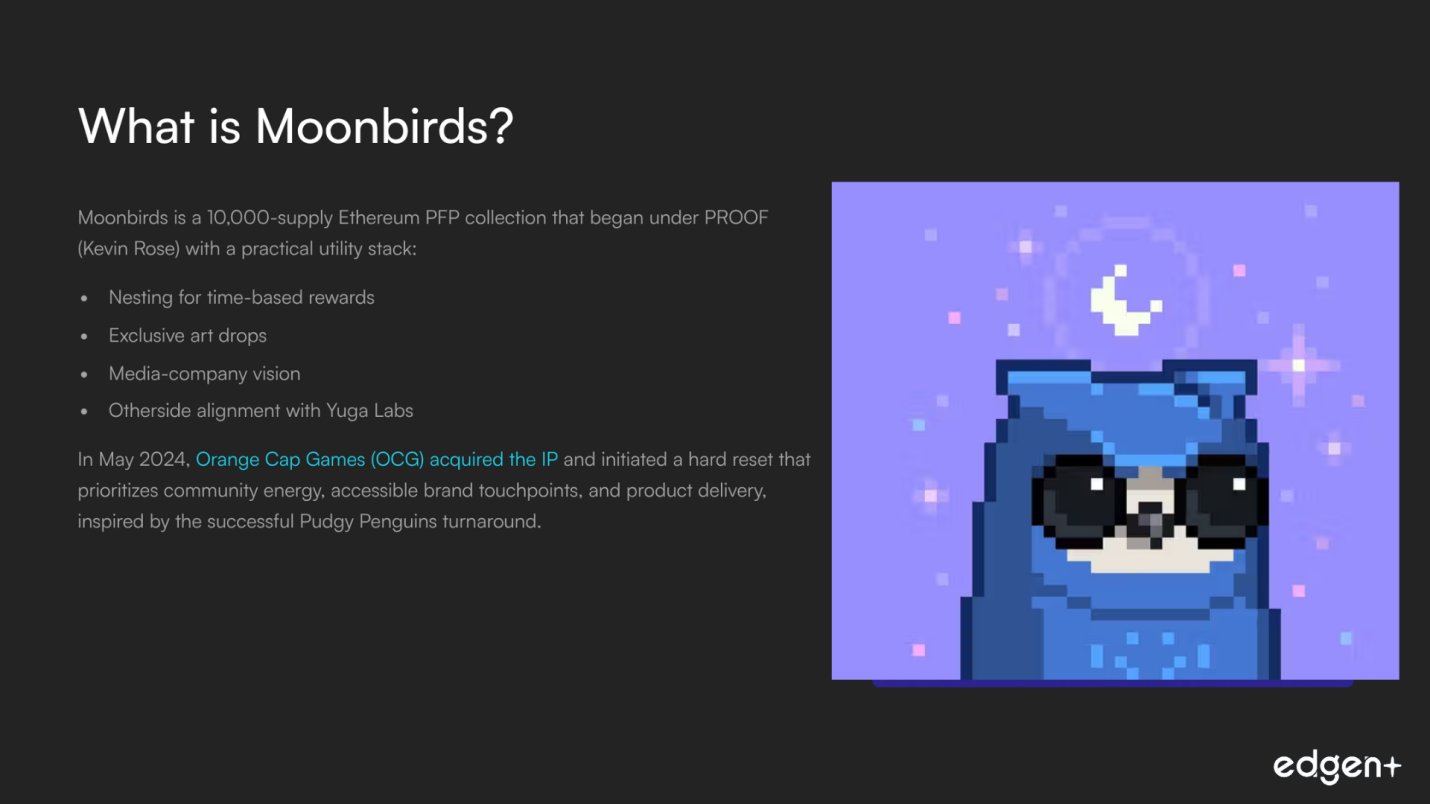
Moonbirds 是一个拥有 10,000 个供应量的 Ethereum PFP 系列,最初由 PROOF(Kevin Rose)发起,具有实际的实用堆栈:通过“筑巢”获得基于时间的奖励、独家艺术品掉落以及媒体公司愿景。后来,它与 Yuga Labs 合作开发 Otherside。2025 年 5 月,Orange Cap Games(OCG)收购了该 IP,并启动了一项硬性重置,优先考虑社区活力、可访问的品牌接触点和产品交付,灵感来自于 Pudgy Penguins 成功的转型。

由 Spencer Gordon-Sand 领导的 OCG 带来了加密原生信誉和产品执行经验,包括 Vibes 集换式卡牌游戏。该计划旨在通过数字和物理渠道扩展 Moonbirds,在主流平台建立分销,并将社区势头转化为收入和可持续的经济效益。与 Kaito AI(社交赚取)等合作伙伴关系以及 Monad 和 Towns 等项目的空投访问权限,为持有者增加了即时价值,同时团队致力于构建更广泛的 IP 和游戏平台。

凭借新的领导层、高知名度的支持者和清晰的运营模式,Moonbirds 有望从一个传奇的 NFT 系列发展成为一个持久的、以实用性为基础的品牌。
一、基础与战略分析

1. 愿景与投资者一致性

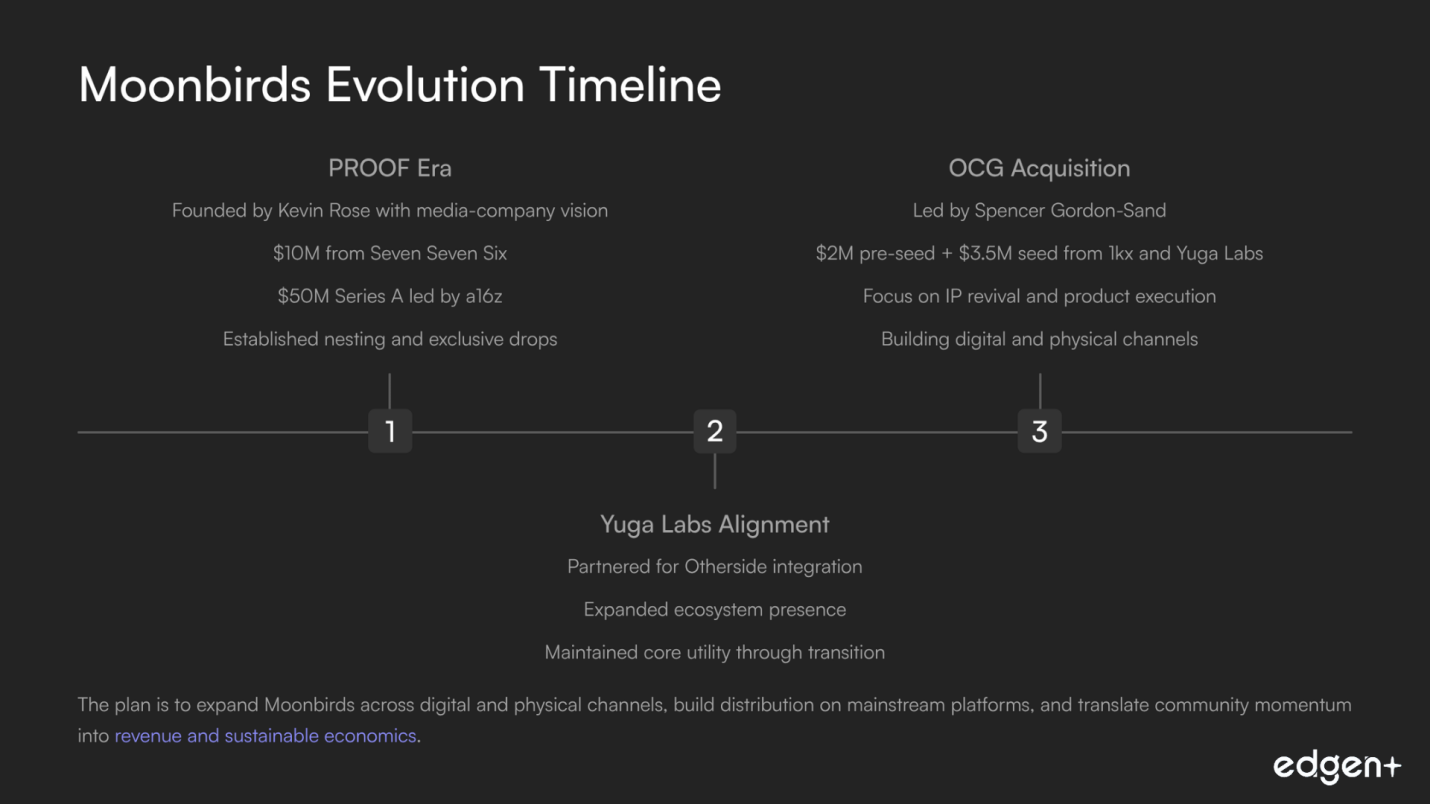
战略在三个时代不断演变,从 PROOF 到 Yuga 再到 OCG,最终聚焦于一个使命:复兴 IP,激活社区,并交付产品。

投资者支持也反映了这一历程,从 a16z 支持 PROOF 的媒体理论,到 1kx 和 Yuga Labs 共同牵头 OCG 的种子轮融资,使资本与转型计划保持一致。
2. 卓越的团队和执行力

  • 由首席执行官 Spencer Gordon-Sand 领导的运营执行,他是一位早期的 NFT 投资者和著名的社区领导者,拥有丰富的实际产品经验。
  • Vibes TCG 展示了实体和数字执行能力,以及通过亚洲制造能力实现生产和规模化的运营路径。

3. 资本实力和认可

历史融资包括 Seven Seven Six 提供的 1000 万美元,以及由 a16z 牵头并有顶级参与者加入的 5000 万美元 A 轮融资。

如今,OCG 获得了 1kx 和 Yuga Labs 提供的 350 万美元种子轮融资(此前还有 200 万美元 Pre-seed 轮融资)的支持,并辅以 Vibes 的收入。这为其提供了健康的、以执行为重点的发展空间。

4. 市场机遇和契合度

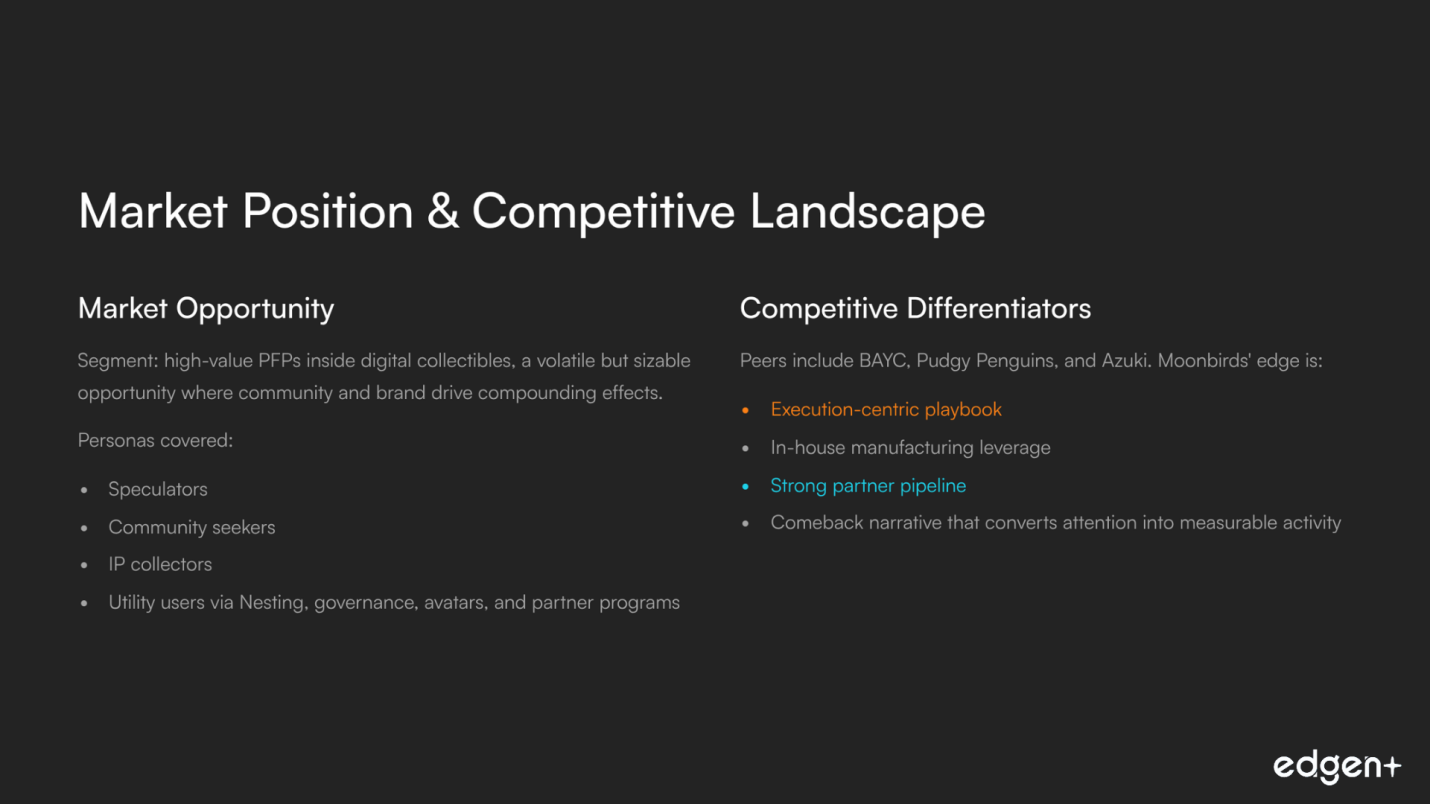
  • 细分市场:数字收藏品中的高价值 PFP,这是一个波动但规模可观的机会,社区和品牌在此推动复合效应。
  • 覆盖人群:投机者、社区寻求者、IP 收藏者和通过“筑巢”、治理、头像和合作伙伴计划的实用工具使用者。


5. 竞争格局与差异化

同行包括 BAYC、Pudgy Penguins 和 Azuki。Moonbirds 的优势在于以执行为中心的策略、内部制造优势、强大的合作伙伴渠道以及一个将关注度转化为可衡量活动的回归叙事。

基础结论: 卓越的基础实力,拥有目标一致的投资者、务实的运营者和产品主导的路线图。
二、预发布生态系统与上市策略

1. 社区与叙事势头

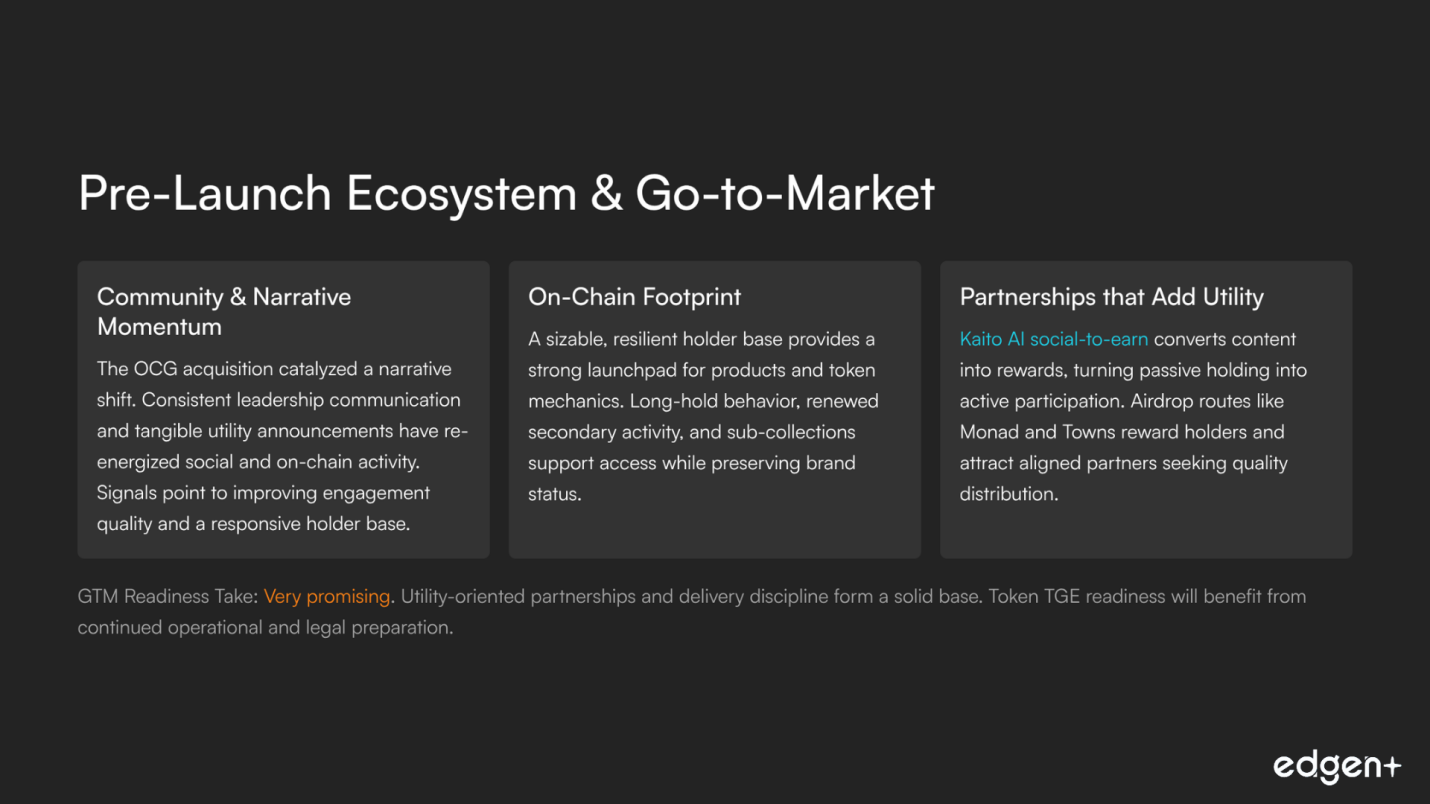
OCG 的收购催化了叙事转变。持续的领导层沟通和 Kaito AI 等切实可行的实用工具公告,重新激发了社交和链上活动。信号表明参与质量正在提高,持有者基础反应积极。

2. 链上足迹

一个规模庞大且具有韧性的持有者基础为产品和代币机制提供了强大的启动平台。长期持有行为、重新活跃的二级市场活动和子收藏品支持访问,同时保持品牌地位。

3. 增加实用性的合作伙伴关系

  • Kaito AI 社交赚取将内容转化为奖励,将被动持有转化为主动参与和发现。
  • Monad 和 Towns 等空投渠道奖励持有者并吸引寻求高质量分销的合作伙伴;Otherside 就绪的 3D 头像扩展了跨生态系统的实用性。

4. 代币经济学和价值积累(当前)

  • “筑巢”创造了基于时间的奖励,支持持有行为,并为未来的 $TALONS 代币做好准备。
  • 通过 Lunar Society 进行的治理将影响力与核心 NFT 和金库联系起来,从而增强了参与者与品牌之间的长期一致性。

上市准备度结论:非常有前景。以实用性为导向的合作关系和交付纪律构成了坚实的基础。代币 TGE 准备度将受益于持续的运营和法律准备。
三、前瞻性分析(催化剂和机会)

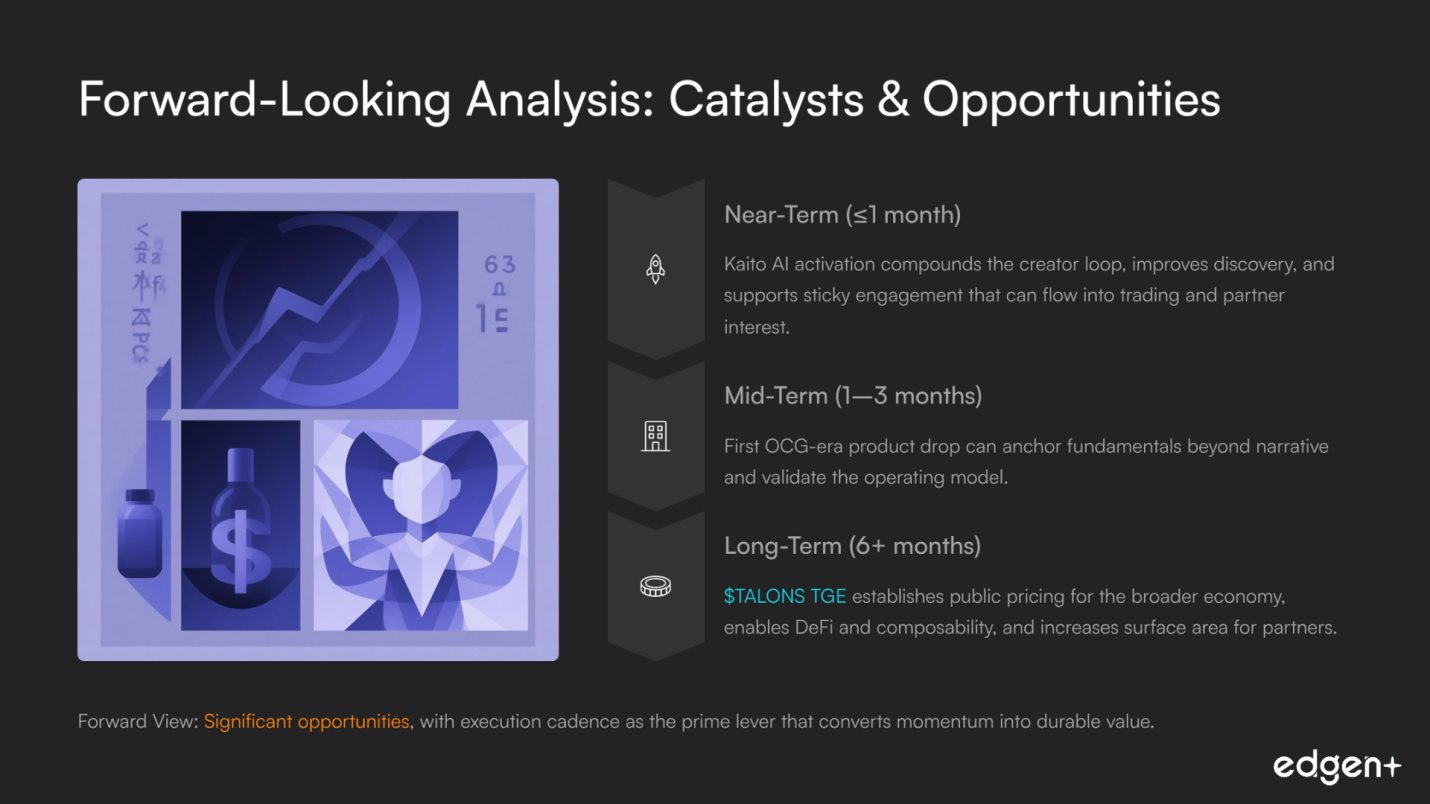
短期(≤1个月)

Kaito AI 激活增强了创作者循环,提高了发现度,并支持粘性互动,从而促进交易和合作伙伴兴趣。

中期(1-3个月)

OCG 时代的首款产品发布可以巩固超越叙事的基本面,并验证运营模式。

长期(6个月以上)

$TALONS TGE 为更广泛的经济确立了公开定价,实现了 DeFi 和可组合性,并增加了与合作伙伴的合作空间。

前瞻性观点: 存在重大机遇,执行节奏是 TGE 将动力转化为持久价值的主要杠杆。
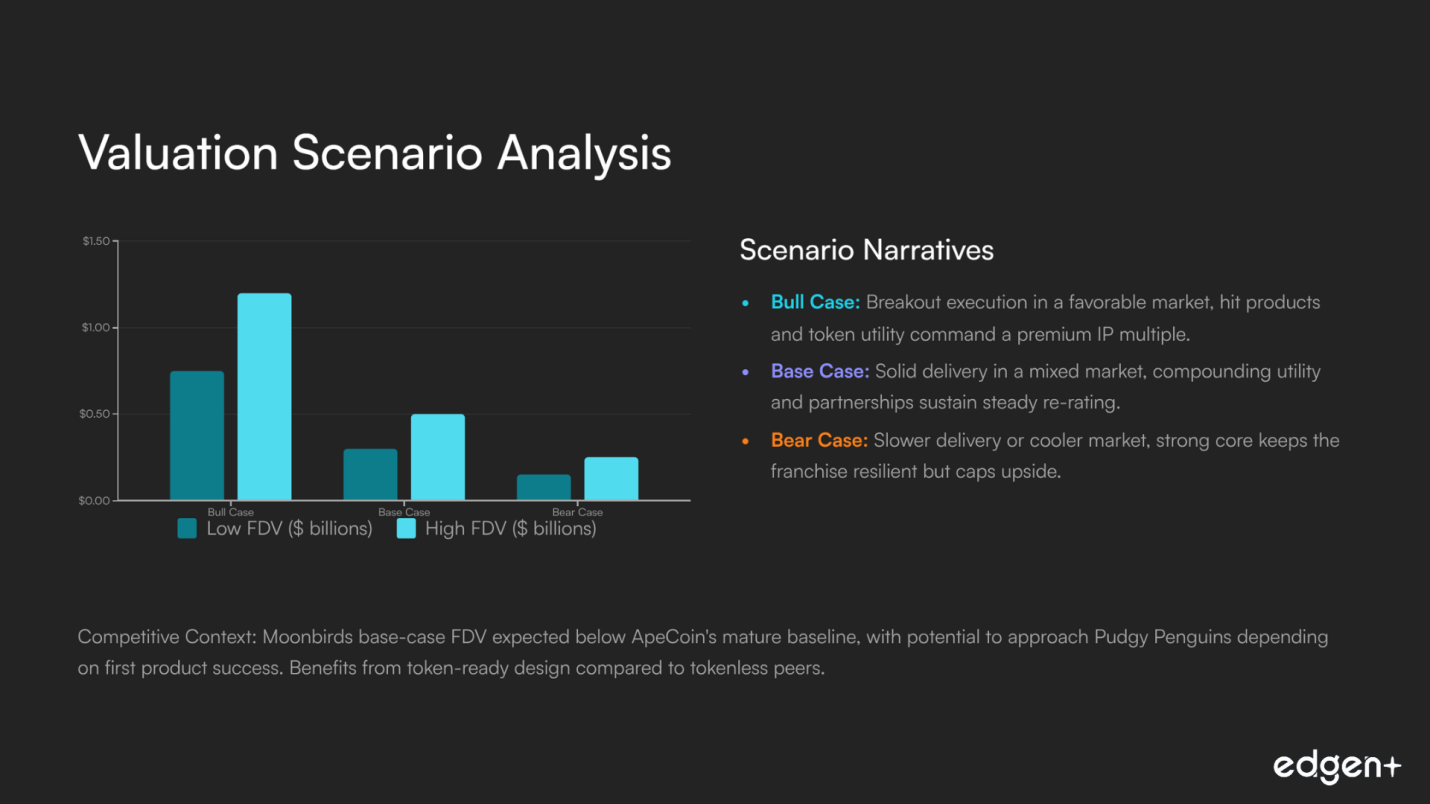
四、估值情景分析 (TGE FDV)

情景

完全稀释估值 (FDV) (数十亿美元)

简要说明

牛市情景

0.75 – 1.20

在有利的市场中取得突破性执行,热门产品和代币效用带来了高溢价的 IP 倍数。

基础情景

0.30 – 0.50

在混合市场中稳健交付,复合效用和合作伙伴关系维持稳定重估。

熊市情景

0.15 – 0.25

交付缓慢或市场降温,强大的核心使特许经营权保持韧性,但限制了上涨空间。

竞争对手格局(TGE 时或临近 TGE 的代币视角)

项目

代币

TGE/代币视角

持有者关联

分发方式

与 Moonbirds 的定位(基础情景)

ApeCoin / Otherside

$APE

生态系统效用和治理

BAYC 关联

空投加上市

Moonbirds 基础情景的 FDV 预计低于 $APE 的成熟基线,与 Yuga 的战略联系是增值的。

Pudgy Penguins

$PENGU

IP、玩具和游戏飞轮

Penguin 持有者

社区导向

Moonbirds 基础情景的 FDV 接近或低于 $PENGU,取决于首个产品的成功。

Azuki

(无)

品牌和动漫导向的 IP

收藏驱动

不适用

无代币的同类基准,Moonbirds 受益于为额外价值积累而设计的代币化。

最终结论

Moonbirds 作为一项专业运营的 IP 复兴项目,具有真实的社区根基和实际的产品路径,显示出巨大的潜力。凭借精英投资者的支持和早期的效用吸引力,该项目看起来非常有前景。执行的速度和质量仍然是解锁估值范围上限的关键。

教育内容,非财务建议。

推荐阅读
Redeem miles for gift cards and each is worth ~1 cent; redeem for long-haul business and they're worth 2.5-4+. With programs now dynamically priced, the one check that decides every redemption.

How to redeem airline miles without wasting them

The single biggest mistake with miles is redeeming them for the easy stuff: gift cards, merchandise, seat upgrades at the gate. Do that and each mile is worth about one cent. Redeem the *same* miles for flights, especially long-haul or premium-cabin flights, and they're often worth two to five cents each, sometimes more. So the real skill isn't earning miles; it's not throwing away their value at the finish line. Here's how to actually use them. A mile has no fixed price; its value depends entirely on what you redeem it for. The way to judge any redemption is simple math: (cash price of the flight) ÷ (miles it costs) = cents per mile. If a flight costs $400 or 20,000 miles, that's 2 cents a mile, a solid deal. If a $90 flight costs 18,000 miles, that's half a cent, which is terrible; pay cash and keep the miles. Run this check before every redemption. It instantly separates a great use from a waste, and it's the one habit that makes miles worth having. As a rule of thumb, most major ai
Edgen
·
Jun 30 2026
Short-term goals (under ~3 years) belong in safe cash; long-term goals (5+ years) can take market risk. The best HYSAs now pay ~4-5% APY. How to sort yours and run both.

Long-term vs short-term financial goals (and how to plan both)

The difference comes down to one thing: time. A short-term goal is money you'll need within roughly three years (an emergency fund, a trip, a wedding, next year's tax bill), so it has to be *safe and reachable*. A long-term goal is five-plus years out (retirement, a house down the road, a kid's education), so it can take market risk, because time smooths the bumps out. Get that match right and you've done most of the work. It's not the size, it's the deadline. A $2,000 goal you need in six months is short-term; a $2,000 goal you won't touch for fifteen years is long-term, and they belong in completely different places. This is the part that actually matters, and where people lose money without realizing it. Short-term money should not be in the stock market. If your emergency fund is in stocks and the market drops 20% the same month your car dies, you're selling at the worst possible time. Short-term goals go somewhere stable and accessible, and a high-yield savings account is the clas
Edgen
·
Jun 30 2026
Mortgages near 6.5%, home prices flat, and the Fed split on rate cuts vs hikes. With timing a coin flip, the 3 questions that actually decide whether to buy now or wait.

Should you buy a house now or wait? How to actually decide

The honest answer: buy when you'll stay put for at least five years and you'll still have an emergency fund left after the down payment. Otherwise, waiting (and renting) is often the smarter money move, not the weaker one. "Rent vs buy" isn't a math problem with one right answer, and it's almost never really about timing the market. It's about your *life*, in three questions. Before the three questions, here's the mid-2026 backdrop — because "now or wait" usually hides a bet on rates and prices, and the data says that bet is a coin flip. The picture: mortgages are still pricey, prices have gone flat (more than half of the 20 big metros saw year-over-year declines in March), and the cheap-money era hasn't returned. So "buy before it runs away" and "wait for the crash" are *both* weak arguments right now. The whole "wait for rates to drop" plan rests on the Fed, and the Fed is split down the middle. In its June 2026 projections, policymakers were divided: 8 expected no change this year,
Edgen
·
Jun 30 2026
Most financial goals fail because they're wishes, not systems. Here's the 3-part anatomy of a goal that sticks (a number, a date, one automatic move), plus why 37% of adults can't cover a $400 surprise.

How to set financial goals you'll actually hit

A financial goal you'll actually hit has three things a vague wish doesn't: a number, a date, and one automatic move that happens whether or not you remember it. "Save more" is a wish. "$6,000 in a separate account by next December, $500 auto-transferred on payday" is a goal. The gap between those two sentences is the reason most goals quietly die, and it has almost nothing to do with willpower. Key Takeaways A real financial goal answers three questions: how much, by when, and what for. Drop any one and it stops working. "Pay off debt" has no number and no date, so there's nothing to aim at or measure, while "$8,000 of card debt cleared in 18 months" tells you exactly whether you're on track and the day you're done. The "what for" matters more than people expect. A goal tied to something real (a buffer so a bad month isn't a crisis, a deposit on a first place) survives the months when motivation dips. In our experience reading how people actually use a money tool, the goals that get
Edgen
·
Jun 30 2026
A big RSU grant just vested — now what? Here's what a modern money tool actually surfaces first, using Ed as a worked example: a reality check, the 22% tax gap most high earners miss, and the concentration risk nobody flags.

Your RSUs Just Vested. Here's What a Money Tool Surfaces First.

You just had a big RSU grant vest. Congratulations — and now the awkward part: a six-figure pile of your own company's stock, a vague sense you should "do something," and no one actually telling you what. An advisor, a spreadsheet, and a piece of software each handle this moment differently. Here's what a modern money tool surfaces in a moment like this — using Ed as a worked example — so you can decide what kind of help actually fits. Key takeaways You connect your brokerage and bank through read-only aggregation, so the tool can read balances but can't move a dollar. Ed's framing is simple: precise about your money, blind to your identity. Instead of sorting your lattes into categories, Ed opens on a single Financial Reality Check — a read on whether your money could survive a bad month. For a lot of high earners, that one number lands harder than any budget, because it answers a question the other apps never ask. (If the Reality Check is the numbers side, your money type is the beha
Edgen
·
Jun 26 2026
A money personality test is more than a quiz if it measures behavior, not just vibes. Here's the science behind money types, how Ed's test works, and how to use your result.

What Is a Money Personality Test? The Science Behind Your Money Type

The short version: a good money personality test should feel like a roast and work like a mirror — fun on the surface, behavioral underneath. The useful ones don't tell you what you know; they show you how you act with money, and the one blind spot worth watching. Key takeaways Here's the uncomfortable backdrop. U.S. financial literacy has been stuck for a decade — adults answer only about 49% of the standard knowledge questions correctly, essentially flat since 2017 (TIAA Institute–GFLEC, 2025) — even as free financial information became infinite. If facts fixed money, they'd have fixed it by now. They don't, because the thing that actually drives your outcomes lives one level below the facts: how you're wired to behave when money is on the line. That's the whole premise of financial fitness — and it's what a money personality test is built to surface. Not what you know. What you do. The idea has real research behind it — money behavior is patterned and measurable, and a few tradition
Edgen
·
Jun 23 2026
A financial reality check scores where you actually stand across safety, control, progress, upside, and Mental Load. Here's why a money score matters, how Ed's checkup works, and what to do with your weakest area.

What Is a Financial Reality Check? Why Your Credit Score Isn't Enough

The short version: your credit score measures how safe you are to lend to. Almost nobody has ever seen the number that measures whether you are actually secure. A financial reality check is that second number. Key takeaways Ask people for their credit score and many can recite it. Ask whether they could survive three months without income, or where their money quietly leaks each month, and you get a shrug. That's the gap. A credit score answers a lender's question — how risky is it to extend this person debt? It can be high while your life is fragile, or low while you're genuinely fine, because it was never built to measure you. A financial reality check answers the question the credit score ignores: are you safe, clear, progressing, building, and at ease? Here's the simple version, with the research behind each axis.
Edgen
·
Jun 23 2026
SpaceX 将于 6/12 在 Nasdaq 挂牌,定价每股 135 美元、估值 1.77 万亿美元,史上最大 IPO。但仅 4.2% 股份实际流通,Musk 锁仓 366 天。未来 366 天的走势由一份解锁时间表主导,以下是 13 个关键日期。

SpaceX 6/12 挂牌估值 1.77 万亿美元 冲向 5 万亿美元的 13 个关键日期

SpaceX 将于本周四(6 月 12 日)正式在 Nasdaq 挂牌,定价每股 135 美元,估值约 1.77 万亿美元,为史上最大规模的 IPO。相比华尔街热议的"冲向 5 万亿美元"多头目标,真正主宰未来一年股价走势的,是一份结构异常清晰的供给释放时间表。 据 Bloomberg 与 Reuters 报道,本次 IPO 订单簿需求达 2,500 亿美元,约为实际发行量的 3.5 至 4 倍。Goldman Sachs 领衔承销,连同其他 22 家顶级投行共同操盘。值得关注的是,Day 1 仅有 4.2% 股份实际流通交易;Musk 本人持股锁仓长达 366 天,其他内部人须等到第 180 天才完全解锁。换言之,接下来半年市场上可实际交易的股票极为有限,而这份解锁时间表是公开披露的。把这份日历看明白,等于提前掌握下个季度大部分财经评论还在试图解释的市场结构。 近期关于 SpaceX IPO 的报道,有两个说法在仔细审视后并不成立。 第一,所谓"指数基金将被迫一次性大举买入 SpaceX"并非事实。Nasdaq 确实开启快速纳入机制,允许 SpaceX 在挂牌后 15 个交易日内纳入 Nasdaq 100,但同一条规则对低流通标的设下权重上限:以流通量的 3 倍为顶。对流通比例仅 4.2% 的 SpaceX 而言,有效权重约为市值的 12.6%。分析师对整个纳入过程的净流入估算,落在 100 至 200 亿美元之间,属于持续性顺风,而非一次性事件。 第二,S&P 500 纳入不会很快发生。S&P Global 已明确拒绝为旗舰指数修改规则,SpaceX 最快也要等到 2027 年中之后才符合资格,且须先连续四季 GAAP 盈利。考虑到 Starship 一年烧掉 30 亿美元研发、公司营业利益仍为负值,最早实际纳入时点落在 2027 年下半,等于把规模最大的被动买盘事件推迟至 2026 年锁仓悬崖之后。
Edgen
·
Jun 10 2026

投资这事,终于不用一个人了

免费试用 Ed。不用信用卡,不绑约