Content
Ether.fi : Bilan du T3 2025 – Architecture de la néobanque DeF...
En bref
Fondamentaux du projet
Qu'est-ce qu'Ether.fi ?
Pivot stratégique vers la néobanque DeFi
Expansion stratégique : Ether.fi Liquid et Cash
Équipe et bailleurs de fonds
Analyse On-Chain et de la Profondeur de Marché
Produit phare : eETH
Valorisation et position concurrentielle
Scénarios de prévision TGE
Paysage concurrentiel
Points clés
Prochaines étapes

Markets Confusing? Ask Edgen Search.

Instant answers, zero BS, and trading decisions your future self will thank you for.

Try Search Now

Ether.fi : Bilan du T3 2025 – Architecture de la néobanque DeFi

· Mar 31 2026
Ether.fi : Bilan du T3 2025 – Architecture de la néobanque DeFi

Ether.fi : Bilan du T3 2025 – Architecture de la néobanque DeFi

Ether.fi(ETHFI) est un protocole de staking liquide décentralisé majeur avec 9,7 milliards de dollars de TVL en octobre 2025, ce qui en fait l'un des plus grands protocoles DeFi. La plateforme offre des services de staking d'ETH de qualité institutionnelle et s'est étendue à la banque de cryptomonnaies avec des retours d'utilisateurs positifs.

En bref

  • Leader du restaking liquide non dépositaire avec des clés de validation contrôlées par l'utilisateur.
  • Extension vers des services bancaires DeFi complets via Ether.fi Liquid et Cash.
  • Relier les rendements DeFi à des usages concrets grâce à un écosystème à forte efficacité capitalistique.
  • Accélération de la croissance via les rachats, les institutions et une feuille de route claire.

Fondamentaux du projet

Qu'est-ce qu'Ether.fi ?

Ether.fi est un protocole de staking liquide décentralisé et non dépositaire construit sur Ethereum. Il permet aux utilisateurs de staker leur ETH pour gagner des récompenses tout en conservant le contrôle de leurs clés privées, un différenciateur clé dans l'espace du staking liquide.

Lorsque les utilisateurs stakent, ils mintent des eETH, un jeton de restaking liquide (LRT) qui peut être utilisé dans tout l'écosystème DeFi pour générer des rendements supplémentaires. Le protocole s'intègre nativement à EigenLayer, permettant aux actifs stakés d'être «restakés» pour sécuriser d'autres réseaux, amplifiant ainsi le potentiel de rendement.

En simplifiant le processus de staking non dépositaire et en offrant des produits innovants, Ether.fi vise à fournir une expérience financière fluide et sécurisée qui comble le fossé entre la DeFi et la finance traditionnelle.

Pivot stratégique vers la néobanque DeFi

Ether.fi évolue stratégiquement de ses origines en tant que protocole de restaking liquide décentralisé vers une néobanque DeFi complète. L'écosystème est structuré autour de trois produits centraux analogues aux services bancaires traditionnels : « Stake » fonctionne comme un compte d'épargne, « Liquid » comme un compte d'investissement et « Cash » comme un outil de dépense et d'emprunt.

Cette vision s'étend au-delà du marché DeFi central pour cibler les secteurs plus vastes de la CeFi et des néobanques, qui représentent respectivement une base d'utilisateurs de 30 à 50 millions et une valorisation boursière de 176 milliards de dollars. La croissance impressionnante du protocole, marquée par une Valeur Totale Verrouillée (TVL) qui a atteint 6,86 milliards de dollars en mai 2025, démontre une forte adéquation produit-marché et fournit une base solide pour cette expansion. Les projections pour 2025 estiment un revenu total entre 65 millions et 96 millions de dollars, ce qui indique une traction commerciale significative pour son modèle de services financiers intégrés.

Expansion stratégique : Ether.fi Liquid et Cash

S'appuyant sur sa base de staking, Ether.fi a lancé deux nouvelles lignes de produits pour créer une plateforme financière complète.

  • Ether.fi Liquid : Ce produit propose des coffres-forts de stratégie DeFi automatisés pour une variété d'actifs, y compris l'ETH, le BTC et les stablecoins. Il devrait générer 28 millions de dollars de revenus en 2025, démontrant son potentiel en tant que moteur de croissance significatif.
  • Ether.fi Cash : Lancé en avril 2025, ce produit est une carte de crédit native crypto et un portefeuille intelligent qui permet aux utilisateurs de dépenser contre leurs actifs stakés sans les vendre. Il a déjà atteint une traction notable, traitant plus de 10 millions de dollars en volumes quotidiens en juin 2025, et devrait générer plus de 60 millions de dollars de revenus au cours de sa deuxième année.

Équipe et bailleurs de fonds

Ether.fi a obtenu un soutien et une validation significatifs de la part d'investisseurs institutionnels et de participants influents du marché. Le projet a levé 32,3 millions de dollars sur trois tours de financement, fournissant un capital substantiel pour la croissance et le développement.

Tour de financement

Date

Montant levé

Investisseurs principaux

Autres investisseurs notables

Série A

Fév/Mars 2024

23M à 27M $

Bullish Capital, CoinFund

OKX Ventures, Foresight Ventures, Consensys, Amber, Selini, Draper Dragon, Bankless Ventures, et fondateurs/dirigeants de Aave, Polygon, Kraken, Curve, Ethena, et DeFi Llama.

Tour de pré-amorçage

T1 2023

5,3 Millions $

North Island Ventures, Chapter One

Maelstrom (fonds d'Arthur Hayes), Node Capital, Arrington Capital, Version One Ventures, Purpose Investments.

Tour non annoncé/SAFE

Fin 2023

4 Millions $

Analyse On-Chain et de la Profondeur de Marché

Modèle de jeton robuste et mécanisme de rachat

Le jeton ETHFI est essentiel au modèle de gouvernance et économique du protocole. Avec une offre maximale de 1 milliard de jetons, l'allocation est structurée pour aligner les intérêts de toutes les parties prenantes, y compris les investisseurs, l'équipe principale et la communauté.

Catégorie d'allocation

Pourcentage

Investisseurs

33.74%

Trésorerie

21.62%

Contributeurs principaux

21.47%

Airdrops utilisateurs

19.27%

Partenariats & Liquidité

3.90%

Une caractéristique clé de la conception économique du jeton est l'engagement du protocole à utiliser 25 % de tous les revenus pour les rachats de jetons. Ce mécanisme est conçu pour réduire l'offre en circulation et restituer de la valeur aux détenteurs de jetons, créant ainsi un moteur de demande durable pour l'ETHFI.

Produit phare : eETH

La proposition de valeur principale du protocole est son jeton de restaking liquide, eETH, qui permet aux utilisateurs de gagner des récompenses de staking et de restaking tout en maintenant la liquidité. Selon un récent rapport de 2025, l'eETH a une capitalisation boursière de 871,36 millions de dollars et un volume de transactions sur 24 heures de 113 751 dollars. La santé et l'adoption de l'eETH sont essentielles au succès à long terme d'Ether.fi, car c'est le principal moteur du TVL et des revenus du protocole.

Valorisation et position concurrentielle

Scénarios de prévision TGE

Sur la base de l'analyse de marché et des projections de croissance, les scénarios suivants décrivent les fourchettes de valorisation potentielles pour la Valorisation Entièrement Diluée (FDV) d'Ether.fi au cours des 6 à 18 prochains mois.

Scénario

Fourchette de FDV (USD)

Narratif

Cas haussier

2,5 Mds $ – 3,5 Mds $

Supposons une exécution réussie de la stratégie de néobanque DeFi, une forte croissance des revenus des produits Liquid et Cash, et des conditions de marché favorables.

Cas de base

1,1 Md $ – 1,8 Md $

Reflète une croissance continue du TVL et une adoption stable des nouveaux produits, le protocole consolidant sa position de leader sur le marché du restaking.

Cas baissier

0,9 Md $ – 1,1 Md $

Considère des vents contraires potentiels sur le marché, une concurrence accrue ou une adoption plus lente que prévu des nouveaux produits, conduisant à une appréciation des prix plus modérée.

Paysage concurrentiel

Ether.fi est un projet de premier plan dans le secteur du restaking liquide en pleine croissance. Comparée à ses pairs, sa capitalisation boursière reflète une forte position concurrentielle avec une marge de croissance significative.

Jeton

Symbole

Capitalisation boursière

eETH enveloppé

weETH

10,43 Mds $

Kelp DAO Restaked ETH

rsETH

1,54 Md $

Renzo Restaked ETH

ezETH

1,22 Md $

Ether.fi

ETHFI

0,55 Md $

Points clés

  • Ether.fi réussit sa transition d'un protocole de staking à une néobanque DeFi intégrée, créant de multiples sources de revenus et une base d'utilisateurs plus fidélisée.
  • Le modèle non dépositaire du protocole et les clés contrôlées par l'utilisateur offrent un avantage convaincant en matière de sécurité et de décentralisation par rapport aux concurrents.
  • Une forte croissance des revenus, un programme robuste de rachat de jetons et une adoption institutionnelle croissante constituent de puissants vents arrière pour une future appréciation de la valorisation.

Prochaines étapes

  • Surveiller la croissance des revenus d'Ether.fi Liquid et Ether.fi Cash, car ils sont essentiels pour valider la thèse de la banque DeFi.
  • Suivre l'exécution du programme de rachat de jetons et son impact sur l'offre en circulation de l'ETHFI.

Recommend
Redeem miles for gift cards and each is worth ~1 cent; redeem for long-haul business and they're worth 2.5-4+. With programs now dynamically priced, the one check that decides every redemption.

How to redeem airline miles without wasting them

The single biggest mistake with miles is redeeming them for the easy stuff: gift cards, merchandise, seat upgrades at the gate. Do that and each mile is worth about one cent. Redeem the *same* miles for flights, especially long-haul or premium-cabin flights, and they're often worth two to five cents each, sometimes more. So the real skill isn't earning miles; it's not throwing away their value at the finish line. Here's how to actually use them. A mile has no fixed price; its value depends entirely on what you redeem it for. The way to judge any redemption is simple math: (cash price of the flight) ÷ (miles it costs) = cents per mile. If a flight costs $400 or 20,000 miles, that's 2 cents a mile, a solid deal. If a $90 flight costs 18,000 miles, that's half a cent, which is terrible; pay cash and keep the miles. Run this check before every redemption. It instantly separates a great use from a waste, and it's the one habit that makes miles worth having. As a rule of thumb, most major ai
Edgen
·
Jun 30 2026
Short-term goals (under ~3 years) belong in safe cash; long-term goals (5+ years) can take market risk. The best HYSAs now pay ~4-5% APY. How to sort yours and run both.

Long-term vs short-term financial goals (and how to plan both)

The difference comes down to one thing: time. A short-term goal is money you'll need within roughly three years (an emergency fund, a trip, a wedding, next year's tax bill), so it has to be *safe and reachable*. A long-term goal is five-plus years out (retirement, a house down the road, a kid's education), so it can take market risk, because time smooths the bumps out. Get that match right and you've done most of the work. It's not the size, it's the deadline. A $2,000 goal you need in six months is short-term; a $2,000 goal you won't touch for fifteen years is long-term, and they belong in completely different places. This is the part that actually matters, and where people lose money without realizing it. Short-term money should not be in the stock market. If your emergency fund is in stocks and the market drops 20% the same month your car dies, you're selling at the worst possible time. Short-term goals go somewhere stable and accessible, and a high-yield savings account is the clas
Edgen
·
Jun 30 2026
Mortgages near 6.5%, home prices flat, and the Fed split on rate cuts vs hikes. With timing a coin flip, the 3 questions that actually decide whether to buy now or wait.

Should you buy a house now or wait? How to actually decide

The honest answer: buy when you'll stay put for at least five years and you'll still have an emergency fund left after the down payment. Otherwise, waiting (and renting) is often the smarter money move, not the weaker one. "Rent vs buy" isn't a math problem with one right answer, and it's almost never really about timing the market. It's about your *life*, in three questions. Before the three questions, here's the mid-2026 backdrop — because "now or wait" usually hides a bet on rates and prices, and the data says that bet is a coin flip. The picture: mortgages are still pricey, prices have gone flat (more than half of the 20 big metros saw year-over-year declines in March), and the cheap-money era hasn't returned. So "buy before it runs away" and "wait for the crash" are *both* weak arguments right now. The whole "wait for rates to drop" plan rests on the Fed, and the Fed is split down the middle. In its June 2026 projections, policymakers were divided: 8 expected no change this year,
Edgen
·
Jun 30 2026
Most financial goals fail because they're wishes, not systems. Here's the 3-part anatomy of a goal that sticks (a number, a date, one automatic move), plus why 37% of adults can't cover a $400 surprise.

How to set financial goals you'll actually hit

A financial goal you'll actually hit has three things a vague wish doesn't: a number, a date, and one automatic move that happens whether or not you remember it. "Save more" is a wish. "$6,000 in a separate account by next December, $500 auto-transferred on payday" is a goal. The gap between those two sentences is the reason most goals quietly die, and it has almost nothing to do with willpower. Key Takeaways A real financial goal answers three questions: how much, by when, and what for. Drop any one and it stops working. "Pay off debt" has no number and no date, so there's nothing to aim at or measure, while "$8,000 of card debt cleared in 18 months" tells you exactly whether you're on track and the day you're done. The "what for" matters more than people expect. A goal tied to something real (a buffer so a bad month isn't a crisis, a deposit on a first place) survives the months when motivation dips. In our experience reading how people actually use a money tool, the goals that get
Edgen
·
Jun 30 2026
A big RSU grant just vested — now what? Here's what a modern money tool actually surfaces first, using Ed as a worked example: a reality check, the 22% tax gap most high earners miss, and the concentration risk nobody flags.

Your RSUs Just Vested. Here's What a Money Tool Surfaces First.

You just had a big RSU grant vest. Congratulations — and now the awkward part: a six-figure pile of your own company's stock, a vague sense you should "do something," and no one actually telling you what. An advisor, a spreadsheet, and a piece of software each handle this moment differently. Here's what a modern money tool surfaces in a moment like this — using Ed as a worked example — so you can decide what kind of help actually fits. Key takeaways You connect your brokerage and bank through read-only aggregation, so the tool can read balances but can't move a dollar. Ed's framing is simple: precise about your money, blind to your identity. Instead of sorting your lattes into categories, Ed opens on a single Financial Reality Check — a read on whether your money could survive a bad month. For a lot of high earners, that one number lands harder than any budget, because it answers a question the other apps never ask. (If the Reality Check is the numbers side, your money type is the beha
Edgen
·
Jun 26 2026
A money personality test is more than a quiz if it measures behavior, not just vibes. Here's the science behind money types, how Ed's test works, and how to use your result.

What Is a Money Personality Test? The Science Behind Your Money Type

The short version: a good money personality test should feel like a roast and work like a mirror — fun on the surface, behavioral underneath. The useful ones don't tell you what you know; they show you how you act with money, and the one blind spot worth watching. Key takeaways Here's the uncomfortable backdrop. U.S. financial literacy has been stuck for a decade — adults answer only about 49% of the standard knowledge questions correctly, essentially flat since 2017 (TIAA Institute–GFLEC, 2025) — even as free financial information became infinite. If facts fixed money, they'd have fixed it by now. They don't, because the thing that actually drives your outcomes lives one level below the facts: how you're wired to behave when money is on the line. That's the whole premise of financial fitness — and it's what a money personality test is built to surface. Not what you know. What you do. The idea has real research behind it — money behavior is patterned and measurable, and a few tradition
Edgen
·
Jun 23 2026
A financial reality check scores where you actually stand across safety, control, progress, upside, and Mental Load. Here's why a money score matters, how Ed's checkup works, and what to do with your weakest area.

What Is a Financial Reality Check? Why Your Credit Score Isn't Enough

The short version: your credit score measures how safe you are to lend to. Almost nobody has ever seen the number that measures whether you are actually secure. A financial reality check is that second number. Key takeaways Ask people for their credit score and many can recite it. Ask whether they could survive three months without income, or where their money quietly leaks each month, and you get a shrug. That's the gap. A credit score answers a lender's question — how risky is it to extend this person debt? It can be high while your life is fragile, or low while you're genuinely fine, because it was never built to measure you. A financial reality check answers the question the credit score ignores: are you safe, clear, progressing, building, and at ease? Here's the simple version, with the research behind each axis.
Edgen
·
Jun 23 2026
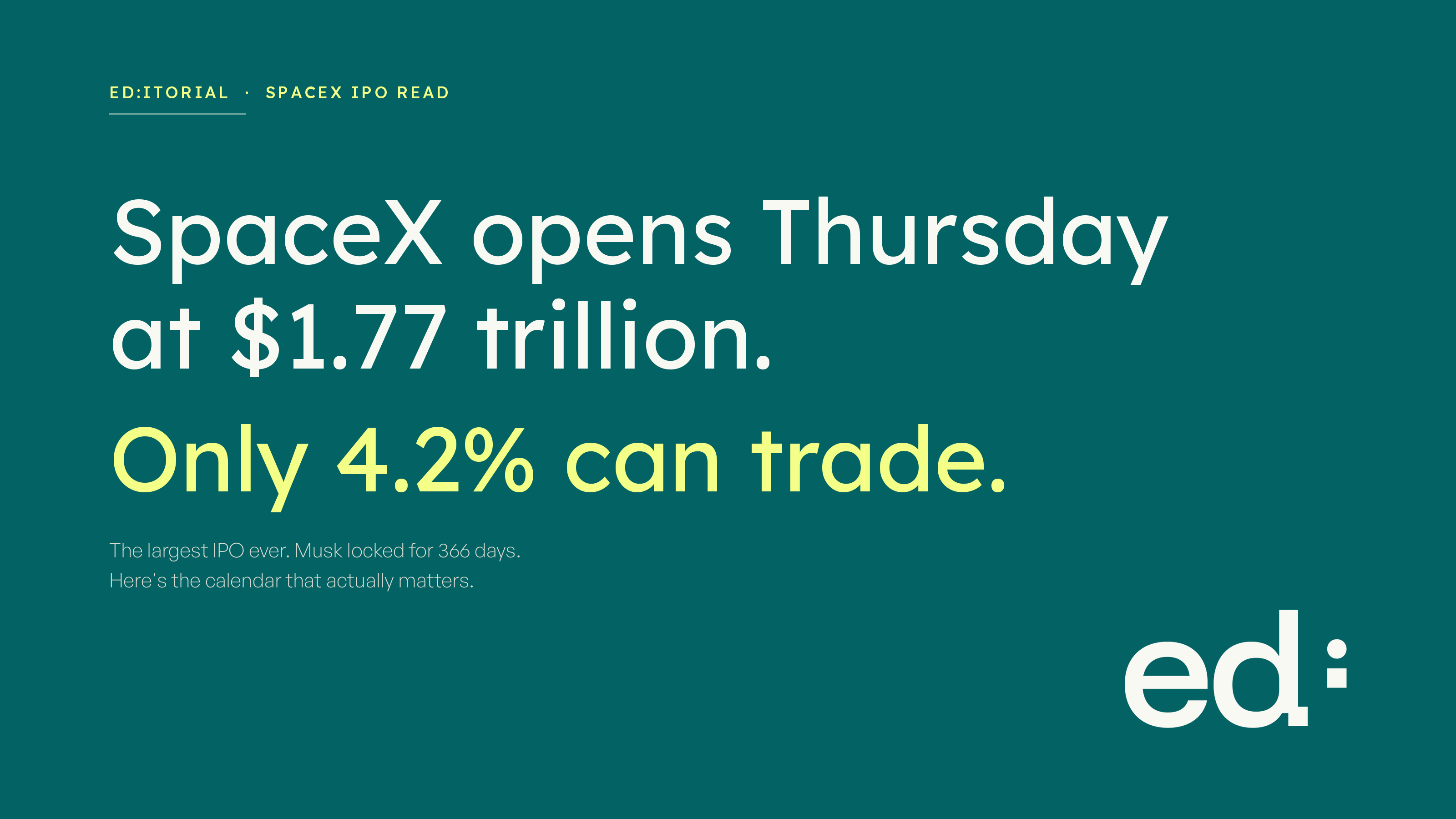
SpaceX opens Thursday at a $1.77 trillion valuation — the largest IPO ever. Only 4.2% of stock actually trades. Musk is locked up for 366 days. The next 366 days run on an unusually clean calendar of supply releases. Here are the 13 dates worth watching.

SpaceX goes public Thursday with a possible $5 trillion hit. Here's the calendar that actually matters.

SpaceX prices Wednesday night and opens Thursday on Nasdaq at $135 per share — a $1.77 trillion valuation, the largest IPO ever. Most coverage will frame what comes next as a sentiment trade, an Elon story, or a race to Goldman's $5 trillion bull case. The reality is more grounded and more useful: the next 366 days are governed by an unusually clean calendar of supply releases — when 95.8% of the company can or cannot trade, when index funds add weight, when the lock-up cliff arrives, when Musk himself becomes a potential seller for the first time. Read the calendar and you've already understood the structure most market commentary will spend the next quarter trying to explain. Here are the 13 dates worth watching. Two things keep showing up in headlines that don't survive a careful read. The first is the idea that index funds are about to be forced into a massive single-event SpaceX buy. They aren't. Nasdaq did create a fast-track inclusion rule that lets SpaceX join the Nasdaq 100 wi
Edgen
·
Jun 10 2026

Investir, enfin, tu n'es plus seul.

Essaie Ed gratuitement. Sans carte, sans engagement.