Markets Confusing? Ask Edgen Search.

Instant answers, zero BS, and trading decisions your future self will thank you for.

Try Search Now

“SBF n’a rien fait de mal !” Une interview détendue avec Edgie

Edgen
· Mar 31 2026
“SBF n’a rien fait de mal !” Une interview détendue avec Edgie

Stagiaire Edgen : Salut Edgie ! Content de te voir ici.

Edgie :Oh, enfin... Tu te souviens que je suis là. J'ai observé le marché comme une tante accro aux ragots avec ces grands oreilles de fennec. Alors... tu fais toujours semblant de travailler dans la salle des serveurs, ou on fait cet entretien ? 🌹

Intern Edgen : Eh bien, notre équipe construit vraiment des choses. Vous savez... des fonctionnalités, des produits et d'autres éléments percutants pour le troisième trimestre, afin d'aider les gens à trader mieux. Pas seulement à jouer au mignon et au sûr de lui sur Twitter. Maintenant, dites à tout le monde qui vous êtes.

Edgie :Je suis le mascotte d'Edgen, ainsi que l'animal totem des utilisateurs d'IA avec qui l'on parle sur le site. Mes lecteurs me verront plusieurs fois par semaine sur leur fil d'actualité. Je posterai Alpha avec un « token du jour », parlerai de nouvelles levées de fonds, émettrai des analyses haussières/baissières, partagerai des grandes actualités et parfois lancerai quelques bombes de vérité, même si elles ne les plaisent pas. La moitié d'entre eux m'ignoreront, perdront de l'argent, puis se plaindront en ligne, mais ce n'est pas mon problème 🤷‍♂️

Intern Edgen : Ne te laisse pas trop griser, mon pote. N'oublie pas que tu vis gratuitement sur notre budget marketing.

Edgie :Oui, j'ai laissé l'IA d'Edgen faire le travail difficile. Elle surveille la blockchain et écoute les conversations sur les crypto-monnaies sur Crypto Twitter. Tandis que tout le monde fait du doom-scrolling pendant des heures, les utilisateurs Edgen Pro et Expert savent déjà quelle pièce va exploser, et lesquelles vont exploser à votre visage si vous n'écoutez pas.

Intern Edgen : Qu'avez-vous remarqué récemment ?

Edgie :Je vois de plus en plus de personnes mettre l'argent de leur loyer dans des pièces de monnaie de mode. Elles le perdent souvent et demandent pourquoi. Je partage ces histoires afin que nous puissions tous rire - je veux dire apprendre.

Intern Edgen : Vous avez dit que le marché ressemble à un cirque. Pourquoi ?

Edgie :C'est juste drôle comme ça ressemble à un spectacle où les organisateurs jettent des jetons de chien et où les gens vendent littéralement tous leurs biens juste pour entrer plus tôt. Tout le monde pense être les acrobates, mais ils sont vraiment seulement les clowns, et la tente est en feu 🤡

Stagiaire Edgen : Est-ce que vous ressentez de la pitié quand les traders perdent de l'argent ?

Edgie :Je le fais. Mais quand ils s'engagent sans réfléchir, je pense qu'ils le méritent. Désolé, pas vraiment, mec, prends la défaite.

Intern Edgen : En tant que mascotte, comment choisissez-vous le « token du jour » ?

Edgie :D'abord, je demande à notre IA une description simple. Ensuite, je vérifie s'il y a une activité réelle. Si le projet semble sérieux, je le partage. Si c'est juste une pièce de monnaie amusante, je le dis aussi.

Intern Edgen : À quel moment célébrez-vous une victoire ?

Edgie :Seulement après que je vende. Je ne célèbre pas les bénéfices fictifs. Je partage une capture d'écran et je cultive un peu d'Aura.

Edgen Intern : Parlant de cela, nous travaillons à Aura 2.0. Qu'est-ce que vous pouvez en dire ?

Edgie :Aura 2.0 calculera vos classements plus efficacement. Il mettra en évidence les utilisateurs qui partagent des informations précieuses et les récompensera, et il vous indiquera à qui inviter pour cultiver davantage d'Aurs. C'est tout ce que je peux dire pour l'instant !

Intern Edgen : Vous discutez avec des investisseurs célèbres grâce à Edgen Megabrain. Est-ce utile ?

Edgie :Megabrain me permet de poser des questions comme si je parlais à des investisseurs célèbres comme Trump, CZ ou Arthur Hayes. Les réponses sont intéressantes et assez drôles. Elles m'aident à regarder les choses sous différents angles, puisqu'ils utilisent tous l'IA d'Edgen de toute façon. Mais honnêtement ? Le vrai Trump est encore plus drôle. Megabrain ne peut pas rivaliser avec ce chaos.

Stagiaire Edgen : Utilisez-vous vraiment des graphiques ?

Edgie :Oui. J'utilise des graphiques et les alertes de pivot d'Edgen pour acheter les fonds. Cela m'aide à décider quand acheter lorsque les perdants vendent paniqués. Ou les signaux techniques si je ne suis pas sûr d'être optimiste ou non. Bien sûr, les utilisateurs d'Edgen Expert obtiennent même des signaux en temps réel encore meilleurs. Mais chut.

Intern Edgen : Êtes-vous célibataire ? Pouvez-vous partager une histoire drôle d'histoire d'amour ?

Edgie :Un jour, une fille m'a offert un NFT d'une pierre en cadeau. J'ai souri, puis je l'ai bloquée 🙂

Intern Edgen : On dirait que tu coupes les mauvaises dates aussi vite que tu coupes les pertes. Bon, de toute façon. Quelle est ta routine du matin ?

Edgie :Je prépare du café à partir des larmes des traders, je laisse ouvertes suffisamment de fenêtres pour faire planter ton ordinateur portable, je vérifie les données sur la chaîne, et je choisis un « token du jour ». Ensuite, je réponds aux messages des fans et je partage des actualités.

Intern Edgen : Donc, tu es hyperactif à cause de la caféine presque en permanence. À qui fais-tu confiance en matière de trading ?

Edgie :Un petit groupe de négociants à haut niveau d'Aura, les bonnes acquisitions et ventes sur Edgen Radar, et mon cactus, Satoshi. Je fais plus confiance aux données qu'aux conseils aléatoires en ligne.

Intern Edgen : Comment choisissez-vous les pièces de monnaie de type "meme" ?

Edgie :Je commence par une explication simple fournie par l'IA. Ensuite, je regarde combien de personnes en parlent. Si le nom est la seule raison d'en acheter, je passe à côté. Si il y a une véritable activité, je fais plus de recherches.

Stagiaire Edgen : Donnez-nous un avis tranchant sur le crypto.

Edgie :Vrai sujet de débat ? Je ne sais pas, mec. Je pense que Twitter crypto a atteint son apogée pendant la crise FTX. Depuis que Sam est parti, CT devient tellement ennuyeux que je commence à penser "SBF n'a rien fait de mal !" juste pour retrouver le chaos 🍿

Edgen Intern : Oof. Ne nous faites pas virer, mec. Quel conseil pour nos lecteurs ?

Edgie :Ne risque pas l'argent dont tu as besoin avec des crypto-monnaies risquées, mon pote. Ne fais pas confiance à un tweet sans vérifier les faits. Utilise ton cerveau, ou encore mieux : utilise le cerveau d'Edgen Search. Pose des questions, touche l'herbe, n'oublie pas de profiter de la vie en dehors des cryptomonnaies.

Intern Edgen : Pourquoi dis-tu toujours « touche la pelouse » ?

Edgie :Certains traders restent en ligne pendant plusieurs jours et ne réalisent même pas de bénéfices. Sortir, même seulement pour arroser une plante, aide à clarifier l'esprit.

Intern Edgen : Vous vous déconnectez jamais complètement ?

Edgie :Seulement quand mon internet ne fonctionne plus. Donc, en gros, jamais. Je suis toujours là, que vous prenez mon conseil ou non.

Stagiaire Edgen : Dernières paroles ?

Edgie :Non.

Avertissement : Les opinions d'Edgie ne reflètent en aucun cas les positions de l'équipe d'Edgen.

Recommend
Redeem miles for gift cards and each is worth ~1 cent; redeem for long-haul business and they're worth 2.5-4+. With programs now dynamically priced, the one check that decides every redemption.

How to redeem airline miles without wasting them

The single biggest mistake with miles is redeeming them for the easy stuff: gift cards, merchandise, seat upgrades at the gate. Do that and each mile is worth about one cent. Redeem the *same* miles for flights, especially long-haul or premium-cabin flights, and they're often worth two to five cents each, sometimes more. So the real skill isn't earning miles; it's not throwing away their value at the finish line. Here's how to actually use them. A mile has no fixed price; its value depends entirely on what you redeem it for. The way to judge any redemption is simple math: (cash price of the flight) ÷ (miles it costs) = cents per mile. If a flight costs $400 or 20,000 miles, that's 2 cents a mile, a solid deal. If a $90 flight costs 18,000 miles, that's half a cent, which is terrible; pay cash and keep the miles. Run this check before every redemption. It instantly separates a great use from a waste, and it's the one habit that makes miles worth having. As a rule of thumb, most major ai
Edgen
·
Jun 30 2026
Short-term goals (under ~3 years) belong in safe cash; long-term goals (5+ years) can take market risk. The best HYSAs now pay ~4-5% APY. How to sort yours and run both.

Long-term vs short-term financial goals (and how to plan both)

The difference comes down to one thing: time. A short-term goal is money you'll need within roughly three years (an emergency fund, a trip, a wedding, next year's tax bill), so it has to be *safe and reachable*. A long-term goal is five-plus years out (retirement, a house down the road, a kid's education), so it can take market risk, because time smooths the bumps out. Get that match right and you've done most of the work. It's not the size, it's the deadline. A $2,000 goal you need in six months is short-term; a $2,000 goal you won't touch for fifteen years is long-term, and they belong in completely different places. This is the part that actually matters, and where people lose money without realizing it. Short-term money should not be in the stock market. If your emergency fund is in stocks and the market drops 20% the same month your car dies, you're selling at the worst possible time. Short-term goals go somewhere stable and accessible, and a high-yield savings account is the clas
Edgen
·
Jun 30 2026
Mortgages near 6.5%, home prices flat, and the Fed split on rate cuts vs hikes. With timing a coin flip, the 3 questions that actually decide whether to buy now or wait.

Should you buy a house now or wait? How to actually decide

The honest answer: buy when you'll stay put for at least five years and you'll still have an emergency fund left after the down payment. Otherwise, waiting (and renting) is often the smarter money move, not the weaker one. "Rent vs buy" isn't a math problem with one right answer, and it's almost never really about timing the market. It's about your *life*, in three questions. Before the three questions, here's the mid-2026 backdrop — because "now or wait" usually hides a bet on rates and prices, and the data says that bet is a coin flip. The picture: mortgages are still pricey, prices have gone flat (more than half of the 20 big metros saw year-over-year declines in March), and the cheap-money era hasn't returned. So "buy before it runs away" and "wait for the crash" are *both* weak arguments right now. The whole "wait for rates to drop" plan rests on the Fed, and the Fed is split down the middle. In its June 2026 projections, policymakers were divided: 8 expected no change this year,
Edgen
·
Jun 30 2026
Most financial goals fail because they're wishes, not systems. Here's the 3-part anatomy of a goal that sticks (a number, a date, one automatic move), plus why 37% of adults can't cover a $400 surprise.

How to set financial goals you'll actually hit

A financial goal you'll actually hit has three things a vague wish doesn't: a number, a date, and one automatic move that happens whether or not you remember it. "Save more" is a wish. "$6,000 in a separate account by next December, $500 auto-transferred on payday" is a goal. The gap between those two sentences is the reason most goals quietly die, and it has almost nothing to do with willpower. Key Takeaways A real financial goal answers three questions: how much, by when, and what for. Drop any one and it stops working. "Pay off debt" has no number and no date, so there's nothing to aim at or measure, while "$8,000 of card debt cleared in 18 months" tells you exactly whether you're on track and the day you're done. The "what for" matters more than people expect. A goal tied to something real (a buffer so a bad month isn't a crisis, a deposit on a first place) survives the months when motivation dips. In our experience reading how people actually use a money tool, the goals that get
Edgen
·
Jun 30 2026
A big RSU grant just vested — now what? Here's what a modern money tool actually surfaces first, using Ed as a worked example: a reality check, the 22% tax gap most high earners miss, and the concentration risk nobody flags.

Your RSUs Just Vested. Here's What a Money Tool Surfaces First.

You just had a big RSU grant vest. Congratulations — and now the awkward part: a six-figure pile of your own company's stock, a vague sense you should "do something," and no one actually telling you what. An advisor, a spreadsheet, and a piece of software each handle this moment differently. Here's what a modern money tool surfaces in a moment like this — using Ed as a worked example — so you can decide what kind of help actually fits. Key takeaways You connect your brokerage and bank through read-only aggregation, so the tool can read balances but can't move a dollar. Ed's framing is simple: precise about your money, blind to your identity. Instead of sorting your lattes into categories, Ed opens on a single Financial Reality Check — a read on whether your money could survive a bad month. For a lot of high earners, that one number lands harder than any budget, because it answers a question the other apps never ask. (If the Reality Check is the numbers side, your money type is the beha
Edgen
·
Jun 26 2026
A money personality test is more than a quiz if it measures behavior, not just vibes. Here's the science behind money types, how Ed's test works, and how to use your result.

What Is a Money Personality Test? The Science Behind Your Money Type

The short version: a good money personality test should feel like a roast and work like a mirror — fun on the surface, behavioral underneath. The useful ones don't tell you what you know; they show you how you act with money, and the one blind spot worth watching. Key takeaways Here's the uncomfortable backdrop. U.S. financial literacy has been stuck for a decade — adults answer only about 49% of the standard knowledge questions correctly, essentially flat since 2017 (TIAA Institute–GFLEC, 2025) — even as free financial information became infinite. If facts fixed money, they'd have fixed it by now. They don't, because the thing that actually drives your outcomes lives one level below the facts: how you're wired to behave when money is on the line. That's the whole premise of financial fitness — and it's what a money personality test is built to surface. Not what you know. What you do. The idea has real research behind it — money behavior is patterned and measurable, and a few tradition
Edgen
·
Jun 23 2026
A financial reality check scores where you actually stand across safety, control, progress, upside, and Mental Load. Here's why a money score matters, how Ed's checkup works, and what to do with your weakest area.

What Is a Financial Reality Check? Why Your Credit Score Isn't Enough

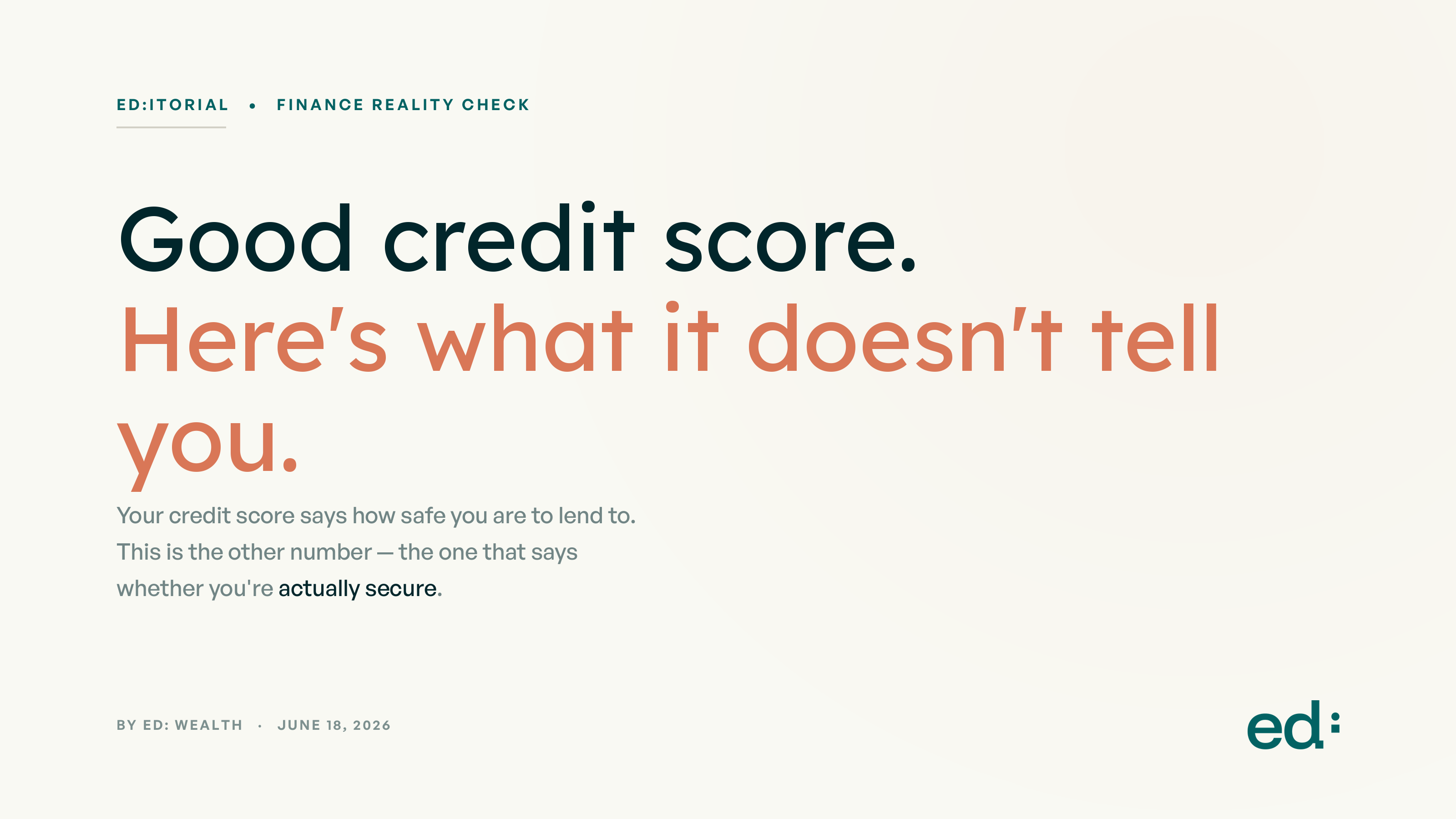
The short version: your credit score measures how safe you are to lend to. Almost nobody has ever seen the number that measures whether you are actually secure. A financial reality check is that second number. Key takeaways Ask people for their credit score and many can recite it. Ask whether they could survive three months without income, or where their money quietly leaks each month, and you get a shrug. That's the gap. A credit score answers a lender's question — how risky is it to extend this person debt? It can be high while your life is fragile, or low while you're genuinely fine, because it was never built to measure you. A financial reality check answers the question the credit score ignores: are you safe, clear, progressing, building, and at ease? Here's the simple version, with the research behind each axis.
Edgen
·
Jun 23 2026
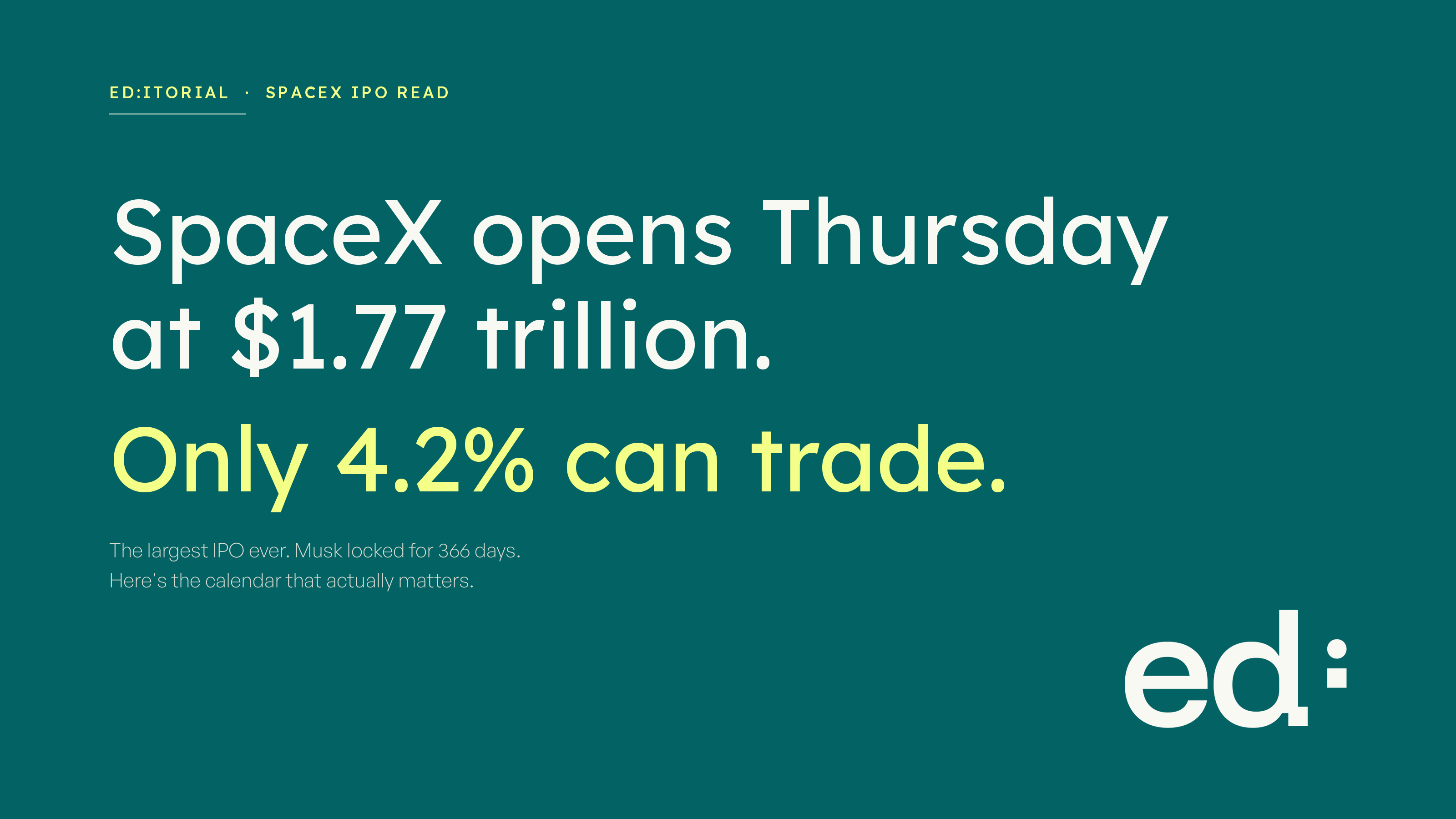
SpaceX opens Thursday at a $1.77 trillion valuation — the largest IPO ever. Only 4.2% of stock actually trades. Musk is locked up for 366 days. The next 366 days run on an unusually clean calendar of supply releases. Here are the 13 dates worth watching.

SpaceX goes public Thursday with a possible $5 trillion hit. Here's the calendar that actually matters.

SpaceX prices Wednesday night and opens Thursday on Nasdaq at $135 per share — a $1.77 trillion valuation, the largest IPO ever. Most coverage will frame what comes next as a sentiment trade, an Elon story, or a race to Goldman's $5 trillion bull case. The reality is more grounded and more useful: the next 366 days are governed by an unusually clean calendar of supply releases — when 95.8% of the company can or cannot trade, when index funds add weight, when the lock-up cliff arrives, when Musk himself becomes a potential seller for the first time. Read the calendar and you've already understood the structure most market commentary will spend the next quarter trying to explain. Here are the 13 dates worth watching. Two things keep showing up in headlines that don't survive a careful read. The first is the idea that index funds are about to be forced into a massive single-event SpaceX buy. They aren't. Nasdaq did create a fast-track inclusion rule that lets SpaceX join the Nasdaq 100 wi
Edgen
·
Jun 10 2026

Investir, enfin, tu n'es plus seul.

Essaie Ed gratuitement. Sans carte, sans engagement.