
コンテンツ
要約
今これが重要な理由:1日に2つのカタリスト
Credoとは何者か、なぜ経営陣が重要なのか
2026年度第3四半期実績:運営の証明
主なリスク
結論:目標株価205ドルで買い推奨
FAQ
2026年4月14日に何が起きましたか?
DustPhotonics買収の戦略的重要性は?
CRDOは割高ですか?

市場が複雑すぎますか?Edgen Searchに聞いてみてください。

答えはすぐに表示され、情報は正確で、あなたが未来を決めるトレーディング判断を下せるようにします。

今すぐ Search を体験

DustPhotonics買収後のCredo Technology:CRDOによる7億5,000万ドルのシリコンフォトニクス獲得とJefferiesの買いレーティングがAIネットワーキングの投資理論を再評価させる理由

· Apr 16 2026
DustPhotonics買収後のCredo Technology:CRDOによる7億5,000万ドルのシリコンフォトニクス獲得とJefferiesの買いレーティングがAIネットワーキングの投資理論を再評価させる理由

デビッド・ハートレー記者 | 2026-04-15 格付け:買い | 目標株価:205ドル(30%の上昇余地) セクター:半導体 — AIネットワーキング、光DSP、アクティブ電気ケーブル(AEC) カテゴリー:テック&AI > 半導体 | AIインフラ | ティッカー:$CRDO


要約

  • Credo Technology (NASDAQ: CRDO) は2026年4月14日、日中15%高の157.69ドルで取引を終えました。これは同日に発生した2つの強力なカタリストによるものです。Jefferiesが目標株価を引き上げ、買い(Buy)の格付けを再確認したこと、そしてCredoがシリコンフォトニクスの革新企業であるDustPhotonicsを7億5,000万ドルで買収すると発表したことです。この取引により、Credoの既存の800G/1.6T SerDesおよびDSPスタックに、共同パッケージ型光学(CPO)の技術とIPが直接統合されることになります。
  • 再評価の背景にある財務状況は驚異的です。2026年度第3四半期の売上高は4億700万ドル(前年同期比64.4%増)、非GAAPベースの売上総利益率は68.6%、非GAAPベースの営業利益率は49.6%に達しました。2026年度通期の売上高成長率は前年比2倍以上(100%超)を追跡しており、成長率においてはMarvellやBroadcomを含むほぼすべてのAIネットワーキング半導体競合他社を(規模ではまだ及ばないものの)上回っています。
  • Edgen 360°の4シナリオモデルは、議論を公平に枠付けしています。強気(Bull)ケース 273ドル / 時価総額494億ドル(確率35%)、基本(Base)ケース 109ドル / 197億ドル(15%)、弱気(Bear)ケース 85ドル / 154億ドル(35%)、壊滅(Disaster)ケース 49ドル / 88億ドル(15%)です。確率加重された公正価値は約148ドルであり、157.69ドルの市場価格は中央値の推定をわずかに上回っています。しかし、DustPhotonicsの買収は強気シナリオの確率を押し上げ、強気の上限そのものを引き上げる可能性があります。
  • 私たちはCRDOを「買い」、目標株価205ドルと評価します。これはDustPhotonics買収後のシナリオ再加重(強気45% / 基本15% / 弱気25% / 壊滅15%)を反映したもので、修正後の確率加重公正価値は約182ドルとなり、これにシリコンフォトニクス統合のオプション価値として約23ドルのカタリストプレミアムを加えています。リスク許容度が高くAI構築に確信を持つ投資家にとって、リスク・リワードは依然として魅力的です。ただし、単一顧客が売上の40%以上を占めていること、90日間のプット・コール・レシオが最近1.39に急上昇したこと、そして弱気・壊滅シナリオの合計確率50%を無視できない点は留意すべきです。

今これが重要な理由:1日に2つのカタリスト

2026年4月14日は、IPO以来、Credoの公開市場史上最も重要な1日となるでしょう。2つの独立したカタリストが1つのニュースサイクルに収束し、株価を日中15%押し上げ、157.69ドルでの引けをもたらしました。

カタリスト #1 — Jefferiesが目標株価を引き上げ、買いを継続。 すでにCRDOの担当アナリストであったJefferies(2026年3月14日付のEdgen 360°レポートによると、3月3日に目標株価を240ドルから200ドルに引き下げていましたが、買いは維持)が、4月14日に目標株価を引き上げ、買いの推奨を再確認しました。この引き上げは格付けそのもの以上に2つの理由で重要です。第一に、すでに前向きであったコンセンサス(平均目標株価は約206ドル、強力な買いのコンセンサス)をさらに強化し、強気のナラティブを固めました。第二に、わずか6週間前に目標を下げたばかりの証券会社が引き上げに転じることは、意味のあるマインドチェンジを示唆し、通常は機関投資家の資金流入に先行します。

カタリスト #2 — DustPhotonicsを7億5,000万ドルで買収。 これは構造的により重要なイベントです。DustPhotonicsは、光学エンジンをスイッチやGPUパッケージに直接配置することでビットあたりの電力を劇的に削減し、1.6T/3.2T世代のAI相互接続を可能にする技術であるCPOに特化したシリコンフォトニクスの革新企業です。Credoは歴史的にSerDes、光DSP、アクティブ電気ケーブル(AEC)を中心に事業を構築してきました。DustPhotonicsは、CredoをMarvell (MRVL)Broadcom (AVGO)といった資金力のある競合から隔てていたシリコンフォトニクスの空白を埋めるものであり、210億ドル超の時価総額に対して妥当な価格で実現しました。
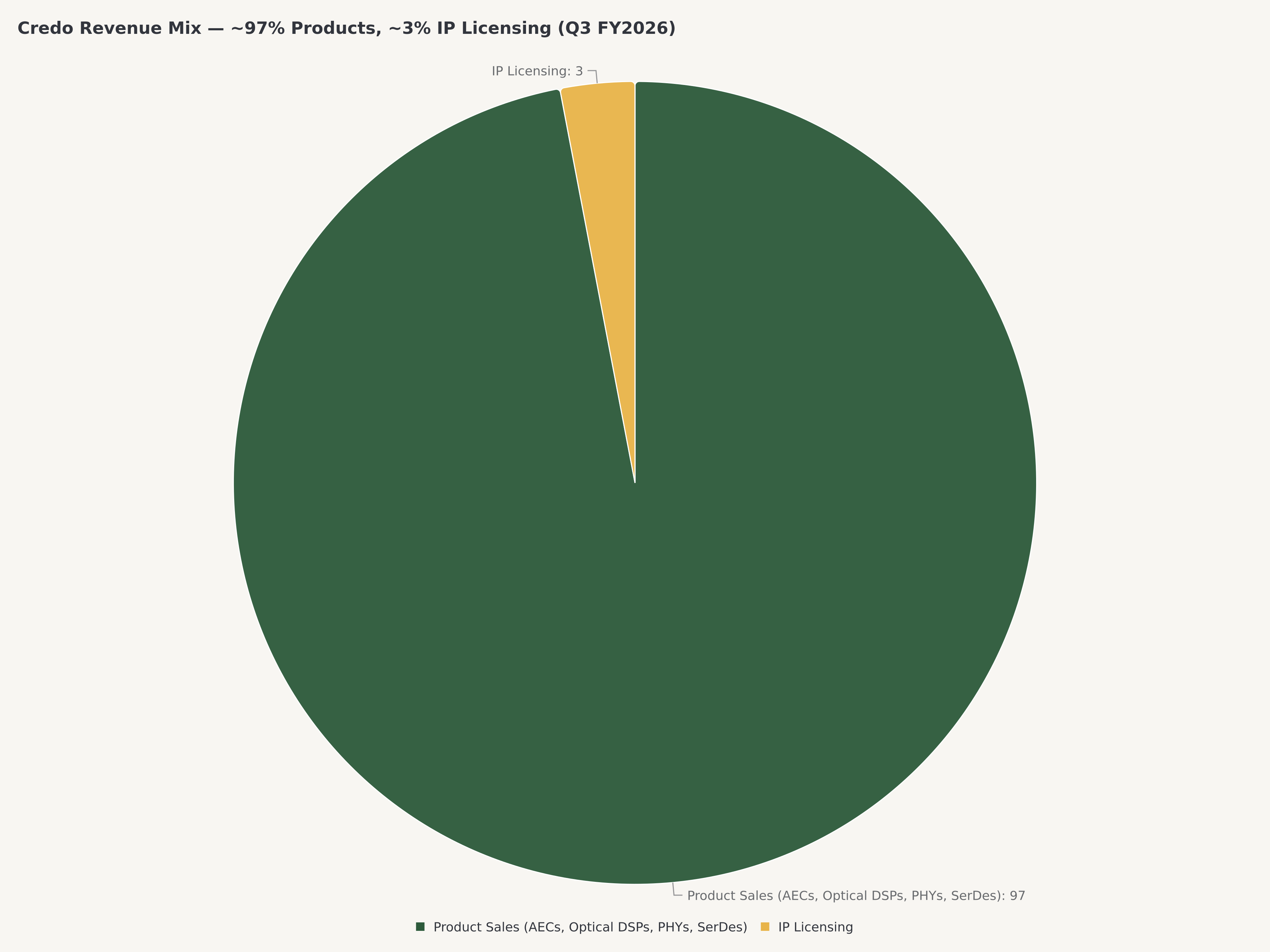

Credo revenue composition: ~97% product sales (AECs, Optical DSPs, Line Card PHYs, SerDes chiplets) and ~3% IP licensing
Credo Revenue Composition: Products vs IP Licensing and Product-Family Mix. Source: Credo filings, Edgen 360° Report.

Credoとは何者か、なぜ経営陣が重要なのか

Credo Technology Group Holding Ltdは、世界のデータインフラ市場における高速かつ低消費電力な接続需要に対応するために設立されたファブレス半導体企業です。同社の使命は、AIやクラウドコンピューティングの爆発的成長によって深刻化したシステムレベルの帯域幅ボトルネックを緩和する画期的な技術を提供することです。直近の決算では、売上の約97%が製品販売によるもので、残りの3%が知的財産(IP)ライセンスによるものです。

製品ポートフォリオは、HiWireブランドのアクティブ電気ケーブル(AEC)、100Gから1.6Tをカバーする光DSPラインカードPHY、SerDesチップレットなどで構成されています。競争力の源泉は製品数だけでなくアーキテクチャの統合にあり、SerDesチップレットとDSP PHYをセットで提案できる強みがあります。

リーダーシップ。 経営陣はWilliam Brennan(CEO兼社長)ダニエル・フレミングCFOが率いています。経営陣はMarvellやInphiでの強力な実績を持っており、Bill Brennan氏は両社で幹部職を歴任しました。また、Marvellの共同創業者であるPantas Sutardja氏もCredoの共同創業者として名を連ねています。ボードメンバーにはリップブー・タン氏も加わっており(2025年3月発表)、AIネットワーキング、ファブレス運営、ハイパースケーラーとの関係構築において、この業界屈指の経験を持つチームと言えます。
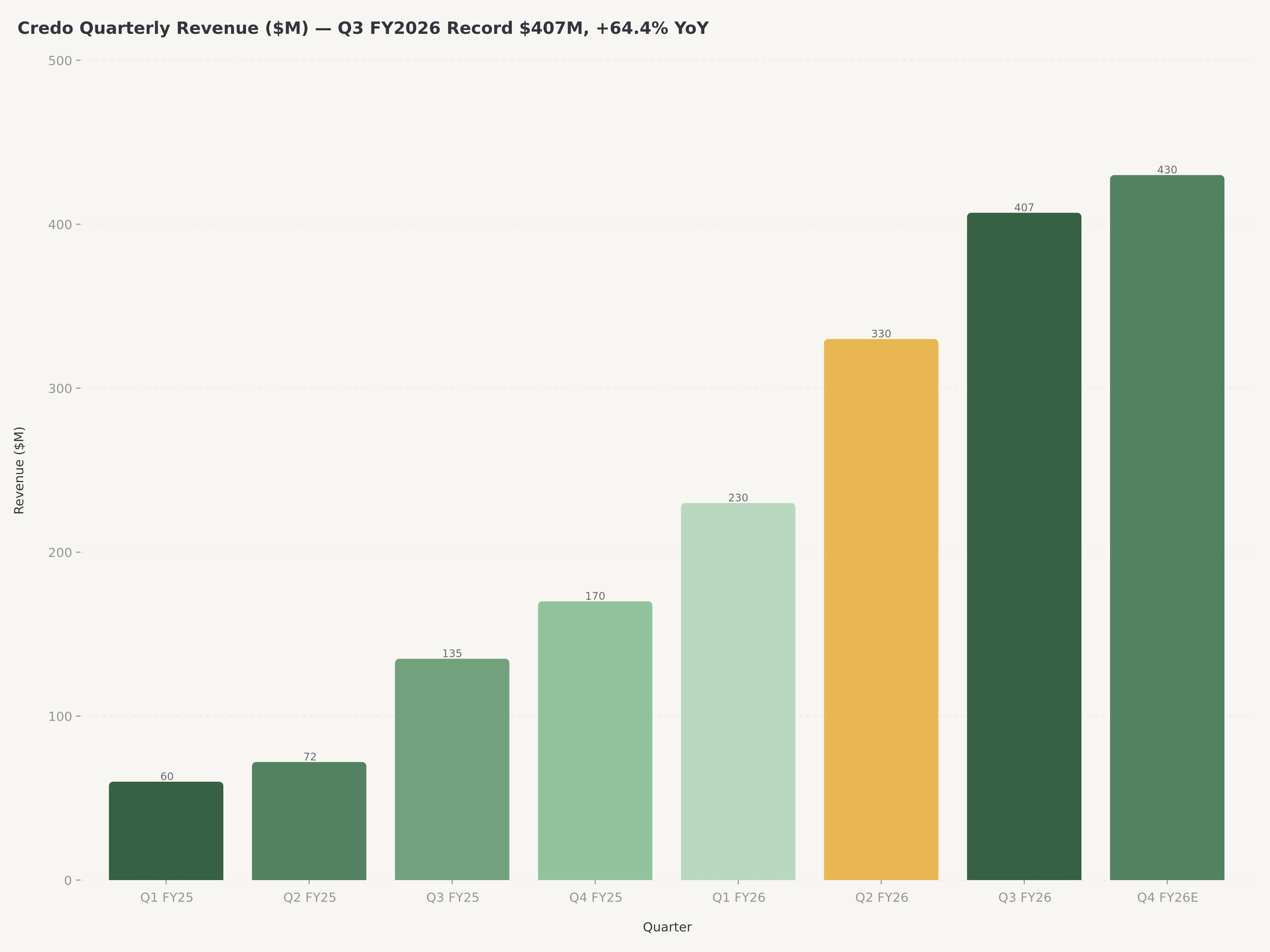

Credo revenue growth trajectory: Q3 FY2026 $407M (+64.4% YoY), Q4 FY2026 guide $425-435M, FY2026 full-year growth ~201% YoY
Credo Revenue Trajectory — Quarterly Revenue FY2025-FY2026. Source: Credo filings, Edgen 360° Report (Mar 14, 2026).

2026年度第3四半期実績:運営の証明

投資理論を裏付ける運営実績は極めて明快です:

  • 売上高:4億700万ドル(前年同期比64.4%増)— 四半期として過去最高。
  • 非GAAP売上総利益率:68.6% — 業界最高水準。
  • 非GAAP営業利益率:49.6% — 売上拡大に伴い大幅上昇。
  • ガイダンス: 2026年度通期の売上高は前年比100%超(2倍以上)となる見込み。

特筆すべきは、ハイパースケーラーを顧客としながら68.6%という高い粗利益率を維持している点です。これは、Credoの製品が十分に差別化されており、顧客が技術に対してプレミアムを支払う意欲があることを示しています。


主なリスク

  • 顧客集中度: 単一の顧客が売上の40%以上を占めています。
  • 買収統合リスク: 7億5,000万ドルの買収に伴うチーム統合やロードマップの調整。
  • 競合他社の反応: MarvellやBroadcomによる価格攻勢や、顧客の囲い込み。
  • マクロおよび地縁政治リスク: TSMCへの生産依存、および米中間のAIチップ輸出規制の強化。

結論:目標株価205ドルで買い推奨

私たちはCredo (CRDO) を、目標株価205ドルで「買い」と評価します。 売上が倍増し、粗利益率が上昇し続けているというファンダメンタルズは極めて強力です。DustPhotonicsの買収は、次世代技術であるCPOにおける地位を盤石にします。140ドルから145ドルへの押し目があればエントリーの好機と考えます。


FAQ

2026年4月14日に何が起きましたか?

Jefferiesによる目標株価引き上げと、DustPhotonicsの買収発表が重なり、株価は15%急騰しました。

DustPhotonics買収の戦略的重要性は?

次世代のAI通信で不可欠となるシリコンフォトニクスとCPO技術を内製化できる点です。これにより大手競合との技術格差を解消します。

CRDOは割高ですか?

確率加重公正価値(148ドル)からは約7%の上振れに留まっており、将来の成長性を加味した目標株価205ドルに対しては、依然として30%の上昇余地があります。


免責事項:本記事は情報提供のみを目的としており、投資勧誘を意図するものではありません。

紹介
banner.jpg

What is a money person? The plain-English alternative to a financial advisor

The short version: a money person is a smart, warm friend who happens to be good with money and explains it like a person, not a bank. Practically, it's a second opinion on your whole financial picture — cash, debt, tax exposure, concentration, and the goals you're working toward — that tells you in plain language what to look at first. It's not a traditional advisor managing your portfolio for 1% a year, and it's not a coach cheering you on. It's the honest read a good advisor's first meeting would give you, without the fee or the asset minimum. It's the role Ed Wealth was built to play. Strip away the label and a money person does four concrete things: Just as important is what it doesn't do: it doesn't take custody of your money, it doesn't sell you products for commission, and it doesn't pretend a forecast is a promise. It's a second opinion: it shows you the structure and lets you decide. People reach for four different things when they say "I should talk to someone." They're not
Edgen
·
Jul 10 2026
banner.jpg

Is a financial advisor worth it? Advisor vs robo vs money person

The short version: a financial advisor is worth it when your money has real complexity — a business, concentrated stock, an estate, a divorce, or turning savings into retirement income. There, a fee pays for itself. But most people don't have a complexity problem; they have a clarity one, and paying 1% of your assets a year — about $3,000 on a $300,000 portfolio, every year — is a lot to pay for reassurance. You have three tiers to choose from: a human advisor (~1% of assets), a robo-advisor (~0.25%), and a money person — a flat-fee second opinion that doesn't grow as your savings do. Start with the honest case for paying. A good advisor earns their fee when your situation is genuinely complex: selling a business, a big block of company stock or options, an estate with kids, a divorce, a windfall, or building a retirement-income plan with real moving parts. In those moments, one right call can save you many times the fee, and the job becomes picking a good one (that's how to choose a f
Edgen
·
Jul 10 2026
banner.jpg

Do You Actually Need a Financial Advisor? (An Honest Test)

The short version: you need a financial advisor when your money has genuine complexity — equity comp across several employers, a business sale, an estate with kids involved, a divorce, a sudden windfall, or a retirement-drawdown plan with real moving parts. If your situation is closer to "I earn well but somehow feel behind," that's a clarity problem, not a complexity one, and hiring someone to manage your money for about 1% a year is an expensive way to solve it. Here's how to tell which one you have. Almost everyone reaching for an advisor falls into one of two camps, and confusing them is where money gets wasted. A complexity problem is when there are real moving parts that interact: decisions where a wrong move costs far more than any fee. Selling a company, exercising stock options with a tax bill attached, splitting assets in a divorce, planning how to draw income across a 30-year retirement. Here, a good advisor earns their keep. A clarity problem looks different. Good income, a
Edgen
·
Jul 06 2026
banner.jpg

How to Choose a Financial Advisor in 2026 (and Whether You Even Need One)

The short version: picking a financial advisor isn't about finding the "smartest" one. It comes down to three boring questions that actually predict whether you'll be treated well: are they legally a fiduciary, how do they get paid, and do you even need one yet. Get those right and the rest is noise. Here's how to run the check — and what to do if you want guidance but can't (or don't want to) meet a $250,000 minimum. Before you choose one, ask whether this is the right tool at all. A full-service advisor earns their fee when your situation is genuinely complex — a business sale, equity comp across several companies, estate planning, a divorce, a sudden windfall, or a retirement-income plan with real moving parts. But a lot of people reaching for an advisor don't have a complexity problem. They have a clarity problem: a good income, a few scattered accounts, and a nagging sense of being behind. That doesn't need someone to manage your money for 1% a year. It needs a clear read on where
Edgen
·
Jul 06 2026
Redeem miles for gift cards and each is worth ~1 cent; redeem for long-haul business and they're worth 2.5-4+. With programs now dynamically priced, the one check that decides every redemption.

How to redeem airline miles without wasting them

The single biggest mistake with miles is redeeming them for the easy stuff: gift cards, merchandise, seat upgrades at the gate. Do that and each mile is worth about one cent. Redeem the *same* miles for flights, especially long-haul or premium-cabin flights, and they're often worth two to five cents each, sometimes more. So the real skill isn't earning miles; it's not throwing away their value at the finish line. Here's how to actually use them. A mile has no fixed price; its value depends entirely on what you redeem it for. The way to judge any redemption is simple math: (cash price of the flight) ÷ (miles it costs) = cents per mile. If a flight costs $400 or 20,000 miles, that's 2 cents a mile, a solid deal. If a $90 flight costs 18,000 miles, that's half a cent, which is terrible; pay cash and keep the miles. Run this check before every redemption. It instantly separates a great use from a waste, and it's the one habit that makes miles worth having. As a rule of thumb, most major ai
Edgen
·
Jun 30 2026
Short-term goals (under ~3 years) belong in safe cash; long-term goals (5+ years) can take market risk. The best HYSAs now pay ~4-5% APY. How to sort yours and run both.

Long-term vs short-term financial goals (and how to plan both)

The difference comes down to one thing: time. A short-term goal is money you'll need within roughly three years (an emergency fund, a trip, a wedding, next year's tax bill), so it has to be *safe and reachable*. A long-term goal is five-plus years out (retirement, a house down the road, a kid's education), so it can take market risk, because time smooths the bumps out. Get that match right and you've done most of the work. It's not the size, it's the deadline. A $2,000 goal you need in six months is short-term; a $2,000 goal you won't touch for fifteen years is long-term, and they belong in completely different places. This is the part that actually matters, and where people lose money without realizing it. Short-term money should not be in the stock market. If your emergency fund is in stocks and the market drops 20% the same month your car dies, you're selling at the worst possible time. Short-term goals go somewhere stable and accessible, and a high-yield savings account is the clas
Edgen
·
Jun 30 2026
Mortgages near 6.5%, home prices flat, and the Fed split on rate cuts vs hikes. With timing a coin flip, the 3 questions that actually decide whether to buy now or wait.

Should you buy a house now or wait? How to actually decide

The honest answer: buy when you'll stay put for at least five years and you'll still have an emergency fund left after the down payment. Otherwise, waiting (and renting) is often the smarter money move, not the weaker one. "Rent vs buy" isn't a math problem with one right answer, and it's almost never really about timing the market. It's about your *life*, in three questions. Before the three questions, here's the mid-2026 backdrop — because "now or wait" usually hides a bet on rates and prices, and the data says that bet is a coin flip. The picture: mortgages are still pricey, prices have gone flat (more than half of the 20 big metros saw year-over-year declines in March), and the cheap-money era hasn't returned. So "buy before it runs away" and "wait for the crash" are *both* weak arguments right now. The whole "wait for rates to drop" plan rests on the Fed, and the Fed is split down the middle. In its June 2026 projections, policymakers were divided: 8 expected no change this year,
Edgen
·
Jun 30 2026
Most financial goals fail because they're wishes, not systems. Here's the 3-part anatomy of a goal that sticks (a number, a date, one automatic move), plus why 37% of adults can't cover a $400 surprise.

How to set financial goals you'll actually hit

A financial goal you'll actually hit has three things a vague wish doesn't: a number, a date, and one automatic move that happens whether or not you remember it. "Save more" is a wish. "$6,000 in a separate account by next December, $500 auto-transferred on payday" is a goal. The gap between those two sentences is the reason most goals quietly die, and it has almost nothing to do with willpower. Key Takeaways A real financial goal answers three questions: how much, by when, and what for. Drop any one and it stops working. "Pay off debt" has no number and no date, so there's nothing to aim at or measure, while "$8,000 of card debt cleared in 18 months" tells you exactly whether you're on track and the day you're done. The "what for" matters more than people expect. A goal tied to something real (a buffer so a bad month isn't a crisis, a deposit on a first place) survives the months when motivation dips. In our experience reading how people actually use a money tool, the goals that get
Edgen
·
Jun 30 2026
A big RSU grant just vested — now what? Here's what a modern money tool actually surfaces first, using Ed as a worked example: a reality check, the 22% tax gap most high earners miss, and the concentration risk nobody flags.

Your RSUs Just Vested. Here's What a Money Tool Surfaces First.

You just had a big RSU grant vest. Congratulations — and now the awkward part: a six-figure pile of your own company's stock, a vague sense you should "do something," and no one actually telling you what. An advisor, a spreadsheet, and a piece of software each handle this moment differently. Here's what a modern money tool surfaces in a moment like this — using Ed as a worked example — so you can decide what kind of help actually fits. Key takeaways You connect your brokerage and bank through read-only aggregation, so the tool can read balances but can't move a dollar. Ed's framing is simple: precise about your money, blind to your identity. Instead of sorting your lattes into categories, Ed opens on a single Financial Reality Check — a read on whether your money could survive a bad month. For a lot of high earners, that one number lands harder than any budget, because it answers a question the other apps never ask. (If the Reality Check is the numbers side, your money type is the beha
Edgen
·
Jun 26 2026
A money personality test is more than a quiz if it measures behavior, not just vibes. Here's the science behind money types, how Ed's test works, and how to use your result.

What Is a Money Personality Test? The Science Behind Your Money Type

The short version: a good money personality test should feel like a roast and work like a mirror — fun on the surface, behavioral underneath. The useful ones don't tell you what you know; they show you how you act with money, and the one blind spot worth watching. Key takeaways Here's the uncomfortable backdrop. U.S. financial literacy has been stuck for a decade — adults answer only about 49% of the standard knowledge questions correctly, essentially flat since 2017 (TIAA Institute–GFLEC, 2025) — even as free financial information became infinite. If facts fixed money, they'd have fixed it by now. They don't, because the thing that actually drives your outcomes lives one level below the facts: how you're wired to behave when money is on the line. That's the whole premise of financial fitness — and it's what a money personality test is built to surface. Not what you know. What you do. The idea has real research behind it — money behavior is patterned and measurable, and a few tradition
Edgen
·
Jun 23 2026

投資、もうひとりじゃない

Edgen を無料で試そう。クレカ不要、縛りなし