
Key Takeaways: Nearly 30,000 objects now crowd low-Earth orbit, and a wave of startups is betting that cleaning them up becomes a commercial business.
Key Takeaways: Nearly 30,000 objects now crowd low-Earth orbit, and a wave of startups is betting that cleaning them up becomes a commercial business.
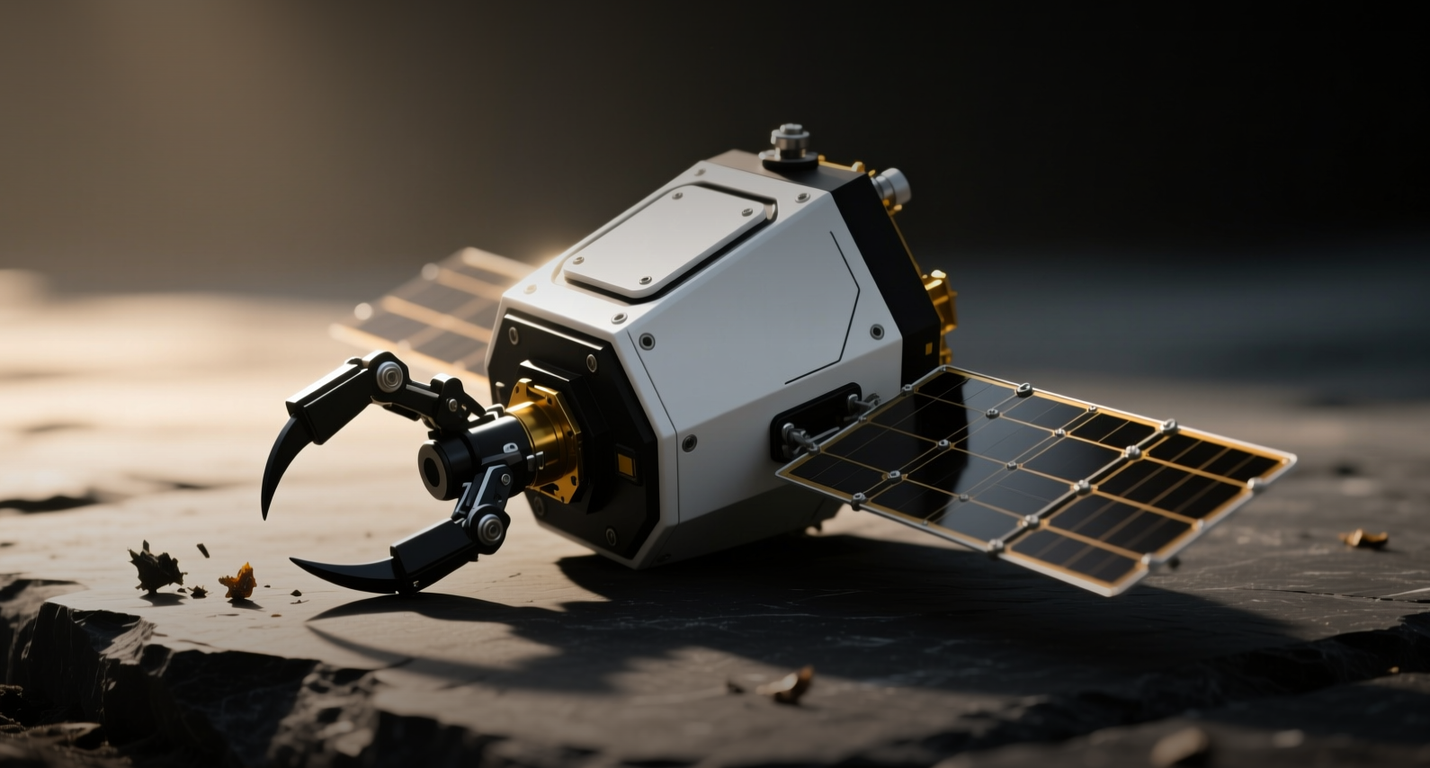
Space debris removal is emerging as a commercial market as nearly 30,000 trackable objects crowd low-Earth orbit, with startups Astroscale and ClearSpace betting cleanup becomes an entry point to satellite repair and life-extension services.
"Space is a global commons, and we're mucking it up," Andrew Faiola, commercial vice president at Tokyo-listed Astroscale, said. "We do need to clean it up."
Astroscale reported a 142 percent revenue increase in the fiscal year ended April, though it remains loss-making and derives a large share of project income from government grants. ClearSpace raised 26 million euros ($30 million) in 2023 and plans another funding round later this year. OrbitRadar data shows about 18,500 of the nearly 30,000 tracked objects are active satellites; the rest are debris fragments or spent rocket bodies.
The stakes extend beyond orbital safety. Space infrastructure underpins financial transactions, GPS navigation, weather forecasting and missile tracking, and the European Space Agency warns that some orbits risk becoming unusable as debris fragments faster than it re-enters the atmosphere. For investors, the commercialization timeline hinges on regulatory progress rather than technology alone.
The congestion is visible in real time. An interactive map developed by researchers at the University of Texas at Austin shows decades-old rocket bodies and defunct satellites from the U.S. and former Soviet Union sharing airspace with next-generation commercial constellations. Faiola compared a space collision to a grenade hitting a car, producing a debris cloud whose fragments scatter into unpredictable orbits — some too small to track from the ground yet large enough to damage a satellite or pierce an astronaut's spacesuit during a spacewalk.
Tim Flohrer, head of the European Space Agency's Space Debris Office, said the amount of debris would keep growing even if no new satellites were launched, because objects fragment faster than debris naturally re-enters the atmosphere. Active satellites are being forced to perform more collision-avoidance maneuvers, consuming fuel and shortening their operational lives.
Astroscale builds highly maneuverable spacecraft designed to approach and operate near other spacecraft in orbit. Its core technology is a magnetic capture docking system — a difficult task given objects in low-Earth orbit travel at 7 to 8 kilometers per second and may tumble uncontrollably. The company is also seeing growing demand from the defense sector, where its technology has potential military applications, Faiola said.
ClearSpace takes a broader view. Co-founder and CEO Luc Piguet describes the company as a "service layer for space infrastructure," drawing an analogy to the maintenance industries built around roads, shipping and aviation. The company has developed a satellite with a claw-like mechanism that can capture debris and either drag it back into the atmosphere or push it into a "space graveyard" orbit with lower collision risk.
Piguet said investor sophistication has improved markedly. Three years ago, investors asked how satellites reach orbit; today many have backed companies such as SpaceX and Rocket Lab and ask professional questions about supply chains and delivery timelines. European defense investment has also accelerated because of the geopolitical situation, making the timing "phenomenal," he added.
The fundamental obstacle remains liability, a legal gray zone. The European Space Agency has said it is not a regulator and can only enforce debris-mitigation requirements for its own missions, describing space debris as a "tragedy of the commons" that requires global cooperation. Flohrer acknowledged that commercial operators' compliance is improving slowly, but not fast enough to curb the growth of orbital junk.
Faiola argued that regulation itself can create a market, citing the precedent of nuclear power plant decommissioning — companies exist to dismantle plants because regulations require it. "We need the regulations to catch up, and then this is all going to make sense," he said. For investors, that means the market's commercialization timeline depends on regulatory progress by governments and international bodies, not purely on technology or demand. Until the framework is clarified, Astroscale and ClearSpace will continue to rely on government contracts, waiting for the commercial inflection point.
This article is for informational purposes only and does not constitute investment advice.
