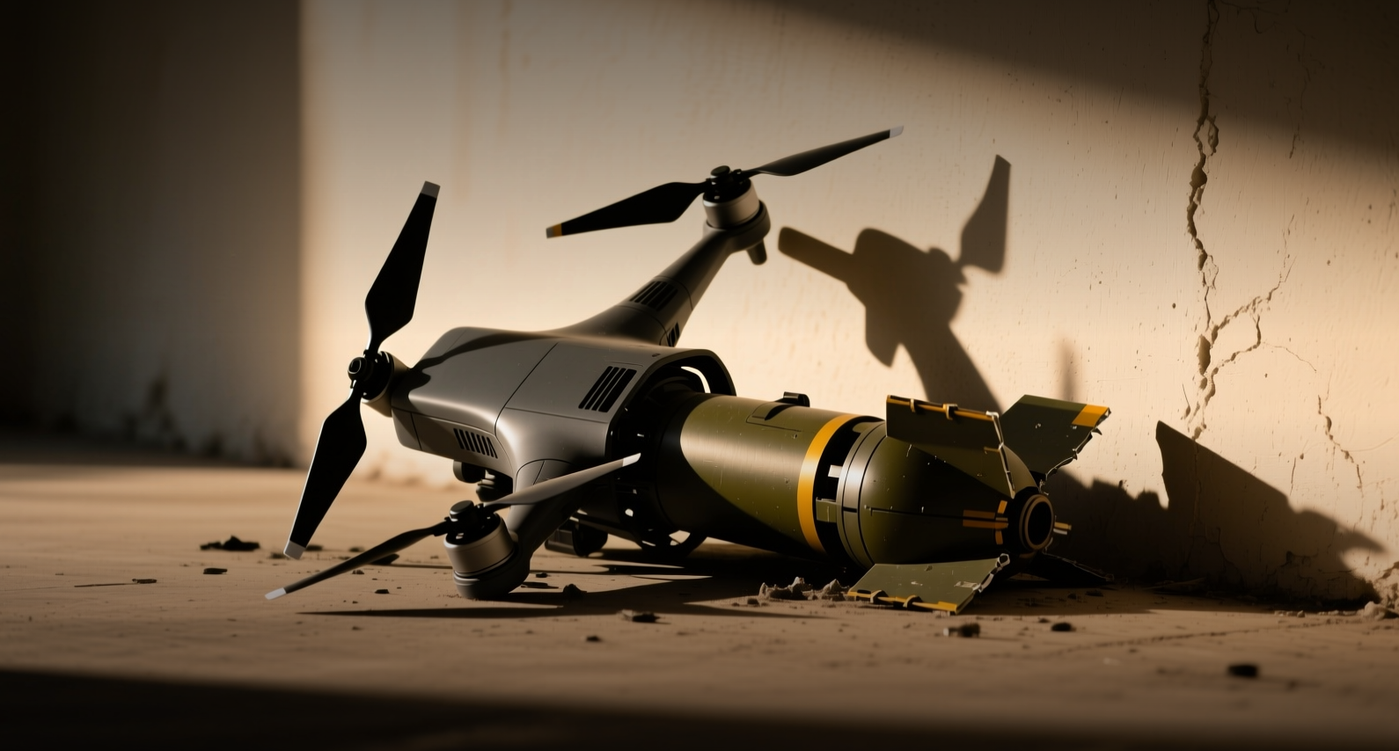
A bomb-laden drone found beside a Ukrainian Antonov transport at Leipzig/Halle Airport marks the first confirmed armed incursion in a two-year Russian campaign that has probed Europe's defenses with at least 144 sightings across 13 countries.
German bomb-disposal experts defused the drone, fitted with military-grade explosives whose detonator failed, after an airport worker discovered it near the south runway on Aug. 5, authorities said. A DHL cargo plane that aborted its landing struck an unidentified flying object and diverted to Hanover with minor damage. The airport, a major European cargo hub and transit point for Western weapons to Ukraine, resumed full operations Thursday.
"We can't rule out the possibility that foreign powers are behind this," Federal Interior Minister Alexander Dobrindt told reporters, calling the incident a "hybrid attack scenario" and a "new quality of danger." Saxony's state prosecutor's office for combating extremism and the state's counterterrorism unit have taken over the investigation, while Ukraine's Foreign Ministry said no Antonov aircraft were damaged.
The episode fits a documented pattern. From August 2024 to February 2026, suspicious drones were spotted at least 144 times in 13 countries, according to a report last month from the London-based International Institute for Strategic Studies (IISS). The think tank warned that Russia likely conducted a sustained drone campaign to probe gaps in Europe's air defenses, "penetrating the perimeters of some of Europe's most sensitive defence installations," including naval facilities and air bases hosting U.S. nuclear weapons under NATO sharing arrangements. In February, a drone flew near the French nuclear-powered aircraft carrier Charles de Gaulle as it visited Sweden; Sweden's armed forces said it took off from a Russian spy ship.
A failure of deterrence
The IISS report describes "a pattern that is harder to explain by coincidence than by coordination," noting the Kremlin conducted the campaign "with substantial impunity" — European governments said and did little in response. The drones have shut down civilian traffic at major airports, including Munich, Berlin Brandenburg, Brussels and Copenhagen, and have lurked near ports, energy terminals and logistics companies. In 2024, an incendiary device ignited at a logistics center at Leipzig/Halle and set fire to a freight container in a plot security officials suspect Russian intelligence was behind; Russia has denied involvement.
Europe's air defenses were designed to detect conventional threats, and these episodes show drones can slip through. The European Commission published a counter-drone plan this year, but the European Parliament has raised concerns that the initiative "lacked the agility and doctrinal coherence required to deliver scalable results," the IISS report says. A separate problem is legal: national authorities often lack clarity on who is responsible and authorized to intercept a threatening drone, and NATO members could clarify treaty obligations under the United Nations Convention on the Law of the Sea to target ships that launch drones.
Defense budgets respond
The threat is now feeding into procurement. NATO's new target to spend 5 percent of GDP on security by 2035 implies a surge in spending on counter-drone systems, integrated air defense and related technology, a tailwind for European defense primes including Rheinmetall, MBDA, Thales and sensor maker Hensoldt. Hardening air defenses against drones will not be cheap, which underscores why the alliance is pushing members toward the higher spending bar.
The last time European governments faced a comparable air-defense gap was the Cold War-era buildup, when NATO members lifted defense spending to roughly 4 percent of GDP in the early 1980s. The current push to 5 percent by 2035 would mark the largest sustained increase in European defense budgets in four decades. If Russia keeps testing Europe's perimeters with impunity, the IISS warns, the Kremlin will only sharpen its map of weak spots around strategically important sites — and the cost of closing them rises with every undefended incursion.
This article is for informational purposes only and does not constitute investment advice.