

Meta's Project OT reveals the gap between AI-generated code volume and actual productivity gains.
Meta's Project OT reveals the gap between AI-generated code volume and actual productivity gains.
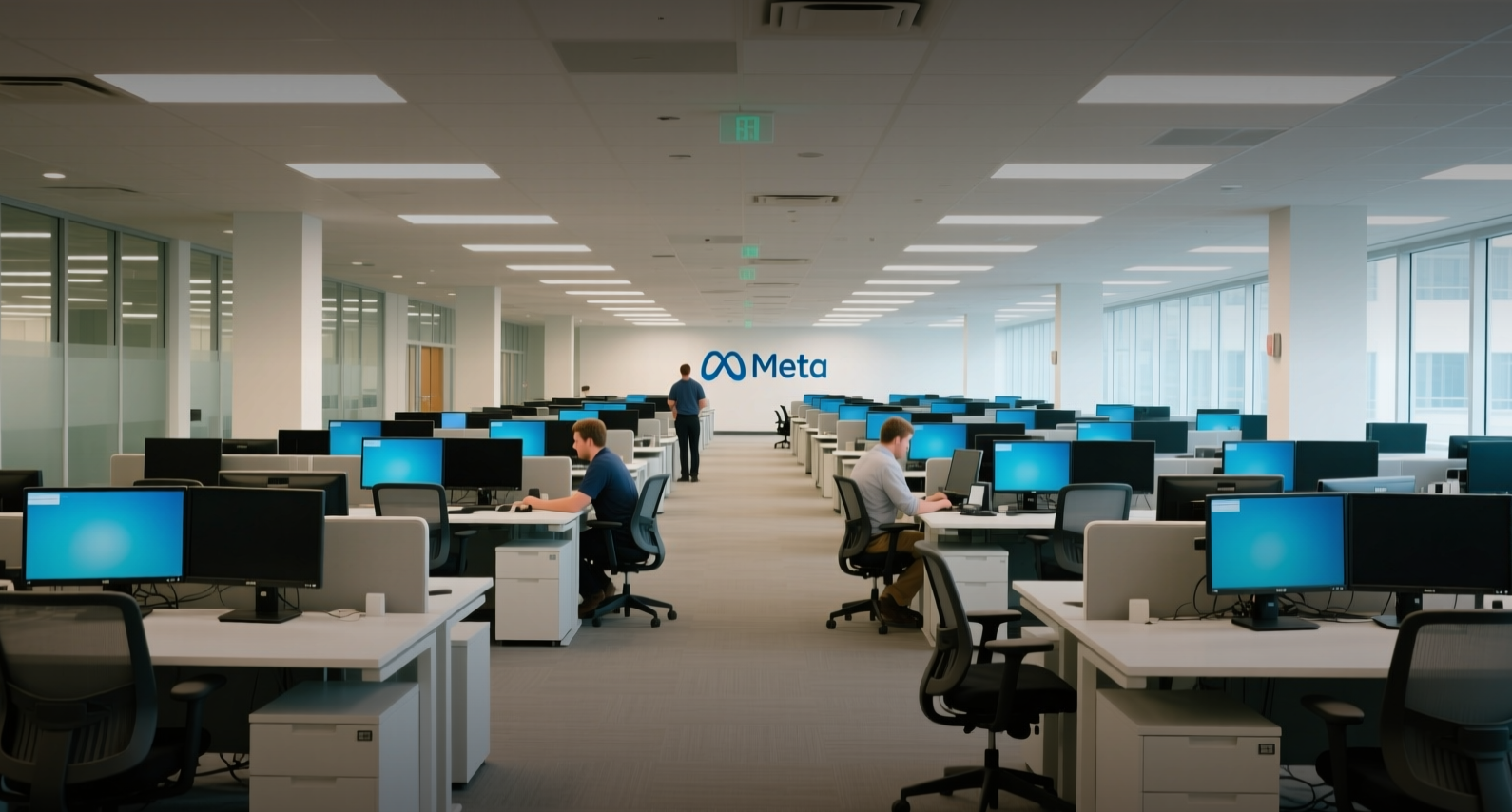
AI coding tools at Meta drove a 220 percent surge in code changes but only a 36 percent rise in user-facing features, as the company cut about 8,000 jobs in an AI-driven restructuring, according to internal company data reviewed by Reuters.
"The kind of trajectory of the agentic development over at least the last four months hasn't really accelerated in the way that we expected," Zuckerberg, chief executive officer at Meta, said at a July town hall.
Major technical and security incidents climbed 40 percent year-over-year, with time spent resolving them up 70 percent. Employee sentiment on Meta's Pulse survey fell from 74 percent to 55 percent favorable. The company recorded $1.18 billion in severance expenses from the May cuts.
Meta plans to spend $130 billion to $145 billion on AI infrastructure in 2026, while free cash flow fell to $784 million in Q2 from $8.55 billion a year earlier — even as revenue rose 28 percent to $60.8 billion. The spending gap raises questions about what the company has to show for its AI bet.
Code Up 220%, Features Up 36%
The restructuring, code-named Project OT (Organization Transformation), was conceived at Zuckerberg's Hawaii retreat in January. It envisioned smaller "talent-dense" teams of three to five people — generalist "builders" using AI tools — replacing traditional product teams of 10 to 20 specialists. By June, at least 11 engineering and research units had adopted versions of the pod structure. Executives during the planning period expressed strong optimism about coding tools such as Anthropic's Claude Code, according to the report.
Internal data showed the gap between code production and delivery. Changes to Meta's software platforms and infrastructure rose 220 percent year-over-year as employees used more AI coding tools, but changes that resulted in new or upgraded features reaching users rose only 36 percent. Infrastructure teams flagged "reliability warning signs" as early as March, and an April internal post warned that unchecked AI agents could carry out "large-scale, disruptive actions that humans are unlikely to execute."
The reliability concerns echo independent research. Google Cloud's 2025 DORA study, based on nearly 5,000 technology professionals, found AI adoption was associated with higher software delivery throughput but lower delivery stability, with around 30 percent of respondents reporting little or no trust in AI-generated code. A controlled 2025 study by research organization METR found experienced open-source developers took 19 percent longer to complete assigned tasks when using the AI tools available at the time.
Specialized Agents Show Promise
Meta has separately reported productivity gains from AI agents used in narrowly defined engineering workflows. Its Ranking Engineer Agent (REA), deployed in advertising infrastructure, generated improvement proposals covering eight models with three engineers — compared with a historical staffing level of about two engineers per model — a fivefold increase in engineering output by that measure. REA-driven iterations doubled average model accuracy across six models, though the figures were reported by Meta and not independently verified.
Another Meta engineering project found that agents initially struggled when working across a proprietary data-processing system containing more than 4,100 files across multiple repositories and three programming languages. The company deployed more than 50 specialized agents to analyze the codebase and create 59 context files containing institutional knowledge, reducing agent tool calls and token use by around 40 percent.
The results suggest AI agents work best in constrained, well-documented environments — not as general-purpose replacements for human engineers. Zuckerberg acknowledged the gap at the July town hall, saying he expected the technology to improve and begin showing more benefits in the next three to six months.
Meta's workforce stood at 75,472 employees as of June 30, down 1 percent from a year earlier. The company said most employees affected by the May reduction would no longer be included in its reported headcount by the end of the third quarter. Zuckerberg has told employees he does not expect additional company-wide layoffs this year, language that leaves open the possibility of team-level reductions.
Meta shares trade at roughly 25 times forward earnings, reflecting investor expectations that AI-driven efficiency gains will eventually translate to margin expansion. The company's $130 billion to $145 billion capital expenditure plan for 2026 — up from an original forecast of $115 billion to $135 billion — has drawn scrutiny from analysts who estimate the low end of that range could consume nearly all of the company's operating cash generation for the year.
This article is for informational purposes only and does not constitute investment advice.
