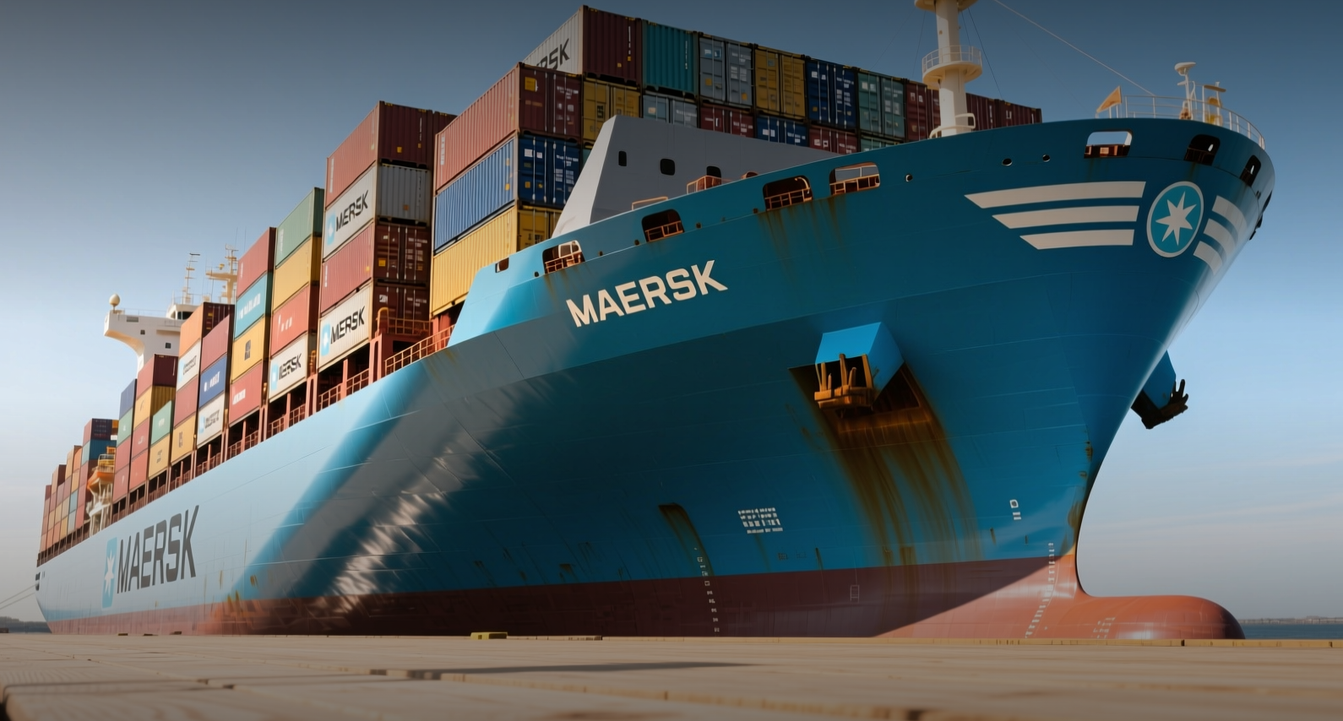
Maersk raised its 2026 EBITDA guidance 25 percent to $10.5-12.5 billion after Q2 profit beat estimates, with shares trading near a record 21,900 kroner.
"The strength and resilience of demand surprised me," CEO Vincent Clerc said on the Q2 earnings call, dismissing concerns that trade wars and deglobalization would weaken container volumes.
Q2 revenue grew 20 percent year-on-year to $15.8 billion, with net profit doubling to $1.31 billion. EBITDA rose 23 percent to $3 billion, beating the $2.12 billion consensus. Ocean segment revenue climbed 30 percent to $10.5 billion, with EBIT tripling to $935 million on average revenue per FFE of $2,746, up 22 percent. Logistics and Services revenue rose 15 percent to $4.2 billion, while Terminals posted an 11 percent gain to $1.4 billion with throughput up 2.2 percent to 3.6 million FFE.
The guidance raise and fleet expansion plans mark a strategic shift for the world's second-largest container carrier. Maersk's B shares closed at 20,830 kroner on Aug. 18, less than 5 percent below the all-time high of 21,900 kroner reached after the Aug. 13 guidance revision.
Clerc said port congestion, not Middle East conflict, is driving freight rates higher. Waiting times to berth have reached 12 days at Shanghai, he said, as surging demand overwhelmed underinvested landside infrastructure across Northern Europe, South America, West Africa and China. The company now routes about a third of its normal traffic through the Suez Canal, covering four of 13 services, with nine still sailing around the Cape of Good Hope.
Fleet expansion and the end of the capacity cap
Clerc said Maersk is "starting to reach the limits" of what its current fleet can deliver, with capacity utilization at 96 percent in Q2. The company intends to revive fleet expansion plans and move away from its long-standing internal cap on container fleet capacity. Maersk's orderbook stands at 90 ships or 1.2 million TEU, equal to 25.4 percent of its existing fleet — well below MSC's 37.8 percent and CMA CGM's 39.3 percent, according to Alphaliner data.
"If the overall market grows 4 percent, but backhaul demand grows 7-8 percent, we need 7-8 percent more capacity annually to move cargo," Clerc said, citing worsening east-west trade imbalances that require more empty-container repositioning.
Clerc also noted that Maersk increasingly transports industrial goods — batteries, air conditioners, solar panels, wind turbines — rather than primarily consumer goods, making demand more stable. He warned that a sudden 10 percent drop in China-bound cargo would eliminate all bottlenecks and "everything would collapse."
The guidance raise and fleet expansion plans point to Maersk's expectation that elevated freight rates will persist. Clerc said rate jumps since May will become more frequent in coming years because of landside bottlenecks, with average rates staying above historical levels. Hapag-Lloyd also recently raised its outlook despite flagging a $600 million hit from Middle East disruption. Investors will watch whether Maersk's planned newbuild orders materialize and how the gradual return to Suez affects freight surcharges in the second half.
This article is for informational purposes only and does not constitute investment advice.