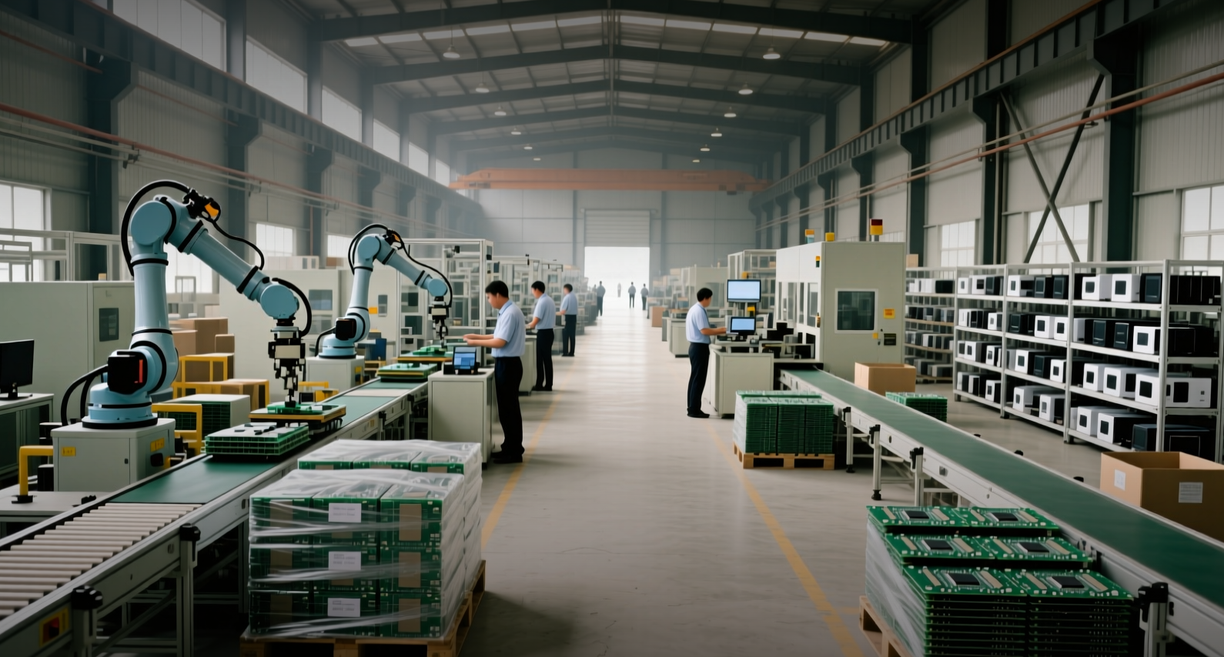
China's industrial profit growth slowed to 11.2 percent in July, with AI-linked electronics makers surging while property and consumer sectors lagged.
China's industrial profit growth cooled to 11.2 percent in July from 15.1 percent in June, as AI-driven electronics makers surged while property and consumer sectors dragged on the broader recovery in the $20 trillion economy.
Rising input costs squeezed margins even as revenue growth held broadly steady, said Zhaopeng Xing, senior China strategist at ANZ, pointing to higher raw material prices pressuring midstream and downstream manufacturers.
Profit at industrial firms grew 11.2 percent last month from a year earlier, down from a 15.1 percent increase in June, while profit for the first seven months slowed to 17.6 percent from 18.7 percent in the first half, data from the National Bureau of Statistics showed Thursday. Total profits reached 4.58 trillion yuan ($681 billion) in January-July.
The divergence leaves policymakers weighing fresh fiscal support after the vice finance minister pledged in late August to roll out additional measures in a timely manner, as consumers' reluctance to spend and businesses' caution toward investment renew pressure to shore up growth.
AI boom lifts electronics, chips
The electronics industry led profit growth, rising 110 percent in January-July and contributing 9.3 percentage points to overall industrial profit growth, the NBS said. The integrated circuit sector, spanning computing and memory chips, saw profits jump 18.5 times, accounting for more than 80 percent of the electronics industry's total increase.
Related segments followed: computer whole-machine manufacturing rose 3.3 times, computer peripheral equipment 2.5 times, and industrial control computers 1.6 times. Electronic specialty materials climbed 226.8 percent, semiconductor discrete devices 45.8 percent, and electronic circuit manufacturing 37.1 percent. The non-ferrous metal smelting and rolling sector leapt 91.8 percent, while fibre optics surged 468.4 percent, optical cable manufacturing 62.6 percent, and communication system equipment 55.0 percent.
By ownership, joint-stock enterprises posted the strongest gain at 23.6 percent, followed by state-controlled firms at 16.3 percent and private enterprises at 10.9 percent. Foreign-invested firms and those with investment from Hong Kong, Macao, and Taiwan rose just 1.2 percent.
Property slump weighs on demand
Consumer-facing and property-related industries continued to suffer from subdued domestic demand. Kweichow Moutai, China's largest liquor maker by revenue, posted a 2 percent fall in first-half net profit as cautious spending, the property market slump, and tighter official outlays weighed on demand for premium liquor.
Property development investment fell 19.2 percent in January-July from a year earlier, with new-home prices in 70 major cities down 0.1 percent month on month and 3.2 percent year on year in July, according to NBS data. The slump has entered its sixth year since Evergrande's default in 2021.
"The global environment remains complex and challenging, while the imbalance between strong supply and weak domestic demand remains a key constraint," NBS statistician Yu Weining said.
The last time industrial profit growth decelerated this sharply, in mid-2025, the People's Bank of China followed with a 25-basis-point cut to the 1-year loan prime rate within two months. With external uncertainties including trade tensions and geopolitical risks clouding the outlook, the CSI 300 and offshore yuan have traded in a narrow range as investors await the next fiscal package and any PBoC easing to bridge the gap between export-led strength and domestic weakness.
This article is for informational purposes only and does not constitute investment advice.