
Content
Qu'est-ce que le trading Alpha ?
Définir l'Alpha en trading
Comment les traders trouvent l'alpha aujourd'hui
Comment l'IA change le trading Alpha
Les Avantages du Trading avec l'Intelligence Artificielle :
Alpha Signal Trading : Trouver des opérations gagnantes
Exemples de Signaux Alpha :
Meilleures stratégies pour le trading Alpha définies
1. Suivi de tendance
2. Réversion à la moyenne
3. Arbitrage intelligent
Pourquoi les données sur la chaîne sont-elles importantes dans...
Les erreurs courantes des traders expliquées (et comment les é...
L'avenir du trading Alpha et de l'intelligence artificielle
Où va désormais Alpha Trading :
Comment les traders restent en avance

Markets Confusing? Ask Edgen Search.

Instant answers, zero BS, and trading decisions your future self will thank you for.

Try Search Now

Alpha Trading : La bonne façon de battre le marché
Edgen
· Mar 31 2026
Alpha Trading : La bonne façon de battre le marché

Qu'est-ce que le trading Alpha ?

La plupart des traders de cryptomonnaies perdent de l'argent. Pourquoi ? Ils manquent d'avantage critique. Un avantage appelé « alpha ».

Le trading alpha consiste à surperformer de manière constante les indicateurs du marché. Il va au-delà des graphiques basiques ou des fondamentaux. Les mouvements du marché d'aujourd'hui suivent des récits, des tendances des données et une dynamique sociale.

Des plateformes alimentées par l'intelligence artificielle commeEdgen AI traiter instantanément de vastes ensembles de données du marché, identifier les schémas et signaux d'avantage (alpha) que les traders humains manquent. En combinant l'analyse de la blockchain, le sentiment social et l'intelligence artificielle avancée, Edgen élimine les points aveugles et offre un avantage concurrentiel.

Définir l'Alpha en trading

Alpha mesure les rendements au-delà des performances standards du marché.

Par exemple :

  • Si la référence du marché augmente de 7 %, mais que votre portefeuille augmente de 12 %, votre alpha est égal à +5 %.
  • Cet excédent de 5 % provient d'une meilleure intelligence du marché, de réactions plus rapides et de décisions plus intelligentes.

Cet excédent de 5 % provient d'une meilleure intelligence du marché, de réactions plus rapides et de prises de décision plus intelligentes.Pour une vue d'ensemble plus détaillée sur le fonctionnement de l'alpha dans la performance d'un portefeuille, consultez leCorporate Finance Institute’s explanation of alpha.

Comment les traders trouvent l'alpha aujourd'hui

Les signaux Alpha proviennent de sources identifiables :

  • Des analyses pilotées par l'IA : les machines analysent des ensembles de données volumineux au-delà des capacités humaines.
  • Suivi de l'opinion publique : Les mouvements du marché suivent souvent des narrations guidées par les réseaux sociaux.
  • Analyse sur la chaîne : Des activités importantes des portefeuilles indiquent des changements potentiels.
  • Réponse rapide au marché : les réactions rapides déterminent la rentabilité sur les marchés volatils.

Les méthodes traditionnelles de trading offrent une visibilité incomplète. Les plateformes commeEdgen AIrévéler des signaux alpha en temps réel, permettant aux traders d'agir en premier.

Crypto trading

Comment l'IA change le trading Alpha

L'IA ne représente plus le futur du trading. Elle définit actuellement le succès sur les marchés.

Les Avantages du Trading avec l'Intelligence Artificielle :

  • Traitement des données en temps réel : l'IA évalue de grands ensembles de données et instantanément.
  • Détection précoce des tendances : l'IA repère les tendances avant les traders humains.
  • Commerce sans émotion : Élimine la vente panique et l'achat impulsif.
  • Détection en temps réel de l'alpha : Découvre des opportunités cachées avant la prise de conscience générale.

Edgen AI propose des outils distincts conçus pour le trading d'alpha :

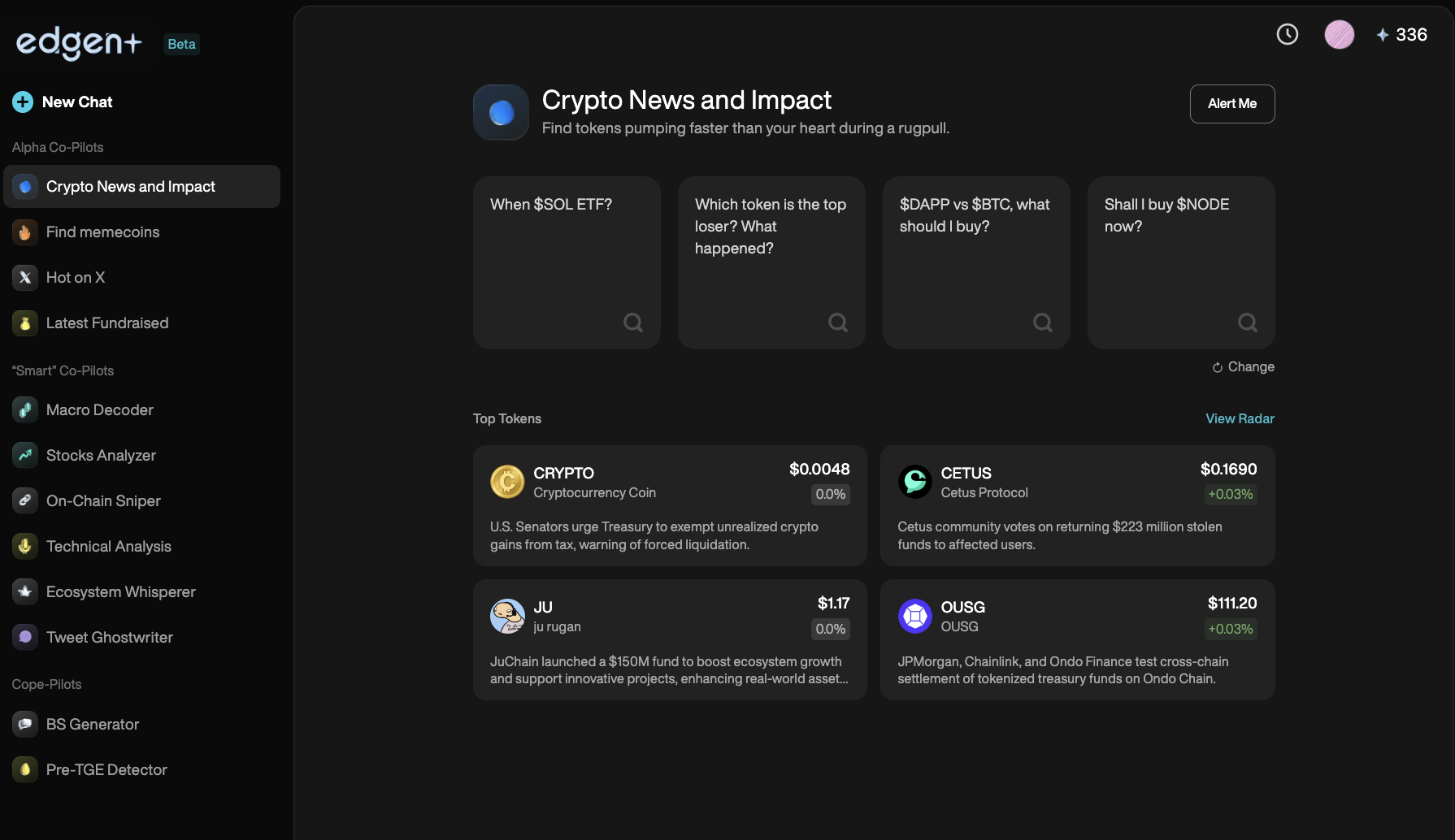
  • Edgen Radaraffiche en temps réel l'orientation du marché, les variations de prix et les signaux d'alpha.
  • Edgen Searchrépondre aux questions détaillées du marché à l'aide de données vérifiées, éliminant le bruit.
  • Edgen Insightsoffre un centre de collaboration pour les traders afin qu'ils puissent partager instantanément leurs analyses.

Le trading sans IA limite fortement la visibilité du marché. Edgen AI permet aux traders de voir ce que les autres ignorent.

Alpha Signal Trading : Trouver des opérations gagnantes

Les signaux Alpha fournissent des indications précoces des opérations rentables.

Exemples de Signaux Alpha :

  • Déplacements brusques des prix : des pics ou chutes rapides signalent des points d'action.
  • Pics de volume : un fort volume de trading indique des opportunités.
  • Activités sur la chaîne : Les portefeuilles de whales et les mouvements des portefeuilles influents prédisent les mouvements du marché.
  • Sentiment social : la hype de la communauté prévoit des hausses de prix des cryptomonnaies.

Edgen Radaridentifie ces signaux instantanément, tout enEdgen Searchsuivent les traders influents et les sujets tendances, permettant aux traders d'agir en premier.

Meilleures stratégies pour le trading Alpha définies

Pour trader de manière rentable, suivez des stratégies d'alpha éprouvées :

1. Suivi de tendance

identifier les tendances du marché fortes dès le début. Utiliser des alertes IA pour entrer et sortir au bon moment.

2. Réversion à la moyenne

Le commerce identifie les conditions de surachat ou de survente en direction de la valeur juste. L'IA repère les moments optimaux pour trader.

3. Arbitrage intelligent

Capturez instantanément les écarts de prix entre les échanges. Des bots d'IA exécutent efficacement les opérations.

Edgen AI développe des outils spécialisés pour exécuter ces stratégies avec précision.

Pourquoi les données sur la chaîne sont-elles importantes dans le trading d'alpha

Les transactions sur la blockchain fournissent des informations, révélant des signaux de trading critiques :

  • Les portefeuilles intelligents : Les principaux portefeuilles influencent les prix du marché cryptographique.
  • Activité des contrats intelligents : Les tendances DeFi émergent des dApps actives.
  • Flux de liquidité : Les mouvements d'argent vers et provenant des échanges signalent des changements sur le marché à venir.

Edgen Radarfournit des informations en temps réel sur la blockchain, permettant aux traders d'agir de manière décisive avant les autres.

Les erreurs courantes des traders expliquées (et comment les éviter)

  • Erreur : Négocier sans plan.

Solution : Définir les points d'entrée et de sortie avant d'entrer dans une opération.

  • Erreur : Négliger les données sociales et blockchain.

Solution : Reconnaître que les récits et les activités liées aux blockchain alimentent les marchés aujourd'hui.

  • Erreur : Surplus de trading en raison de la peur de manquer quelque chose (FOMO).

Solution : Privilégier la qualité à la quantité. L'IA aide à éliminer les biais émotionnels.

  • Erreur : Négocier comme les investisseurs de détail typiques.

Solution : Utiliser l'intelligence artificielle, l'analyse de la blockchain et des outils d'automatisation pour un avantage décisif.
L'avenir du trading Alpha et de l'intelligence artificielle

Les stratégies de trading se sont orientées vers l'intelligence artificielle, l'analyse de la blockchain et l'intelligence sociale.

Où va désormais Alpha Trading :

  • La domination de l'IA : les machines prédisent et exécutent des opérations mieux que les humains.
  • Analyse de la blockchain : les données sur la chaîne deviennent une analyse du marché standard.
  • Intelligence sociale : capture l'émotion comme nouvelle mesure fondamentale.

Edgen AI mène ce changement, intégrant de manière transparente les analyses de la blockchain, le sentiment social et les stratégies pilotées par l'intelligence artificielle.

Comment les traders restent en avance

Les traders qui réussissent dans le trading alpha suivent constamment ces règles d'or :

  • utiliserEdgen Radar,Edgen Search, etEdgen Feedpour des informations précises.
  • surveiller les activités sur la blockchain, en particulier les mouvements des portefeuilles de whales.
  • suivre les tendances de l'opinion publique sociale, car la hype déplace les marchés de façon décisive.
  • éviter le trading émotionnel en suivant strictement les signaux d'IA basés sur des données.
  • Restez adaptable ; les dynamiques du marché évoluent constamment.

Les meilleurs traders anticipent les mouvements du marché avant que les autres ne les suivent.

Recommend
banner.jpg

What is a money person? The plain-English alternative to a financial advisor

The short version: a money person is a smart, warm friend who happens to be good with money and explains it like a person, not a bank. Practically, it's a second opinion on your whole financial picture — cash, debt, tax exposure, concentration, and the goals you're working toward — that tells you in plain language what to look at first. It's not a traditional advisor managing your portfolio for 1% a year, and it's not a coach cheering you on. It's the honest read a good advisor's first meeting would give you, without the fee or the asset minimum. It's the role Ed Wealth was built to play. Strip away the label and a money person does four concrete things: Just as important is what it doesn't do: it doesn't take custody of your money, it doesn't sell you products for commission, and it doesn't pretend a forecast is a promise. It's a second opinion: it shows you the structure and lets you decide. People reach for four different things when they say "I should talk to someone." They're not
Edgen
·
Jul 10 2026
banner.jpg

Is a financial advisor worth it? Advisor vs robo vs money person

The short version: a financial advisor is worth it when your money has real complexity — a business, concentrated stock, an estate, a divorce, or turning savings into retirement income. There, a fee pays for itself. But most people don't have a complexity problem; they have a clarity one, and paying 1% of your assets a year — about $3,000 on a $300,000 portfolio, every year — is a lot to pay for reassurance. You have three tiers to choose from: a human advisor (~1% of assets), a robo-advisor (~0.25%), and a money person — a flat-fee second opinion that doesn't grow as your savings do. Start with the honest case for paying. A good advisor earns their fee when your situation is genuinely complex: selling a business, a big block of company stock or options, an estate with kids, a divorce, a windfall, or building a retirement-income plan with real moving parts. In those moments, one right call can save you many times the fee, and the job becomes picking a good one (that's how to choose a f
Edgen
·
Jul 10 2026
banner.jpg

Do You Actually Need a Financial Advisor? (An Honest Test)

The short version: you need a financial advisor when your money has genuine complexity — equity comp across several employers, a business sale, an estate with kids involved, a divorce, a sudden windfall, or a retirement-drawdown plan with real moving parts. If your situation is closer to "I earn well but somehow feel behind," that's a clarity problem, not a complexity one, and hiring someone to manage your money for about 1% a year is an expensive way to solve it. Here's how to tell which one you have. Almost everyone reaching for an advisor falls into one of two camps, and confusing them is where money gets wasted. A complexity problem is when there are real moving parts that interact: decisions where a wrong move costs far more than any fee. Selling a company, exercising stock options with a tax bill attached, splitting assets in a divorce, planning how to draw income across a 30-year retirement. Here, a good advisor earns their keep. A clarity problem looks different. Good income, a
Edgen
·
Jul 06 2026
banner.jpg

How to Choose a Financial Advisor in 2026 (and Whether You Even Need One)

The short version: picking a financial advisor isn't about finding the "smartest" one. It comes down to three boring questions that actually predict whether you'll be treated well: are they legally a fiduciary, how do they get paid, and do you even need one yet. Get those right and the rest is noise. Here's how to run the check — and what to do if you want guidance but can't (or don't want to) meet a $250,000 minimum. Before you choose one, ask whether this is the right tool at all. A full-service advisor earns their fee when your situation is genuinely complex — a business sale, equity comp across several companies, estate planning, a divorce, a sudden windfall, or a retirement-income plan with real moving parts. But a lot of people reaching for an advisor don't have a complexity problem. They have a clarity problem: a good income, a few scattered accounts, and a nagging sense of being behind. That doesn't need someone to manage your money for 1% a year. It needs a clear read on where
Edgen
·
Jul 06 2026
Redeem miles for gift cards and each is worth ~1 cent; redeem for long-haul business and they're worth 2.5-4+. With programs now dynamically priced, the one check that decides every redemption.

How to redeem airline miles without wasting them

The single biggest mistake with miles is redeeming them for the easy stuff: gift cards, merchandise, seat upgrades at the gate. Do that and each mile is worth about one cent. Redeem the *same* miles for flights, especially long-haul or premium-cabin flights, and they're often worth two to five cents each, sometimes more. So the real skill isn't earning miles; it's not throwing away their value at the finish line. Here's how to actually use them. A mile has no fixed price; its value depends entirely on what you redeem it for. The way to judge any redemption is simple math: (cash price of the flight) ÷ (miles it costs) = cents per mile. If a flight costs $400 or 20,000 miles, that's 2 cents a mile, a solid deal. If a $90 flight costs 18,000 miles, that's half a cent, which is terrible; pay cash and keep the miles. Run this check before every redemption. It instantly separates a great use from a waste, and it's the one habit that makes miles worth having. As a rule of thumb, most major ai
Edgen
·
Jun 30 2026
Short-term goals (under ~3 years) belong in safe cash; long-term goals (5+ years) can take market risk. The best HYSAs now pay ~4-5% APY. How to sort yours and run both.

Long-term vs short-term financial goals (and how to plan both)

The difference comes down to one thing: time. A short-term goal is money you'll need within roughly three years (an emergency fund, a trip, a wedding, next year's tax bill), so it has to be *safe and reachable*. A long-term goal is five-plus years out (retirement, a house down the road, a kid's education), so it can take market risk, because time smooths the bumps out. Get that match right and you've done most of the work. It's not the size, it's the deadline. A $2,000 goal you need in six months is short-term; a $2,000 goal you won't touch for fifteen years is long-term, and they belong in completely different places. This is the part that actually matters, and where people lose money without realizing it. Short-term money should not be in the stock market. If your emergency fund is in stocks and the market drops 20% the same month your car dies, you're selling at the worst possible time. Short-term goals go somewhere stable and accessible, and a high-yield savings account is the clas
Edgen
·
Jun 30 2026
Mortgages near 6.5%, home prices flat, and the Fed split on rate cuts vs hikes. With timing a coin flip, the 3 questions that actually decide whether to buy now or wait.

Should you buy a house now or wait? How to actually decide

The honest answer: buy when you'll stay put for at least five years and you'll still have an emergency fund left after the down payment. Otherwise, waiting (and renting) is often the smarter money move, not the weaker one. "Rent vs buy" isn't a math problem with one right answer, and it's almost never really about timing the market. It's about your *life*, in three questions. Before the three questions, here's the mid-2026 backdrop — because "now or wait" usually hides a bet on rates and prices, and the data says that bet is a coin flip. The picture: mortgages are still pricey, prices have gone flat (more than half of the 20 big metros saw year-over-year declines in March), and the cheap-money era hasn't returned. So "buy before it runs away" and "wait for the crash" are *both* weak arguments right now. The whole "wait for rates to drop" plan rests on the Fed, and the Fed is split down the middle. In its June 2026 projections, policymakers were divided: 8 expected no change this year,
Edgen
·
Jun 30 2026
Most financial goals fail because they're wishes, not systems. Here's the 3-part anatomy of a goal that sticks (a number, a date, one automatic move), plus why 37% of adults can't cover a $400 surprise.

How to set financial goals you'll actually hit

A financial goal you'll actually hit has three things a vague wish doesn't: a number, a date, and one automatic move that happens whether or not you remember it. "Save more" is a wish. "$6,000 in a separate account by next December, $500 auto-transferred on payday" is a goal. The gap between those two sentences is the reason most goals quietly die, and it has almost nothing to do with willpower. Key Takeaways A real financial goal answers three questions: how much, by when, and what for. Drop any one and it stops working. "Pay off debt" has no number and no date, so there's nothing to aim at or measure, while "$8,000 of card debt cleared in 18 months" tells you exactly whether you're on track and the day you're done. The "what for" matters more than people expect. A goal tied to something real (a buffer so a bad month isn't a crisis, a deposit on a first place) survives the months when motivation dips. In our experience reading how people actually use a money tool, the goals that get
Edgen
·
Jun 30 2026
A big RSU grant just vested — now what? Here's what a modern money tool actually surfaces first, using Ed as a worked example: a reality check, the 22% tax gap most high earners miss, and the concentration risk nobody flags.

Your RSUs Just Vested. Here's What a Money Tool Surfaces First.

You just had a big RSU grant vest. Congratulations — and now the awkward part: a six-figure pile of your own company's stock, a vague sense you should "do something," and no one actually telling you what. An advisor, a spreadsheet, and a piece of software each handle this moment differently. Here's what a modern money tool surfaces in a moment like this — using Ed as a worked example — so you can decide what kind of help actually fits. Key takeaways You connect your brokerage and bank through read-only aggregation, so the tool can read balances but can't move a dollar. Ed's framing is simple: precise about your money, blind to your identity. Instead of sorting your lattes into categories, Ed opens on a single Financial Reality Check — a read on whether your money could survive a bad month. For a lot of high earners, that one number lands harder than any budget, because it answers a question the other apps never ask. (If the Reality Check is the numbers side, your money type is the beha
Edgen
·
Jun 26 2026
A money personality test is more than a quiz if it measures behavior, not just vibes. Here's the science behind money types, how Ed's test works, and how to use your result.

What Is a Money Personality Test? The Science Behind Your Money Type

The short version: a good money personality test should feel like a roast and work like a mirror — fun on the surface, behavioral underneath. The useful ones don't tell you what you know; they show you how you act with money, and the one blind spot worth watching. Key takeaways Here's the uncomfortable backdrop. U.S. financial literacy has been stuck for a decade — adults answer only about 49% of the standard knowledge questions correctly, essentially flat since 2017 (TIAA Institute–GFLEC, 2025) — even as free financial information became infinite. If facts fixed money, they'd have fixed it by now. They don't, because the thing that actually drives your outcomes lives one level below the facts: how you're wired to behave when money is on the line. That's the whole premise of financial fitness — and it's what a money personality test is built to surface. Not what you know. What you do. The idea has real research behind it — money behavior is patterned and measurable, and a few tradition
Edgen
·
Jun 23 2026

Investir, enfin, tu n'es plus seul.

Essaie Edgen gratuitement. Sans carte, sans engagement.