Content
TL;DR
¿Qué es Moonbirds?
¿Quién es el equipo detrás de Moonbirds?
¿Cuánto recaudaron y quiénes son los patrocinadores?
¿Cuál es la valoración del proyecto?
¿Hay alguna oportunidad de airdrop?
¿Cómo puedo acceder a la oportunidad de airdrop?
Pronóstico de valoración TGE
Preguntas frecuentes (FAQ)

Markets Confusing? Ask Edgen Search.

Instant answers, zero BS, and trading decisions your future self will thank you for.

Try Search Now

¿Qué es Moonbirds? – Guía para principiantes del IP que regresa

· Mar 31 2026
¿Qué es Moonbirds? – Guía para principiantes del IP que regresa

Una guía sencilla del proyecto Moonbirds, su equipo, patrocinadores, ángulos de airdrop y un pronóstico positivo del proyecto para los recién llegados. Puede encontrar un informe detallado sobre Moonbirds aquí:

TL;DR

  • Moonbirds es un proyecto PFP NFT de primer nivel ahora liderado por Orange Cap Games (OCG), con un plan de recuperación centrado en la comunidad, la IP y los productos.
  • Respaldado por inversores de primer nivel a lo largo de las épocas: a16z y ahora 1kx + Yuga Labs (semilla), lo que indica una gran confianza en el futuro del proyecto.
  • La utilidad real está regresando a través de asociaciones (por ejemplo, Kaito AI social-to-earn) y avatares 3D para Otherside, impulsando la narrativa y el impulso del precio del proyecto.
  • Pronóstico del proyecto: una historia de resurgimiento creíble que aplica el “Pudgy playbook”, es decir, activación de la comunidad + productos físicos/digitales, apunta a un futuro prometedor, con un alza impulsada por la ejecución.

¿Qué es Moonbirds?

Moonbirds es una colección PFP de Ethereum de 10.000 piezas (lanzada el 16 de abril de 2022). Comenzó bajo PROOF (Kevin Rose) con utilidades como Nesting (un sistema de retención y ganancia similar al staking), acceso a PROOF Collective y lanzamientos de arte (por ejemplo, Grails, Oddities).

Después de una era de Yuga Labs alineada con el metaverso Otherside, la IP fue adquirida por Orange Cap Games (OCG) en mayo de 2025. El plan de OCG: reiniciar la marca con una estrategia que priorice a la comunidad, canales principales (Giphy/IG/TikTok) y expansión de productos, haciendo eco del exitoso cambio de Pudgy Penguins.

¿Quién es el equipo detrás de Moonbirds?

  • Operador actual: Orange Cap Games (OCG), liderado por Spencer Gordon-Sand (inversor/operador cripto-nativo; cofundador de OCG; lanzó Vibes TCG para Pudgy Penguins con millones en ingresos).
  • Creatividad y operaciones: liderado por un equipo reducido con enlaces de fabricación internos en Asia, lo que permite ciclos rápidos de productos físicos/digitales.
  • Eras anteriores: PROOF (Kevin Rose, Justin Mezzell) > administración de Yuga Labs > reinicio completo de OCG.

¿Cuánto recaudaron y quiénes son los patrocinadores?

  • Histórico (PROOF): 10 millones de dólares (Seven Seven Six) + 50 millones de dólares en Serie A liderados por a16z con True Ventures, Collab+Currency, Flamingo DAO, SV Angel, VaynerFund, etc.
  • Actual (OCG): 3,5 millones de dólares en capital semilla (junio de 2025) co-liderados por 1kx y Yuga Labs, tras una pre-semilla de 2 millones de dólares. OCG también obtiene ingresos de las tarjetas coleccionables Vibes (más de 4 millones de tarjetas vendidas).
  • Por qué es importante: los patrocinadores de alto nivel validan la IP y el nuevo plan centrado en la ejecución, lo que es bueno para la confianza en la valoración del proyecto.

¿Cuál es la valoración del proyecto?

El precio del proyecto NFT de Moonbirds y la capitalización de mercado se mueven con el sentimiento y la ejecución. El contexto reciente de la capitalización de mercado se sitúa en torno a cientos de millones de USD equivalentes para la colección, con una actividad que se fortalece a medida que OCG implementa utilidades y asociaciones. (Las valoraciones fluctúan; esto no es un consejo de inversión).

¿Hay alguna oportunidad de airdrop?

Sí. Los ángulos recientes han incluido:

  • Acceso al airdrop Monad ($MON) para los poseedores de Moonbirds/Mythics/Oddities.
  • Precedente de participación en el airdrop de Towns a través de la vinculación de la billetera.
  • Kaito AI x Moonbirds: gane Yap Points por contenido social de calidad; los puntos pueden alinearlo para futuras recompensas.

¿Cómo puedo acceder a la oportunidad de airdrop?

  1. Tenga un NFT del ecosistema Moonbirds (Moonbird / Mythic / Oddity).
  2. Únase a los canales oficiales (Discord/Telegram/X) para obtener acceso a listas blancas y instantáneas.
  3. Complete tareas (por ejemplo, flujos de contenido de Kaito AI) con su billetera vinculada.
  4. Esté atento a las instantáneas/fechas límite de reclamo; vincule las billeteras con anticipación si es necesario.

Pronóstico de valoración TGE

A continuación, se presenta un pronóstico de proyecto simplificado para una posible TGE de $TALONS, basado en la ejecución y las condiciones del mercado:

Escenario

FDV (USD)

Narrativa

Caso alcista

750 millones $ – 1.2 mil millones $

Fuerte ejecución + mercado caliente; producto(s) exitoso(s) + utilidad del token impulsan una nueva calificación.

Caso base

300 millones $ – 500 millones $

Entrega sólida en un mercado mixto; la utilidad y las asociaciones mantienen un crecimiento constante.

Caso bajista

150 millones $ – 250 millones $

Ejecución más lenta o mercado más frío; la comunidad sigue anclando el valor, pero el alza se atenúa.

Esta es una proyección educativa de los rangos de valoración del proyecto, no un consejo financiero.

Preguntas frecuentes (FAQ)

P1: ¿Moonbirds lanzará un token?
R: El ecosistema destaca a $TALONS como el token de recompensa probable vinculado a Nesting. Aún no hay detalles oficiales de TGE: esté atento a los canales oficiales.

P2: ¿Qué utilidad tiene Moonbirds más allá del arte?
R: Recompensas de Nesting, poder de voto de DAO (Lunar Society), asociaciones (por ejemplo, Kaito AI), acceso a airdrops y próximos avatares 3D para Otherside.

P3: ¿Por qué los inversores están entusiasmados de nuevo?
R: El “reinicio completo” de OCG aplica un plan de recuperación probado (comunidad > IP > productos), con fuertes patrocinadores y una tracción temprana visible.

P4: ¿Qué tan riesgoso es este proyecto?
R: Todos los proyectos de criptomonedas conllevan riesgos. La velocidad de ejecución, los ciclos de mercado y el diseño del token son importantes. Diversifique y realice su propia investigación.

P5: ¿Por dónde puedo empezar como novato?
R: Únase a Discord/Telegram, siga las cuentas oficiales de X, conecte una billetera y pruebe el flujo de contenido a puntos de Kaito AI.

Recommend
Redeem miles for gift cards and each is worth ~1 cent; redeem for long-haul business and they're worth 2.5-4+. With programs now dynamically priced, the one check that decides every redemption.

How to redeem airline miles without wasting them

The single biggest mistake with miles is redeeming them for the easy stuff: gift cards, merchandise, seat upgrades at the gate. Do that and each mile is worth about one cent. Redeem the *same* miles for flights, especially long-haul or premium-cabin flights, and they're often worth two to five cents each, sometimes more. So the real skill isn't earning miles; it's not throwing away their value at the finish line. Here's how to actually use them. A mile has no fixed price; its value depends entirely on what you redeem it for. The way to judge any redemption is simple math: (cash price of the flight) ÷ (miles it costs) = cents per mile. If a flight costs $400 or 20,000 miles, that's 2 cents a mile, a solid deal. If a $90 flight costs 18,000 miles, that's half a cent, which is terrible; pay cash and keep the miles. Run this check before every redemption. It instantly separates a great use from a waste, and it's the one habit that makes miles worth having. As a rule of thumb, most major ai
Edgen
·
Jun 30 2026
Short-term goals (under ~3 years) belong in safe cash; long-term goals (5+ years) can take market risk. The best HYSAs now pay ~4-5% APY. How to sort yours and run both.

Long-term vs short-term financial goals (and how to plan both)

The difference comes down to one thing: time. A short-term goal is money you'll need within roughly three years (an emergency fund, a trip, a wedding, next year's tax bill), so it has to be *safe and reachable*. A long-term goal is five-plus years out (retirement, a house down the road, a kid's education), so it can take market risk, because time smooths the bumps out. Get that match right and you've done most of the work. It's not the size, it's the deadline. A $2,000 goal you need in six months is short-term; a $2,000 goal you won't touch for fifteen years is long-term, and they belong in completely different places. This is the part that actually matters, and where people lose money without realizing it. Short-term money should not be in the stock market. If your emergency fund is in stocks and the market drops 20% the same month your car dies, you're selling at the worst possible time. Short-term goals go somewhere stable and accessible, and a high-yield savings account is the clas
Edgen
·
Jun 30 2026
Mortgages near 6.5%, home prices flat, and the Fed split on rate cuts vs hikes. With timing a coin flip, the 3 questions that actually decide whether to buy now or wait.

Should you buy a house now or wait? How to actually decide

The honest answer: buy when you'll stay put for at least five years and you'll still have an emergency fund left after the down payment. Otherwise, waiting (and renting) is often the smarter money move, not the weaker one. "Rent vs buy" isn't a math problem with one right answer, and it's almost never really about timing the market. It's about your *life*, in three questions. Before the three questions, here's the mid-2026 backdrop — because "now or wait" usually hides a bet on rates and prices, and the data says that bet is a coin flip. The picture: mortgages are still pricey, prices have gone flat (more than half of the 20 big metros saw year-over-year declines in March), and the cheap-money era hasn't returned. So "buy before it runs away" and "wait for the crash" are *both* weak arguments right now. The whole "wait for rates to drop" plan rests on the Fed, and the Fed is split down the middle. In its June 2026 projections, policymakers were divided: 8 expected no change this year,
Edgen
·
Jun 30 2026
Most financial goals fail because they're wishes, not systems. Here's the 3-part anatomy of a goal that sticks (a number, a date, one automatic move), plus why 37% of adults can't cover a $400 surprise.

How to set financial goals you'll actually hit

A financial goal you'll actually hit has three things a vague wish doesn't: a number, a date, and one automatic move that happens whether or not you remember it. "Save more" is a wish. "$6,000 in a separate account by next December, $500 auto-transferred on payday" is a goal. The gap between those two sentences is the reason most goals quietly die, and it has almost nothing to do with willpower. Key Takeaways A real financial goal answers three questions: how much, by when, and what for. Drop any one and it stops working. "Pay off debt" has no number and no date, so there's nothing to aim at or measure, while "$8,000 of card debt cleared in 18 months" tells you exactly whether you're on track and the day you're done. The "what for" matters more than people expect. A goal tied to something real (a buffer so a bad month isn't a crisis, a deposit on a first place) survives the months when motivation dips. In our experience reading how people actually use a money tool, the goals that get
Edgen
·
Jun 30 2026
A big RSU grant just vested — now what? Here's what a modern money tool actually surfaces first, using Ed as a worked example: a reality check, the 22% tax gap most high earners miss, and the concentration risk nobody flags.

Your RSUs Just Vested. Here's What a Money Tool Surfaces First.

You just had a big RSU grant vest. Congratulations — and now the awkward part: a six-figure pile of your own company's stock, a vague sense you should "do something," and no one actually telling you what. An advisor, a spreadsheet, and a piece of software each handle this moment differently. Here's what a modern money tool surfaces in a moment like this — using Ed as a worked example — so you can decide what kind of help actually fits. Key takeaways You connect your brokerage and bank through read-only aggregation, so the tool can read balances but can't move a dollar. Ed's framing is simple: precise about your money, blind to your identity. Instead of sorting your lattes into categories, Ed opens on a single Financial Reality Check — a read on whether your money could survive a bad month. For a lot of high earners, that one number lands harder than any budget, because it answers a question the other apps never ask. (If the Reality Check is the numbers side, your money type is the beha
Edgen
·
Jun 26 2026
A money personality test is more than a quiz if it measures behavior, not just vibes. Here's the science behind money types, how Ed's test works, and how to use your result.

What Is a Money Personality Test? The Science Behind Your Money Type

The short version: a good money personality test should feel like a roast and work like a mirror — fun on the surface, behavioral underneath. The useful ones don't tell you what you know; they show you how you act with money, and the one blind spot worth watching. Key takeaways Here's the uncomfortable backdrop. U.S. financial literacy has been stuck for a decade — adults answer only about 49% of the standard knowledge questions correctly, essentially flat since 2017 (TIAA Institute–GFLEC, 2025) — even as free financial information became infinite. If facts fixed money, they'd have fixed it by now. They don't, because the thing that actually drives your outcomes lives one level below the facts: how you're wired to behave when money is on the line. That's the whole premise of financial fitness — and it's what a money personality test is built to surface. Not what you know. What you do. The idea has real research behind it — money behavior is patterned and measurable, and a few tradition
Edgen
·
Jun 23 2026
A financial reality check scores where you actually stand across safety, control, progress, upside, and Mental Load. Here's why a money score matters, how Ed's checkup works, and what to do with your weakest area.

What Is a Financial Reality Check? Why Your Credit Score Isn't Enough

The short version: your credit score measures how safe you are to lend to. Almost nobody has ever seen the number that measures whether you are actually secure. A financial reality check is that second number. Key takeaways Ask people for their credit score and many can recite it. Ask whether they could survive three months without income, or where their money quietly leaks each month, and you get a shrug. That's the gap. A credit score answers a lender's question — how risky is it to extend this person debt? It can be high while your life is fragile, or low while you're genuinely fine, because it was never built to measure you. A financial reality check answers the question the credit score ignores: are you safe, clear, progressing, building, and at ease? Here's the simple version, with the research behind each axis.
Edgen
·
Jun 23 2026
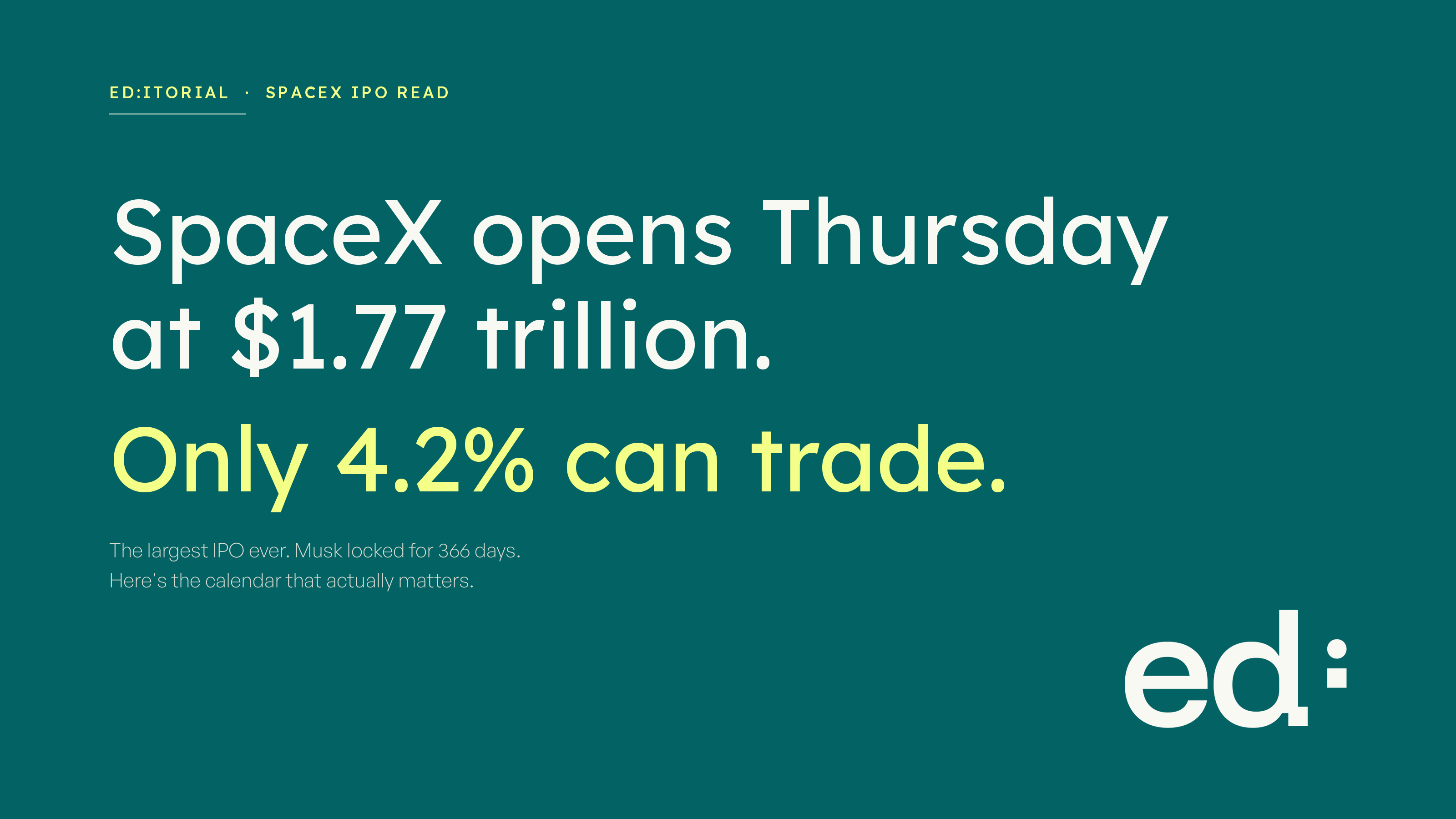
SpaceX opens Thursday at a $1.77 trillion valuation — the largest IPO ever. Only 4.2% of stock actually trades. Musk is locked up for 366 days. The next 366 days run on an unusually clean calendar of supply releases. Here are the 13 dates worth watching.

SpaceX goes public Thursday with a possible $5 trillion hit. Here's the calendar that actually matters.

SpaceX prices Wednesday night and opens Thursday on Nasdaq at $135 per share — a $1.77 trillion valuation, the largest IPO ever. Most coverage will frame what comes next as a sentiment trade, an Elon story, or a race to Goldman's $5 trillion bull case. The reality is more grounded and more useful: the next 366 days are governed by an unusually clean calendar of supply releases — when 95.8% of the company can or cannot trade, when index funds add weight, when the lock-up cliff arrives, when Musk himself becomes a potential seller for the first time. Read the calendar and you've already understood the structure most market commentary will spend the next quarter trying to explain. Here are the 13 dates worth watching. Two things keep showing up in headlines that don't survive a careful read. The first is the idea that index funds are about to be forced into a massive single-event SpaceX buy. They aren't. Nasdaq did create a fast-track inclusion rule that lets SpaceX join the Nasdaq 100 wi
Edgen
·
Jun 10 2026

Invertir, por fin, ya no es cosa de uno solo.

Prueba Ed gratis. Sin tarjeta, sin compromiso.