Content
En bref
Principes fondamentaux du projet
Protocole & Technologie
Équipe et Exécution
Narratif et Sentiment du Marché
Sentiment Social
Adoption On-Chain
Métriques On-Chain Clés
Analyse Technique (au 17 septembre 2025)
Facteurs de Croissance et Risques
Facteurs de Croissance
Risques
Scénarios de Valorisation (6-12 Mois)
Scénarios FDV de Solana
Thèse d'Investissement et Indicateurs Clés
Résumé de la Thèse d'Investissement
Indicateurs Clés à Surveiller

Markets Confusing? Ask Edgen Search.

Instant answers, zero BS, and trading decisions your future self will thank you for.

Try Search Now

Examen de Solana au T2 2025 : La couche de performance de niveau institutionnel

· Mar 31 2026
Examen de Solana au T2 2025 : La couche de performance de niveau institutionnel

Solana (SOL) est une blockchain Layer 1 haute performance qui consolide sa position en tant qu'infrastructure de base pour la finance institutionnelle et les applications décentralisées grand public.

En bref

  • Solana est devenue une blockchain haute performance de premier plan, démontrant une croissance robuste en termes d'activité des développeurs, d'adoption par les utilisateurs et de valeur économique on-chain.
  • Le principal catalyseur à court terme du réseau est l'approbation potentielle des ETF spot Solana aux États-Unis, ce qui pourrait débloquer des capitaux institutionnels importants.
  • Un risque majeur est le déverrouillage prévu d'une importante tranche de jetons SOL provenant de la masse successorale de FTX en mars 2025, ce qui mettra à l'épreuve la capacité d'absorption du marché.
  • La santé fondamentale est solide, comme en témoignent plus de 1,25 milliard de dollars de revenus cumulés, un nombre d'utilisateurs actifs quotidiens maintenu au-dessus de 2,3 millions et une position dominante en volume DEX.
  • Des mises à niveau technologiques telles que le client Firedancer et la refonte du consensus Alpenglow à venir visent à résoudre de manière permanente les problèmes de stabilité historiques et à consolider son avance en matière de performances.

Principes fondamentaux du projet

Solana est un réseau Layer 1 open source conçu pour des solutions de finance décentralisée (DeFi) à haute vitesse et faible coût. Son état unique, partagé globalement, est optimisé pour l'évolutivité et la performance, ce qui le rend adapté aux applications à haute fréquence.

Protocole & Technologie

L'architecture de Solana est conçue pour atteindre des débits théoriques allant jusqu'à 65 000 transactions par seconde (TPS). Les innovations clés incluent :

  • Preuve d'Historique (PoH) : Une horloge cryptographique qui crée un ordre d'événements vérifiable et horodaté.
  • Sealevel : Un environnement d'exécution de contrats intelligents parallèle qui permet l'exécution concurrente des transactions.
  • Mises à jour récentes : QUIC, QoS pondéré par le stake et les Marchés de frais localisés ont considérablement amélioré la stabilité, contribuant à plus de 19 mois de disponibilité à 100 %.

Équipe et Exécution

  • Solana Labs : Fondée par Anatoly Yakovenko, Raj Gokal et Greg Fitzgerald, l'équipe a fait ses preuves en matière de résolution des défis techniques fondamentaux.
  • Solana Foundation : Dirigée par Lily Liu, la fondation favorise la croissance de l'écosystème, la décentralisation et la sensibilisation des développeurs, aidant à faire de Solana la blockchain leader pour l'activité des développeurs.

Narratif et Sentiment du Marché

Le narratif de Solana est passé de « Tueur d'Ethereum » à « NASDAQ de la cryptographie », reflétant sa position de L1 haute performance pour les applications grand public, la DeFi à haute fréquence et les Réseaux d'Infrastructure Physique Décentralisés (DePIN).

Sentiment Social

L'analyse de plus de 1 000 documents récents montre que le sentiment est majoritairement positif. Cela est favorisé par un fort engagement communautaire via des événements comme Solana Breakpoint et les Hacker Houses locales.

Adoption On-Chain

Les métriques on-chain de Solana démontrent une adoption robuste et croissante, générant plus de 1,25 milliard de dollars de revenus on-chain depuis le début de l'année.

Métrique

Valeur Actuelle

Perspective

Capitalisation boursière

127,38 milliards $

Classement 6ème, montrant une validation significative du marché.

Portefeuilles Actifs Quotidiens

> 2,3 millions

Indique une base d'utilisateurs importante et soutenue.

TVL DeFi

> 12,7 milliards $

Consolide sa position de #2 blockchain selon cette métrique.

Volume DEX Quotidien

> 4,9 milliards $

Domine l'activité DEX, représentant 81% de tout le volume.

Métriques On-Chain Clés

Analyse Technique (au 17 septembre 2025)

Les indicateurs techniques pour Solana sur le graphique journalier montrent une dynamique haussière, le prix se négociant près de son plus haut sur 24 heures.

Indicateur

Valeur

Signal

Prix

234,33 $

Se négocie près du plus haut sur 24 heures de 240,55 $.

RSI (14)

64,72

Momentum haussier, pas encore de surachat.

MACD (12,26,9)

Histogramme: 1.701

La ligne MACD est au-dessus de la ligne de signal, un croisement haussier.

Bandes de Bollinger (20,2)

Supérieure : 247,1 $

Le prix se négocie dans la moitié supérieure, indiquant une force.

Facteurs de Croissance et Risques

Facteurs de Croissance

  • Approbation des ETF Spot aux États-Unis : Le catalyseur à court terme le plus important, avec une forte probabilité d'approbation d'ici octobre 2025.
  • Firedancer & Alpenglow : Des mises à niveau promettant de résoudre les problèmes de stabilité et d'apporter une amélioration d'environ 80x de la finalité des transactions.
  • Adoption Institutionnelle : La tendance accélérée à l'adoption par les trésoreries d'entreprise fournit une nouvelle couche de demande structurelle.

Risques

  • Déverrouillage des actifs de FTX : Le déverrouillage en mars 2025 d'une tranche de SOL de plusieurs milliards de dollars est le risque le plus important du côté de l'offre.
  • Centralisation des clients : Plus de 90 % de la participation du réseau utilise le client Jito-Solana, ce qui représente un point de défaillance unique potentiel jusqu'à l'adoption de Firedancer.
  • Examen Réglementaire : Les activités spéculatives à volume élevé pourraient devenir une cible pour les régulateurs.

Scénarios de Valorisation (6-12 Mois)

Scénarios

Valorisation entièrement diluée (FDV)

Facteurs Clés

Scénario Haussier

314 Mds $ - 393 Mds $

Déploiement impeccable de Firedancer, approbation des ETF et environnement macroéconomique favorable.

Scénario de Base

115 Mds $ - 153 Mds $

Forte croissance du réseau atténuée par un environnement macroéconomique défavorable.

Scénario Baissier

90 Mds $ - 128 Mds $

Échecs d'exécution (par exemple, un déploiement bâclé de Firedancer) alors que le marché crypto est haussier.

Scénarios FDV de Solana

Thèse d'Investissement et Indicateurs Clés

Résumé de la Thèse d'Investissement

Solana est passée avec succès à un réseau Layer 1 fondamentalement robuste et reconnu par les institutions. Sa technologie de base offre un avantage concurrentiel durable dans les cas d'utilisation à haute fréquence, ce qui s'est traduit par une activité économique on-chain supérieure. Les perspectives d'avenir présentent un profil risque/récompense asymétrique, dominé par le potentiel transformateur d'une approbation d'ETF spot américain, face au risque bien défini du déverrouillage de l'approvisionnement FTX en mars 2025.

Indicateurs Clés à Surveiller

  • Décision et Afflux d'ETF Spot aux États-Unis : Une approbation et des afflux nets subséquents supérieurs à 4 milliards de dollars au cours des six premiers mois constitueraient une validation puissante.
  • Absorption par le marché du déverrouillage de FTX : Une absorption ordonnée de l'offre de mars 2025 sans perturbation significative des prix.
  • Taux d'adoption de Firedancer : Dépasser un poids de participation de 33 % exécutant le client Firedancer serait un événement de dérisquage transformateur.
  • Métriques de Santé On-Chain : Croissance soutenue des utilisateurs actifs quotidiens, du volume DEX et du TVL.

Recommend
Redeem miles for gift cards and each is worth ~1 cent; redeem for long-haul business and they're worth 2.5-4+. With programs now dynamically priced, the one check that decides every redemption.

How to redeem airline miles without wasting them

The single biggest mistake with miles is redeeming them for the easy stuff: gift cards, merchandise, seat upgrades at the gate. Do that and each mile is worth about one cent. Redeem the *same* miles for flights, especially long-haul or premium-cabin flights, and they're often worth two to five cents each, sometimes more. So the real skill isn't earning miles; it's not throwing away their value at the finish line. Here's how to actually use them. A mile has no fixed price; its value depends entirely on what you redeem it for. The way to judge any redemption is simple math: (cash price of the flight) ÷ (miles it costs) = cents per mile. If a flight costs $400 or 20,000 miles, that's 2 cents a mile, a solid deal. If a $90 flight costs 18,000 miles, that's half a cent, which is terrible; pay cash and keep the miles. Run this check before every redemption. It instantly separates a great use from a waste, and it's the one habit that makes miles worth having. As a rule of thumb, most major ai
Edgen
·
Jun 30 2026
Short-term goals (under ~3 years) belong in safe cash; long-term goals (5+ years) can take market risk. The best HYSAs now pay ~4-5% APY. How to sort yours and run both.

Long-term vs short-term financial goals (and how to plan both)

The difference comes down to one thing: time. A short-term goal is money you'll need within roughly three years (an emergency fund, a trip, a wedding, next year's tax bill), so it has to be *safe and reachable*. A long-term goal is five-plus years out (retirement, a house down the road, a kid's education), so it can take market risk, because time smooths the bumps out. Get that match right and you've done most of the work. It's not the size, it's the deadline. A $2,000 goal you need in six months is short-term; a $2,000 goal you won't touch for fifteen years is long-term, and they belong in completely different places. This is the part that actually matters, and where people lose money without realizing it. Short-term money should not be in the stock market. If your emergency fund is in stocks and the market drops 20% the same month your car dies, you're selling at the worst possible time. Short-term goals go somewhere stable and accessible, and a high-yield savings account is the clas
Edgen
·
Jun 30 2026
Mortgages near 6.5%, home prices flat, and the Fed split on rate cuts vs hikes. With timing a coin flip, the 3 questions that actually decide whether to buy now or wait.

Should you buy a house now or wait? How to actually decide

The honest answer: buy when you'll stay put for at least five years and you'll still have an emergency fund left after the down payment. Otherwise, waiting (and renting) is often the smarter money move, not the weaker one. "Rent vs buy" isn't a math problem with one right answer, and it's almost never really about timing the market. It's about your *life*, in three questions. Before the three questions, here's the mid-2026 backdrop — because "now or wait" usually hides a bet on rates and prices, and the data says that bet is a coin flip. The picture: mortgages are still pricey, prices have gone flat (more than half of the 20 big metros saw year-over-year declines in March), and the cheap-money era hasn't returned. So "buy before it runs away" and "wait for the crash" are *both* weak arguments right now. The whole "wait for rates to drop" plan rests on the Fed, and the Fed is split down the middle. In its June 2026 projections, policymakers were divided: 8 expected no change this year,
Edgen
·
Jun 30 2026
Most financial goals fail because they're wishes, not systems. Here's the 3-part anatomy of a goal that sticks (a number, a date, one automatic move), plus why 37% of adults can't cover a $400 surprise.

How to set financial goals you'll actually hit

A financial goal you'll actually hit has three things a vague wish doesn't: a number, a date, and one automatic move that happens whether or not you remember it. "Save more" is a wish. "$6,000 in a separate account by next December, $500 auto-transferred on payday" is a goal. The gap between those two sentences is the reason most goals quietly die, and it has almost nothing to do with willpower. Key Takeaways A real financial goal answers three questions: how much, by when, and what for. Drop any one and it stops working. "Pay off debt" has no number and no date, so there's nothing to aim at or measure, while "$8,000 of card debt cleared in 18 months" tells you exactly whether you're on track and the day you're done. The "what for" matters more than people expect. A goal tied to something real (a buffer so a bad month isn't a crisis, a deposit on a first place) survives the months when motivation dips. In our experience reading how people actually use a money tool, the goals that get
Edgen
·
Jun 30 2026
A big RSU grant just vested — now what? Here's what a modern money tool actually surfaces first, using Ed as a worked example: a reality check, the 22% tax gap most high earners miss, and the concentration risk nobody flags.

Your RSUs Just Vested. Here's What a Money Tool Surfaces First.

You just had a big RSU grant vest. Congratulations — and now the awkward part: a six-figure pile of your own company's stock, a vague sense you should "do something," and no one actually telling you what. An advisor, a spreadsheet, and a piece of software each handle this moment differently. Here's what a modern money tool surfaces in a moment like this — using Ed as a worked example — so you can decide what kind of help actually fits. Key takeaways You connect your brokerage and bank through read-only aggregation, so the tool can read balances but can't move a dollar. Ed's framing is simple: precise about your money, blind to your identity. Instead of sorting your lattes into categories, Ed opens on a single Financial Reality Check — a read on whether your money could survive a bad month. For a lot of high earners, that one number lands harder than any budget, because it answers a question the other apps never ask. (If the Reality Check is the numbers side, your money type is the beha
Edgen
·
Jun 26 2026
A money personality test is more than a quiz if it measures behavior, not just vibes. Here's the science behind money types, how Ed's test works, and how to use your result.

What Is a Money Personality Test? The Science Behind Your Money Type

The short version: a good money personality test should feel like a roast and work like a mirror — fun on the surface, behavioral underneath. The useful ones don't tell you what you know; they show you how you act with money, and the one blind spot worth watching. Key takeaways Here's the uncomfortable backdrop. U.S. financial literacy has been stuck for a decade — adults answer only about 49% of the standard knowledge questions correctly, essentially flat since 2017 (TIAA Institute–GFLEC, 2025) — even as free financial information became infinite. If facts fixed money, they'd have fixed it by now. They don't, because the thing that actually drives your outcomes lives one level below the facts: how you're wired to behave when money is on the line. That's the whole premise of financial fitness — and it's what a money personality test is built to surface. Not what you know. What you do. The idea has real research behind it — money behavior is patterned and measurable, and a few tradition
Edgen
·
Jun 23 2026
A financial reality check scores where you actually stand across safety, control, progress, upside, and Mental Load. Here's why a money score matters, how Ed's checkup works, and what to do with your weakest area.

What Is a Financial Reality Check? Why Your Credit Score Isn't Enough

The short version: your credit score measures how safe you are to lend to. Almost nobody has ever seen the number that measures whether you are actually secure. A financial reality check is that second number. Key takeaways Ask people for their credit score and many can recite it. Ask whether they could survive three months without income, or where their money quietly leaks each month, and you get a shrug. That's the gap. A credit score answers a lender's question — how risky is it to extend this person debt? It can be high while your life is fragile, or low while you're genuinely fine, because it was never built to measure you. A financial reality check answers the question the credit score ignores: are you safe, clear, progressing, building, and at ease? Here's the simple version, with the research behind each axis.
Edgen
·
Jun 23 2026
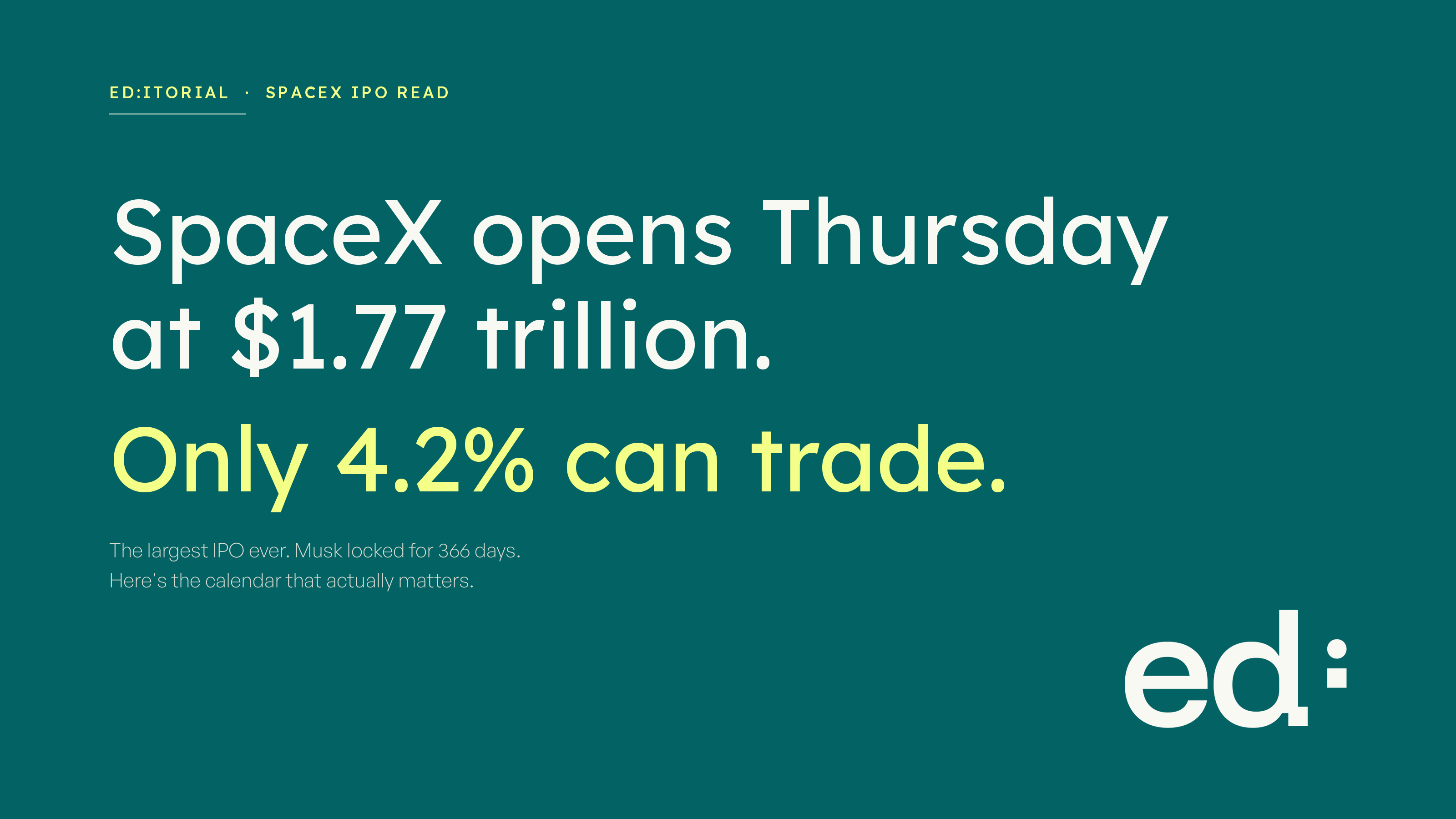
SpaceX opens Thursday at a $1.77 trillion valuation — the largest IPO ever. Only 4.2% of stock actually trades. Musk is locked up for 366 days. The next 366 days run on an unusually clean calendar of supply releases. Here are the 13 dates worth watching.

SpaceX goes public Thursday with a possible $5 trillion hit. Here's the calendar that actually matters.

SpaceX prices Wednesday night and opens Thursday on Nasdaq at $135 per share — a $1.77 trillion valuation, the largest IPO ever. Most coverage will frame what comes next as a sentiment trade, an Elon story, or a race to Goldman's $5 trillion bull case. The reality is more grounded and more useful: the next 366 days are governed by an unusually clean calendar of supply releases — when 95.8% of the company can or cannot trade, when index funds add weight, when the lock-up cliff arrives, when Musk himself becomes a potential seller for the first time. Read the calendar and you've already understood the structure most market commentary will spend the next quarter trying to explain. Here are the 13 dates worth watching. Two things keep showing up in headlines that don't survive a careful read. The first is the idea that index funds are about to be forced into a massive single-event SpaceX buy. They aren't. Nasdaq did create a fast-track inclusion rule that lets SpaceX join the Nasdaq 100 wi
Edgen
·
Jun 10 2026

Investir, enfin, tu n'es plus seul.

Essaie Ed gratuitement. Sans carte, sans engagement.