Content
Kısaca
İş ve Endüstri Manzarası
Rekabet Konumlandırması
Büyüme Katalizörleri ve Projeksiyonları
Finansal ve Değerleme Sağlığı
Piyasa Momentum ve Sahiplik
Kurumsal Sahiplik
İçeriden Öğrenenlerin İşlemleri
Analist Konsensüsü ve Fiyat Hedefleri
Değerleme Senaryoları ve Risk
Yatırım Tezi ve Temel İşaretler
Yatırım Tezi Özeti
İzlenmesi Gereken Temel İşaretler

Markets Confusing? Ask Edgen Search.

Instant answers, zero BS, and trading decisions your future self will thank you for.

Try Search Now

Shopify 2025 2. Çeyrek İncelemesi: Ticaretin Geleceğini Şekillendirmek

· Mar 31 2026
Shopify 2025 2. Çeyrek İncelemesi: Ticaretin Geleceğini Şekillendirmek

Shopify, her büyüklükteki işletme için perakende işletmesini başlatma, yönetme ve büyütme araçları sunan, önde gelen bulut tabanlı, çok kanallı bir ticaret platformu sağlar.

Kısaca

  • Shopify, e-ticarette baskın bir güçtür ve hikayesini başarılı bir şekilde yapay zeka destekli bir platforma dönüştürerek birincil büyüme katalizörü görevi görmüş ve premium değerlemesini haklı çıkarmıştır.
  • Başlıca büyüme itici güçleri arasında B2B ticarete genişleme, güçlü uluslararası performans ve Shopify Magic ile Sidekick gibi entegre AI araçlarının devam eden benimsenmesi yer almaktadır.
  • Hissenin yüksek değerlemesi ana riskidir, bu da onu makroekonomik değişimlere, faiz oranlarına ve yüksek büyüme beklentilerini karşılayamama durumlarına karşı son derece hassas hale getirir.
  • Analistler, şirketin temelleri konusunda genel olarak "AL" konsensüsüyle olumlu olsa da, önemli sayıda "Tut" derecesi mevcut hisse fiyatı hakkındaki yaygın temkinliliği yansıtmaktadır.

İş ve Endüstri Manzarası

Shopify, ticarete yönelik temel internet altyapısını sağlayarak 175 ülkedeki tüccarların işlerini web, mobil, sosyal medya ve fiziksel konumlarda yönetmelerine olanak tanır. Şirket, yapay zekanın entegrasyonu başta olmak üzere güçlü yapısal eğilimlerle yeniden şekillenen bir sektörde faaliyet göstermektedir. Kişiselleştirilmiş öneriler ve otomatik mağaza oluşturma gibi yapay zeka odaklı ticaret, tüccar satışlarını ve verimliliğini artırmak için bunu etkili bir şekilde kullanabilen platformlar için önemli bir rekabet avantajı yaratmaktadır.

Rekabet Konumlandırması

Shopify güçlü bir pazar konumuna sahiptir ancak farklı segmentlerde çeşitli rakiplerle karşılaşmaktadır. Kapsamlı, kullanıcı dostu ekosistemi güçlü bir savunma sağlasa da, pazar hala oldukça rekabetçidir.

Rakip

Segment

Temel Farklılaştırıcı

Adobe Commerce (Magento)

Kurumsal

Büyük işletmeler için derinlemesine özelleştirme sunar ancak daha fazla teknik kaynak gerektirir.

Salesforce Commerce Cloud

Kurumsal

Büyük ölçekli perakende operasyonları için karmaşık, zengin özellikli bir platform sağlar.

WooCommerce

Açık Kaynak

Platform ücreti olmadan maksimum esneklik sunan bir WordPress eklentisi, ancak kullanıcıların barındırma ve güvenliği yönetmesi gerekir.

Amazon

Pazar Yeri ve Hizmetler

Geniş pazar yeri ve büyüyen tüccar hizmetleri paketi aracılığıyla önemli bir rekabet tehdidi.

Shopify'ın çevrimiçi, çevrimdışı, B2B ve yapay zeka destekli araçları entegre eden birleşik bir platforma stratejik odaklanması, bu çeşitli segmentlerde etkili bir şekilde rekabet etmesini sağlar.

Büyüme Katalizörleri ve Projeksiyonları

Shopify'ın büyüme yörüngesi, teknolojik yenilik ve pazar genişlemesine odaklanarak birkaç temel nitel faktörle desteklenmektedir. Şirket, geçici döngüler yerine ticaretteki yapısal değişimlerden faydalanacak şekilde konumlandırılmıştır.

  • Yapay Zeka Destekli Araçlar: En önemli katalizör, "Shopify Magic" ve AI asistanı "Sidekick" dahil olmak üzere yapay zeka ürün paketinin benimsenmesidir. AI ajanlarının kullanıcılar adına işlem yaptığı "ajanik ticaret" vizyonunun başarılı bir şekilde uygulanması, premium değerlemesini doğrulayabilir ve daha fazla büyüme sağlayabilir.
  • B2B Ticaret Genişlemesi: Shopify B2B segmenti üç haneli bir oranla büyümekte olup, şirketin geleneksel KOBİ odak noktasının ötesinde toplam adreslenebilir pazarını önemli ölçüde genişletmektedir.
  • Uluslararası Genişleme: Başta Avrupa olmak üzere kilit uluslararası pazarlardaki büyüme, diğer bölgeleri geride bırakarak devam eden tüccar kazanımı için uzun bir yol sunmaktadır.

Analistler, AI yol haritasının başarılı bir şekilde uygulanmasını "kârlılığın en büyük potansiyel itici gücü" olarak görmektedir; bu, piyasanın benimsediği ancak dönüştürücü ürünler piyasaya sürülürse hala yükseliş potansiyeli taşıyan bir anlatıdır.

Finansal ve Değerleme Sağlığı

Shopify'ın finansal profili iki farklı durumu yansıtmaktadır: olağanüstü operasyonel güç, zorlayıcı bir değerleme ile birleşmiştir. Şirket, güçlü bir bilanço ve sağlam nakit akışını yansıtan Finansal Sağlık için mükemmel 10/10 puan almaktadır. Ancak, değerlemesi C- notu ile 10 üzerinden sadece 2 puan almıştır. Bu durum, hisse senedinin mevcut fiyatının gelecekteki başarının önemli bir kısmını zaten fiyatladığını, herhangi bir yanlış adımın keskin bir düzeltmeye yol açabileceği bir "mükemmellik için fiyatlanmış" dinamik oluşturduğunu göstermektedir.

Piyasa Momentum ve Sahiplik

Shopify hissesi için momentum güçlüdür, ancak bazı uyarı işaretleriyle dengelenmiştir. Mevcut fiyat olan $143.48, 50 günlük ($139.4) ve 200 günlük ($114.4) hareketli ortalamalarının üzerinde işlem görmektedir, bu yükseliş teknik bir sinyaldir. Ancak, son göstergeler bir miktar soğuma olduğunu göstermektedir; Göreceli Güç Endeksi (RSI) aşırı alım bölgesinden nötr 48.28'e düşmüş ve MACD histogramı yakın zamanda negatife dönerek momentumda potansiyel bir duraklamaya işaret etmektedir.

Kurumsal Sahiplik

Büyük yatırımcıların güveni yüksek olup, kurumlar şirketin yaklaşık %75'ine sahiptir. Başlıca sahipleri arasında American Funds Growth Fund of America ve Invesco QQQ Trust bulunmaktadır.

İçeriden Öğrenenlerin İşlemleri

Dikkate değer bir uyarı noktası, üst düzey yöneticiler tarafından yapılan sürekli satışlardan gelmektedir, bu durum kurumların genel olarak yükseliş eğilimli duygularıyla çelişmektedir.

Analist Konsensüsü ve Fiyat Hedefleri

Wall Street'in Shopify'ın temel işine yönelik hissiyatı ağırlıklı olarak boğa yönlüdür, ancak analistler mevcut hisse senedi fiyatının iyi bir giriş noktası sunup sunmadığı konusunda bölünmüş durumdadır.

  • Konsensüs Derecesi: 48 analist arasındaki konsensüs "AL" yönündedir.
  • Tavsiye Eğilimi: En son trend, 11 "Güçlü Al", 27 "Al", 16 "Tut" ve 2 "Güçlü Sat" derecesini göstermektedir.
  • Fiyat Hedefi: Ortalama 12 aylık fiyat hedefi $160.93 olup, en yüksek tahmin $204.75 ve en düşük tahmin $101.00'dır.

Bu ayrım, Shopify etrafındaki merkezi tartışmayı vurgulamaktadır: şirketin uygulaması geniş ölçüde övülse de, değerlemesi temel bir tartışma noktası olmaya devam etmektedir.

Değerleme Senaryoları ve Risk

Shopify'ın ileriye dönük görünümü, kendi uygulaması ile daha geniş makroekonomik ortam arasındaki etkileşime büyük ölçüde bağlıdır. Premium değerlemesi, yatırımcı risk iştahındaki değişimlere çoğu şirketten daha duyarlı olmasını sağlar.

Senaryo

Hisse Fiyat Hedefi

Anlatı

Olasılık

Boğa Senaryosu

$190 - $220

Olumlu, "risk iştahı yüksek" bir makro ortamda kusursuz yapay zeka uygulaması ve B2B büyümesi.

35%

Ayı Senaryosu

$100 - $120

Sağlam şirket performansı, "riskten kaçınma" bir makro ortam (örn. daha yüksek faiz oranları) tarafından gölgelenir ve değerleme çarpanlarının daralmasına neden olur.

40%

Felaket Senaryosu

< $95

Keskin bir durgunluk tüccar satışlarını vurur, yapay zeka beklentileri karşılayamaz ve düşmanca bir makro ortam hissenin ciddi şekilde değer kaybetmesine neden olur.

10%

Risk Yönetimi: İzlenmesi gereken başlıca riskler arasında tüketici harcamalarındaki düşüş, Amazon gibi devlerden gelen artan rekabet, Sezzle antitröst davasında olumsuz bir sonuç ve yapay zeka ürün yol haritasındaki herhangi bir gecikme veya hayal kırıklığı yer almaktadır.

Yatırım Tezi ve Temel İşaretler

Yatırım Tezi Özeti

Shopify, baskın bir yapay zeka destekli ticaret platformuna dönüşen yüksek kaliteli bir büyüme lideridir. Uzun vadeli potansiyeli muazzamdır, ancak premium değerlemesi önemli kısa vadeli riskler yaratmaktadır. Yatırım tezi, şirketin yüksek fiyatını haklı çıkarmak için iddialı yapay zeka ve B2B büyüme planlarını kusursuz bir şekilde yürütme yeteneğine bağlı olup, hem iç yürütmeye hem de dış makroekonomik koşullara karşı son derece hassas olmasını sağlar.

İzlenmesi Gereken Temel İşaretler

  • Yapay Zeka Ürün Benimsenmesi: Yeni yapay zeka araçları için "Shopify Editions" ürün tanıtımlarından yapılan duyuruları izleyin. Ticari satışları gözle görülür şekilde artıran başarılı lansmanlar, temel boğa tezini doğrulayacaktır.
  • Makroekonomik Ortam: Tüketici harcamaları ve faiz oranı politikası gibi temel göstergeleri takip edin. İstikrarlı veya düşen bir faiz oranı ortamı, Shopify'ın değerleme çarpanını desteklemek için kritik öneme sahiptir.
  • Rekabet Gelişmeleri: Adobe, Salesforce ve Amazon gibi e-ticaret alanındaki stratejik hamleleri izleyin. Pazar payı erozyonuna dair herhangi bir işaret önemli bir kırmızı bayrak olacaktır.
  • Yasal Kararlar: Sezzle antitröst davasının sonucu, karlı Tüccar Çözümleri segmentini olumsuz etkileyebilecek hafife alınan bir riski temsil etmektedir.

Recommend
Redeem miles for gift cards and each is worth ~1 cent; redeem for long-haul business and they're worth 2.5-4+. With programs now dynamically priced, the one check that decides every redemption.

How to redeem airline miles without wasting them

The single biggest mistake with miles is redeeming them for the easy stuff: gift cards, merchandise, seat upgrades at the gate. Do that and each mile is worth about one cent. Redeem the *same* miles for flights, especially long-haul or premium-cabin flights, and they're often worth two to five cents each, sometimes more. So the real skill isn't earning miles; it's not throwing away their value at the finish line. Here's how to actually use them. A mile has no fixed price; its value depends entirely on what you redeem it for. The way to judge any redemption is simple math: (cash price of the flight) ÷ (miles it costs) = cents per mile. If a flight costs $400 or 20,000 miles, that's 2 cents a mile, a solid deal. If a $90 flight costs 18,000 miles, that's half a cent, which is terrible; pay cash and keep the miles. Run this check before every redemption. It instantly separates a great use from a waste, and it's the one habit that makes miles worth having. As a rule of thumb, most major ai
Edgen
·
Jun 30 2026
Short-term goals (under ~3 years) belong in safe cash; long-term goals (5+ years) can take market risk. The best HYSAs now pay ~4-5% APY. How to sort yours and run both.

Long-term vs short-term financial goals (and how to plan both)

The difference comes down to one thing: time. A short-term goal is money you'll need within roughly three years (an emergency fund, a trip, a wedding, next year's tax bill), so it has to be *safe and reachable*. A long-term goal is five-plus years out (retirement, a house down the road, a kid's education), so it can take market risk, because time smooths the bumps out. Get that match right and you've done most of the work. It's not the size, it's the deadline. A $2,000 goal you need in six months is short-term; a $2,000 goal you won't touch for fifteen years is long-term, and they belong in completely different places. This is the part that actually matters, and where people lose money without realizing it. Short-term money should not be in the stock market. If your emergency fund is in stocks and the market drops 20% the same month your car dies, you're selling at the worst possible time. Short-term goals go somewhere stable and accessible, and a high-yield savings account is the clas
Edgen
·
Jun 30 2026
Mortgages near 6.5%, home prices flat, and the Fed split on rate cuts vs hikes. With timing a coin flip, the 3 questions that actually decide whether to buy now or wait.

Should you buy a house now or wait? How to actually decide

The honest answer: buy when you'll stay put for at least five years and you'll still have an emergency fund left after the down payment. Otherwise, waiting (and renting) is often the smarter money move, not the weaker one. "Rent vs buy" isn't a math problem with one right answer, and it's almost never really about timing the market. It's about your *life*, in three questions. Before the three questions, here's the mid-2026 backdrop — because "now or wait" usually hides a bet on rates and prices, and the data says that bet is a coin flip. The picture: mortgages are still pricey, prices have gone flat (more than half of the 20 big metros saw year-over-year declines in March), and the cheap-money era hasn't returned. So "buy before it runs away" and "wait for the crash" are *both* weak arguments right now. The whole "wait for rates to drop" plan rests on the Fed, and the Fed is split down the middle. In its June 2026 projections, policymakers were divided: 8 expected no change this year,
Edgen
·
Jun 30 2026
Most financial goals fail because they're wishes, not systems. Here's the 3-part anatomy of a goal that sticks (a number, a date, one automatic move), plus why 37% of adults can't cover a $400 surprise.

How to set financial goals you'll actually hit

A financial goal you'll actually hit has three things a vague wish doesn't: a number, a date, and one automatic move that happens whether or not you remember it. "Save more" is a wish. "$6,000 in a separate account by next December, $500 auto-transferred on payday" is a goal. The gap between those two sentences is the reason most goals quietly die, and it has almost nothing to do with willpower. Key Takeaways A real financial goal answers three questions: how much, by when, and what for. Drop any one and it stops working. "Pay off debt" has no number and no date, so there's nothing to aim at or measure, while "$8,000 of card debt cleared in 18 months" tells you exactly whether you're on track and the day you're done. The "what for" matters more than people expect. A goal tied to something real (a buffer so a bad month isn't a crisis, a deposit on a first place) survives the months when motivation dips. In our experience reading how people actually use a money tool, the goals that get
Edgen
·
Jun 30 2026
A big RSU grant just vested — now what? Here's what a modern money tool actually surfaces first, using Ed as a worked example: a reality check, the 22% tax gap most high earners miss, and the concentration risk nobody flags.

Your RSUs Just Vested. Here's What a Money Tool Surfaces First.

You just had a big RSU grant vest. Congratulations — and now the awkward part: a six-figure pile of your own company's stock, a vague sense you should "do something," and no one actually telling you what. An advisor, a spreadsheet, and a piece of software each handle this moment differently. Here's what a modern money tool surfaces in a moment like this — using Ed as a worked example — so you can decide what kind of help actually fits. Key takeaways You connect your brokerage and bank through read-only aggregation, so the tool can read balances but can't move a dollar. Ed's framing is simple: precise about your money, blind to your identity. Instead of sorting your lattes into categories, Ed opens on a single Financial Reality Check — a read on whether your money could survive a bad month. For a lot of high earners, that one number lands harder than any budget, because it answers a question the other apps never ask. (If the Reality Check is the numbers side, your money type is the beha
Edgen
·
Jun 26 2026
A money personality test is more than a quiz if it measures behavior, not just vibes. Here's the science behind money types, how Ed's test works, and how to use your result.

What Is a Money Personality Test? The Science Behind Your Money Type

The short version: a good money personality test should feel like a roast and work like a mirror — fun on the surface, behavioral underneath. The useful ones don't tell you what you know; they show you how you act with money, and the one blind spot worth watching. Key takeaways Here's the uncomfortable backdrop. U.S. financial literacy has been stuck for a decade — adults answer only about 49% of the standard knowledge questions correctly, essentially flat since 2017 (TIAA Institute–GFLEC, 2025) — even as free financial information became infinite. If facts fixed money, they'd have fixed it by now. They don't, because the thing that actually drives your outcomes lives one level below the facts: how you're wired to behave when money is on the line. That's the whole premise of financial fitness — and it's what a money personality test is built to surface. Not what you know. What you do. The idea has real research behind it — money behavior is patterned and measurable, and a few tradition
Edgen
·
Jun 23 2026
A financial reality check scores where you actually stand across safety, control, progress, upside, and Mental Load. Here's why a money score matters, how Ed's checkup works, and what to do with your weakest area.

What Is a Financial Reality Check? Why Your Credit Score Isn't Enough

The short version: your credit score measures how safe you are to lend to. Almost nobody has ever seen the number that measures whether you are actually secure. A financial reality check is that second number. Key takeaways Ask people for their credit score and many can recite it. Ask whether they could survive three months without income, or where their money quietly leaks each month, and you get a shrug. That's the gap. A credit score answers a lender's question — how risky is it to extend this person debt? It can be high while your life is fragile, or low while you're genuinely fine, because it was never built to measure you. A financial reality check answers the question the credit score ignores: are you safe, clear, progressing, building, and at ease? Here's the simple version, with the research behind each axis.
Edgen
·
Jun 23 2026
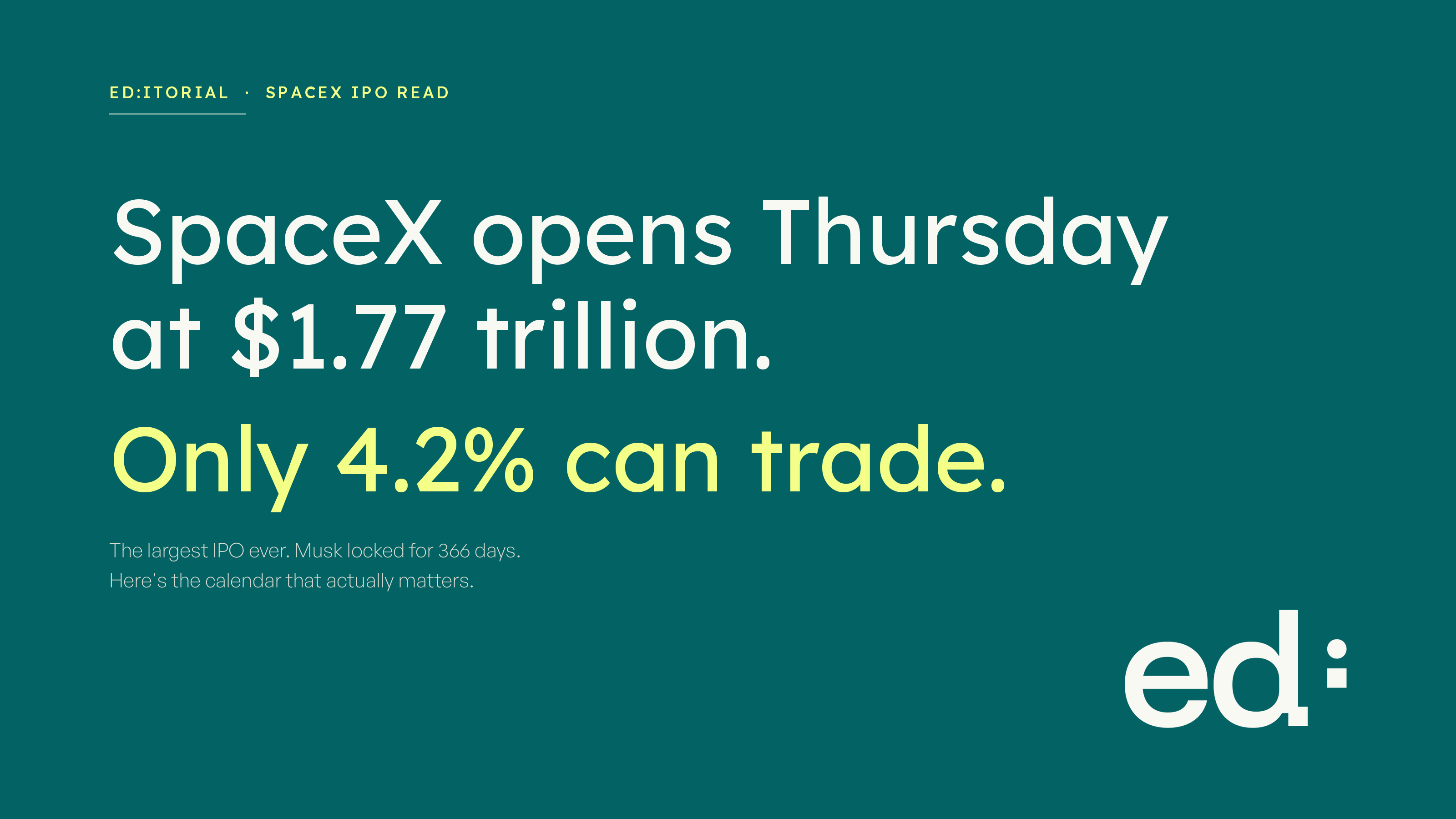
SpaceX opens Thursday at a $1.77 trillion valuation — the largest IPO ever. Only 4.2% of stock actually trades. Musk is locked up for 366 days. The next 366 days run on an unusually clean calendar of supply releases. Here are the 13 dates worth watching.

SpaceX goes public Thursday with a possible $5 trillion hit. Here's the calendar that actually matters.

SpaceX prices Wednesday night and opens Thursday on Nasdaq at $135 per share — a $1.77 trillion valuation, the largest IPO ever. Most coverage will frame what comes next as a sentiment trade, an Elon story, or a race to Goldman's $5 trillion bull case. The reality is more grounded and more useful: the next 366 days are governed by an unusually clean calendar of supply releases — when 95.8% of the company can or cannot trade, when index funds add weight, when the lock-up cliff arrives, when Musk himself becomes a potential seller for the first time. Read the calendar and you've already understood the structure most market commentary will spend the next quarter trying to explain. Here are the 13 dates worth watching. Two things keep showing up in headlines that don't survive a careful read. The first is the idea that index funds are about to be forced into a massive single-event SpaceX buy. They aren't. Nasdaq did create a fast-track inclusion rule that lets SpaceX join the Nasdaq 100 wi
Edgen
·
Jun 10 2026

Yatırım yapmak artık yalnız bir iş değil.

Ed'i ücretsiz dene. Kart yok, taahhüt yok.