
Trading crypto et Edgen AI : comment les chatbots d'IA révolutionnent le trading traditionnel
Le trading de cryptomonnaies évolue rapidement. Si vous utilisez encore des méthodes traditionnelles, notamment :
- le tracé à la main
- les tendances à deviner, ou le trading sur l'intuition
…vous jouez un jeu perdu. Le futur, comme le présent, appartient aux plateformes de trading alimentées par l'intelligence artificielle, aux robots de trading algorithmique et à l'analyse crypto guidée par une IA similaire à ChatGPT.
Aujourd'hui, le succès du trading dépend de l'utilisation d'analyses du marché alimentées par l'intelligence artificielle en temps réel, du suivi des sentiments et d'une exécution automatisée extrêmement rapide. Menant cette charge révolutionnaire est Edgen AIun platforme de trading en achats (buy-side) basée sur l'intelligence artificielle qui combine des analyses rigoureuses sur la chaîne de blocs avec des éléments sociaux critiquesles fondamentaux de la pompe"ou des mouvements de marché entraînés par les influenceurs. Edgen vous permet de trader plus intelligemment, et non à l'aveugle."
L'essor de l'intelligence artificielle dans le trading de cryptomonnaies
Les marchés cryptographiques évoluent à une vitesse de croisière, rendant les stratégies traditionnelles obsolètes. L'IA résout ce problème en traitant instantanément de grands ensembles de données, offrant aux traders un avantage concurrentiel sans précédent.
Pourquoi l'IA domine le trading de cryptomonnaies :
- Avantage de vitesse :L'IA traite les signaux du marché en quelques millisecondes, plus rapidement qu'un trader humain.
- Décrypter les signaux cachés :L'IA surveille les tendances sociales, les actions des influenceurs et les mouvements des portefeuilles intelligents sur la chaîne.
- L'Opinion Sociale Compte :Un seul tweet influent peut déclencher des variations importantes des prix. Les plateformes comme Edgen AI surveillent en temps réel l'opinion publique, vous permettant d'agir avant que le marché ne bouge.
Edgen AI : Votre épée d'Alpha
Edgen AI est un centre d'IA avancé conçu pour relier les analyses en temps réel sur la chaîne, les signaux du marché et le sentiment social.
Les principales caractéristiques d'Edgen :
- Edgen Radar:Suivi en temps réel des déplacements d'actifs et du consensus social.
- Edgen Search:Répond rapidement à des questions complexes sur le marché grâce à des analyses approfondies et vérifiées.
- Edgen FeedRestez connecté aux récits en vogue, aux appels d'alpha et aux changements de sentiment.
- Insights Edgen :Un hub où les traders collaborent, partagent des alpha et apportent des perspectives.
- Système Aura :Récompense les traders pour le partage d'insights précieux, en améliorant continuellement l'intelligence prédictive d'Edgen.

Comment les plateformes similaires à ChatGPT améliorent le trading de cryptomonnaies
La recherche alimentée par les LLM transforme la manière dont les traders interagissent avec les marchés en offrant des analyses et des stratégies guidées par l'intelligence artificielle conversationnelle.
1. Analyse du marché pilotée par l'IA
Les traders traditionnels s'appuient sur les graphiques historiques. Les traders alimentés par l'intelligence artificielle utilisent des analyses en temps réel sur la chaîne, l'analyse de sentiment et des signaux prédictifs, des outils disponibles viaEdgen SearchetEdgen Radar.
2. Stratégies de trading similaires à ChatGPT
- Le Trading algorithmique :Exécute les opérations en se basant sur des stratégies prédéfinies sans délai humain.
- Analyse prédictive :Identifie les tendances du marché et les signaux d'alpha avant qu'elles ne deviennent populaires.
- Amélioration continue :L'apprentissage automatique en finance affine les modèles de trading au fil du temps, améliorant constamment la précision et les profits.
3. Sentiment social et trading d'alpha
Les mouvements du marché sont désormais fortement influencés par le sentiment social. Edgen AI suit les influenceurs, les activités des portefeuilles intelligents et les récits des traders de détail pour identifier des "les fondamentaux de la pompe.
Cette approche globale donne aux traders un avantage distinct.
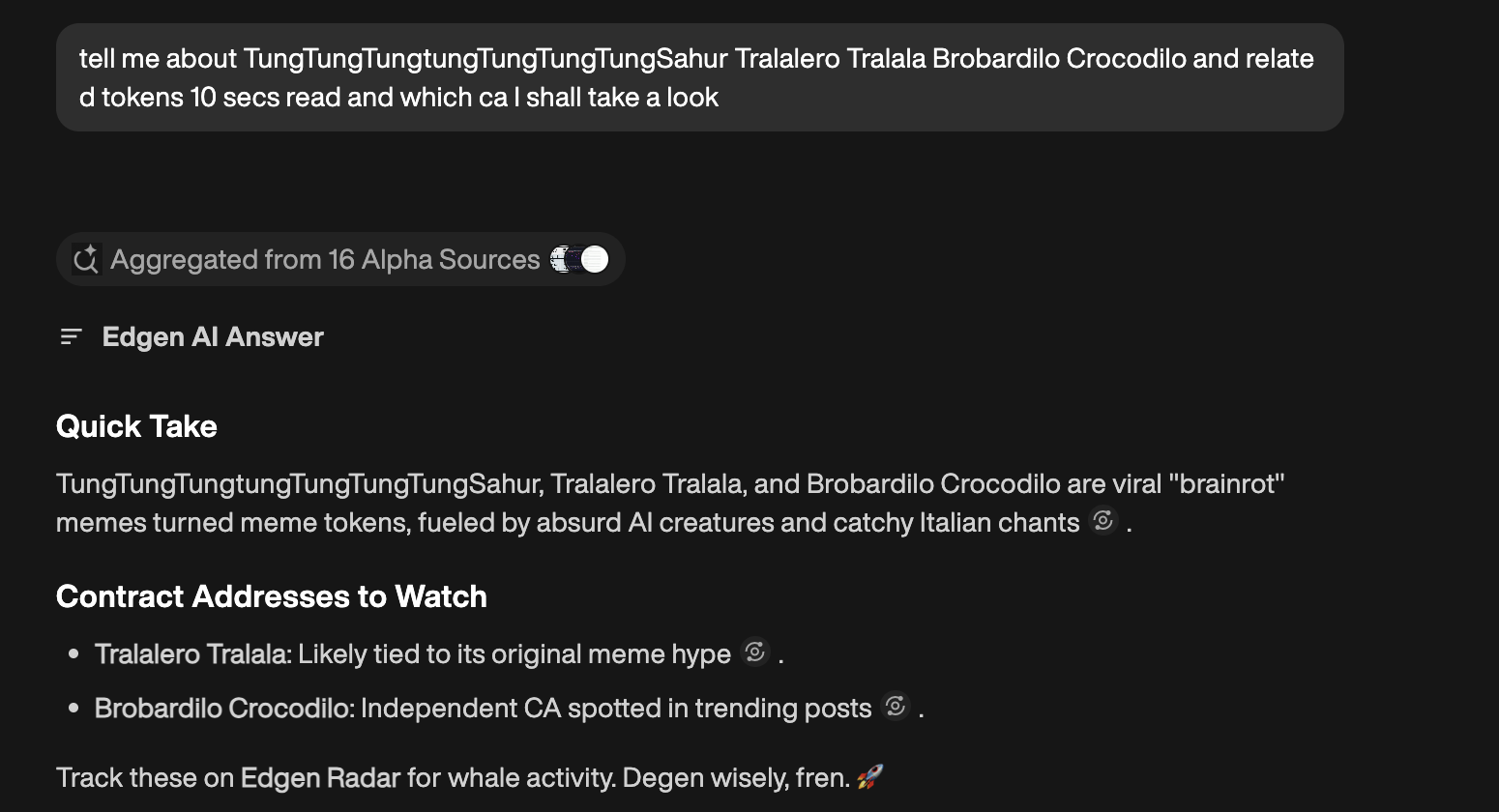
L'analyse des sentiments alimentée par l'IA : Lorsque les cryptomonnaies rencontrent les réseaux sociaux
Le trading de cryptomonnaies aujourd'hui est un croisement de données du marché, de récits sociaux et d'intelligence artificielle. Avec Edgen Radar et des outils de trading renforcés par l'IA, les traders voient clairement comment le sentiment influence les prix.
Comment fonctionne l'analyse de sentiment dans le trading crypto :
- Surveillance en temps réelL'IA scanne en continu les réseaux sociaux, notamment Twitter, à la recherche de nouvelles qui influencent le marché.
- Impact des influenceurs :L'IA suit l'activité des KOL (Key Opinion Leaders) pour identifier les acteurs influents du marché.
- Signes précoces :L'IA repère les tendances du marché avant qu'elles ne se propagent, offrant aux traders la possibilité d'agir en premier.
C'est pourquoi les outils de trading d'IA axés sur les émotions, comme Edgen AI, offrent des avantages sur le marché sans égal.
Gestion des risques : L'IA protège vos opérations
Un commerce réussi consiste à éviter les pertes. L'IA améliore considérablement la gestion des risques en trading.
Comment l'IA gère les risques en trading :
- Optimisation du portefeuille :L'IA équilibre dynamiquement votre portefeuille en fonction des conditions du marché actuelles et de votre tolérance au risque.
- Évaluation des risques en temps réel :L'IA ajuste instantanément les stratégies en réponse à une volatilité soudaine du marché.
- Arrêts de perte dynamiques :Les plateformes alimentées par l'IA ajustent automatiquement les ordres de stop-loss en fonction des signaux du marché et des prévisions de volatilité.
Edgen AI se distingue dans la gestion des risques en intégrant le suivi de l'opinion publique, aidant les traders à éviter les effondrements de marché coûteux déclenchés par la panique ou la FUD.
L'avenir de l'IA dans le trading de cryptomonnaies
Le trading de cryptomonnaies se dirige rapidement vers une intégration plus approfondie avec l'intelligence artificielle. En attendez des analyses plus détaillées alimentées par l'intelligence artificielle, une intégration plus large sur la chaîne de blocs, et des stratégies de trading personnalisées et adaptatives à l'intelligence artificielle.
Les Prochaines Grandes Innovations en Trading par l'IA :
- Marché des fonds en intelligence artificielle :Le marché d'investissement à caractère informatique prévu par Edgen.
- Outils avancés de tire au fusil par IA :Identifier instantanément les opportunités de trading à haute fréquence.
- Portefeuilles et échanges intégrés :Une automatisation de la négociation crypto pilotée par l'IA, pour une exécution sans friction sur plusieurs plateformes.
Edgen AI se situe en tête de ces avancées, assurant aux traders qu'ils ne manquent jamais d'opportunités critiques sur le marché.
Faut-il adopter l'IA pour le trading de cryptomonnaies ?
Les marchés cryptographiques sont chaotiques. L'utilisation de l'intelligence artificielle vous offre clarté, précision et vitesse, vous transformant du statut de suiveur du marché à celui de leader du marché.
Si vous souhaitez :
- Négociez efficacement 24 heures sur 24, sans manquer une opportunité clé
- Comprendre la tendance du marché et les indicateurs sur la chaîne de blocs en même temps
- Mettre en œuvre des stratégies d'investissement basées sur l'intelligence artificielle de pointe
- Éliminer complètement les erreurs émotionnelles coûteuses
Ensuite, le trading alimenté par l'intelligence artificielle, en particulier Edgen AI, devrait être votre prochaine étape.
Gestion des risques liés à l'intelligence artificielle : Négociez plus intelligemment, pas plus durément
Un bon trading ne se limite pas à rechercher des gains. C'est aussi une question de protection contre les pertes.
Voici comment Edgen AI aide :
- Optimisation du portefeuilleIl ajuste dynamiquement les affectations en fonction des changements du marché.
- Évaluation des risques en temps réelSi la volatilité augmente brusquement, votre stratégie s'adapte immédiatement.
- Arrêts de perte dynamiquesLes stops-loss évoluent avec le marché, pas plus de défenses statiques.
En intégrant les données de sentiment, Edgen vous aide à éviter les krachs causés par la peur ou la panique avant qu'ils ne s'aggravent.
Souhaitez-vous comprendre comment l'intelligence artificielle transforme le monde financier pour les consommateurs ordinaires ? Consultez Brookings Institution’s insights on AI in financeC'est puissant
Du instinct à l'intelligence
L'IA ne remplace pas le trader. Elle l'améliore.
Avec des outils comme Edgen, vous êtes équipé pour voir le marché clairement, agir de manière décisive et trader en avance sur la foule. Vous ne réagissez pas seulement, vous façonnez activement votre avantage grâce aux données en temps réel, à l'IA prédictive et aux informations sur les sentiments.
Le trading de cryptomonnaies n'est plus une question de qui a raison. C'est une question de qui reçoit le signal en premier et agit rapidement.
Prêt à trader plus intelligemment ?
Ne regardez pas seulement le marché —le devancer.Commencez à utiliser l'IA qui s'adapte àtu, pas l'inverse.
Get started with Edgen AI today— votre assistant de trading en cryptomonnaie vous attend !






Investir, enfin, tu n'es plus seul.
Essaie Ed gratuitement. Sans carte, sans engagement.