Content
Perspectives de Centrifuge pour le T4 2025 : Libérer des milli...
En bref
Qu'est-ce que Centrifuge (CFG) ?
Principes fondamentaux du projet
Orientation stratégique et trajectoire narrative
Produit et prouesses technologiques

Markets Confusing? Ask Edgen Search.

Instant answers, zero BS, and trading decisions your future self will thank you for.

Try Search Now

Perspectives de Centrifuge pour le T4 2025 : Libérer des milliers de milliards d'actifs du monde réel

· Mar 31 2026
Perspectives de Centrifuge pour le T4 2025 : Libérer des milliers de milliards d'actifs du monde réel

Perspectives de Centrifuge pour le T4 2025 : Libérer des milliers de milliards d'actifs du monde réel

Centrifuge (CFG) est un fournisseur d'infrastructure essentiel dans le secteur en plein essor de la tokenisation des actifs du monde réel (RWA), visant à connecter la finance traditionnelle à la liquidité DeFi.

En bref

  • Centrifuge est un protocole pionnier qui relie la finance traditionnelle à la finance décentralisée par la tokenisation des actifs du monde réel (RWA).
  • Son pivot stratégique vers une architecture EVM multi-chaînes améliore considérablement l'évolutivité et l'attrait institutionnel.
  • Le projet démontre une adoption remarquable du marché, en témoigne plus de 1,45 milliard de dollars de valeur totale verrouillée (TVL) et des partenariats stratégiques.
  • Une évolution récente de la gouvernance rationalise la prise de décision, positionnant Centrifuge pour une exécution agile et une croissance soutenue.

Qu'est-ce que Centrifuge (CFG) ?

Centrifuge est un protocole décentralisé qui connecte le monde des actifs traditionnels de plusieurs milliers de milliards de dollars avec l'efficacité et la liquidité de la finance décentralisée (DeFi). Il permet aux entreprises de tokeniser des actifs du monde réel (RWA) tels que les factures, l'immobilier et le crédit structuré, les rendant disponibles comme garantie pour le financement on-chain. Cette approche innovante vise à réduire le coût du capital pour les entreprises tout en offrant aux investisseurs crypto-natifs des opportunités de rendement stables et non corrélées.

Principes fondamentaux du projet

Orientation stratégique et trajectoire narrative

Centrifuge est stratégiquement positionné à l'avant-garde du récit de la tokenisation des actifs du monde réel (RWA), un thème d'investissement à forte conviction dans le cycle de marché actuel. La mission principale du projet est de relier les actifs traditionnels au DeFi, s'alignant sur la demande institutionnelle croissante de transfert de valeur tangible et hors chaîne sur la blockchain. Cette tendance est validée par des initiatives telles que le fonds BUIDL de BlackRock, indiquant un changement significatif du marché. Le secteur de la tokenisation des RWA représente à lui seul une opportunité de marché de plusieurs milliers de milliards de dollars, avec des projections allant de 16 billions de dollars d'ici 2030 à 30 billions de dollars d'ici 2034, offrant à Centrifuge une très grande marge d'expansion. Ce fort vent arrière thématique renforce son potentiel d'adoption par le marché et l'intérêt des investisseurs, car son succès est soutenu par une transformation plus large et sectorielle des marchés de capitaux.

Produit et prouesses technologiques

Centrifuge a effectué un pivot stratégique et technique crucial vers Centrifuge V3, évoluant vers un modèle plus évolutif, interopérable et institutionnellement convivial. Cette nouvelle architecture est un protocole multi-chaînes entièrement natif EVM, lancé sur six chaînes EVM, y compris Ethereum, Plume, Base, Arbitrum, Avalanche et BNB Chain, et alimenté par le protocole d'interopérabilité Wormhole. Cette conception permet aux gestionnaires d'actifs d'émettre et de gérer des produits tokenisés à partir d'une seule interface, accédant à la liquidité et aux investisseurs sur plusieurs blockchains, abstraiant ainsi les complexités spécifiques à la chaîne et unifiant la liquidité fragmentée.

La suite de produits de Centrifuge a évolué pour servir une base d'utilisateurs de plus en plus institutionnelle. Les offres clés comprennent :

  • Plateforme Centrifuge (V3) : L'infrastructure de base pour les gestionnaires d'actifs, les DAO et les entreprises de technologie financière pour créer et gérer des fonds tokenisés à l'aide de contrats intelligents pré-construits et audités.
  • Fonds Anemoy : En partenariat avec des acteurs financiers établis, ceux-ci comprennent le Janus Henderson Anemoy AAA CLO Fund (JAAA) et le Anemoy Liquid Treasury Fund (JTRSY), offrant une exposition aux obligations de prêt garanties de catégorie AAA et des rendements des bons du Trésor américain à court terme, respectivement.
  • SPXA : Un partenariat historique avec S&P Dow Jones Indices, lançant le premier jeton de fonds indiciel S&P 500 sous licence, démontrant sa capacité à gérer des produits financiers hautement réglementés.

Le principal différenciateur du protocole est son écosystème complet et établi qui combine l'infrastructure technique avec les cadres juridiques et opérationnels nécessaires à l'adoption institutionnelle. Sa stratégie

Recommend
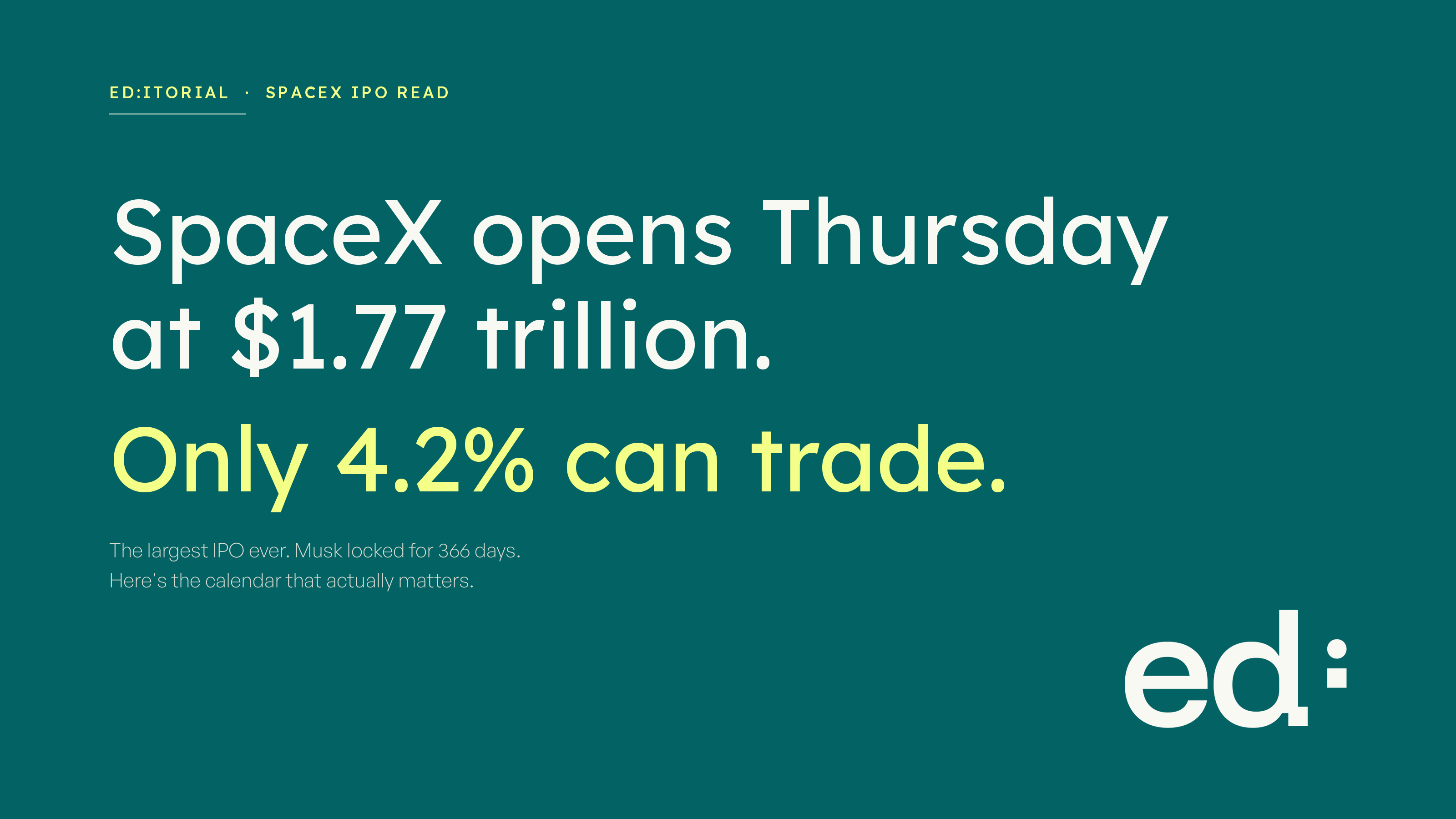
SpaceX opens Thursday at a $1.77 trillion valuation — the largest IPO ever. Only 4.2% of stock actually trades. Musk is locked up for 366 days. The next 366 days run on an unusually clean calendar of supply releases. Here are the 13 dates worth watching.

SpaceX goes public Thursday with a possible $5 trillion hit. Here's the calendar that actually matters.

SpaceX prices Wednesday night and opens Thursday on Nasdaq at $135 per share — a $1.77 trillion valuation, the largest IPO ever. Most coverage will frame what comes next as a sentiment trade, an Elon story, or a race to Goldman's $5 trillion bull case. The reality is more grounded and more useful: the next 366 days are governed by an unusually clean calendar of supply releases — when 95.8% of the company can or cannot trade, when index funds add weight, when the lock-up cliff arrives, when Musk himself becomes a potential seller for the first time. Read the calendar and you've already understood the structure most market commentary will spend the next quarter trying to explain. Here are the 13 dates worth watching. Two things keep showing up in headlines that don't survive a careful read. The first is the idea that index funds are about to be forced into a massive single-event SpaceX buy. They aren't. Nasdaq did create a fast-track inclusion rule that lets SpaceX join the Nasdaq 100 wi
Edgen
·
Jun 10 2026
SpaceX prices its IPO June 11 at a $1.75–2T valuation. Most retail is asking "how do I buy SpaceX?" — here's the wider way to think about it, with three paths to be on the right side of the catalyst.

Investing in SpaceX Doesn't Mean Buying SpaceX

By Edgen Research | 2026-05-28 Everyone is talking about SpaceX right now. The S-1 went public on May 20. Pricing is set for June 11, trading begins June 12 under ticker SPCX, and the deal targets $80 billion raised at a $1.75–2 trillion valuation — the largest IPO in history by a wide margin. So the natural question coming up in every group chat, every brokerage app, every Reddit thread is: how do I buy SpaceX before it IPOs? Fair question. There's also a wider one underneath it that's worth a minute of your time. What most people are really after isn't a specific stock — it's being on the right side of what SpaceX is dragging up: reusable launch becoming the default, Starlink turning satellite connectivity into everyday infrastructure, space turning into the next platform layer for defense, telecom and industrial software. You can absolutely play that by buying SpaceX equity. You can also play it through stocks you can already buy today, sometimes with cleaner risk and without the IP
Edgen
·
May 27 2026
Five small fixes shipped this week to Ed by Edgen — refreshed web design with bell notifications, charts inside chat answers, simpler thinking process, voice input, and a homepage that knows you.

Ed Got Smarter This Week (May 22 Update) — Here's How

By Edgen | 2026-05-26 Your money person should solve the small annoyances first. This week Ed knocked out five of them — desktop and mobile felt like two different products, data answers were lifeless, you couldn't tell what he was thinking, typing detailed questions on the go was a pain, and the homepage didn't really know you. All five just got better. Web just picked up the same brand color, clean cards, and bell-notification setup the mobile app already had. Whether you open Ed on your phone in the morning or your laptop at lunch, it's one consistent product — and alerts find you on both. Ask Ed about a stock price, a market-cap split, or a year-over-year trend — the answer now comes back with a clean chart inside the reply. Same data, much easier to read at a glance, no need to imagine the picture from a wall of numbers. Ed is a proactive AI — what he's doing for you matters as much as the final answer. The thinking process is now one clean line you can follow: "Reading Goldman Sa
Edgen
·
May 26 2026
Aschenbrenner's Q1 13F: $5.52B in AI infrastructure longs (BE, SNDK, CRWV) + $1.6B NVDA puts. The puts are most likely a hedge — not a short.

Leopold Aschenbrenner's Real AI Bets: Bloom Energy, SanDisk, CoreWeave — the NVDA Put Is Probably a Hedge

What are the world's most-watched investors actually buying right now? The Q1 2026 13F filings — released May 15 — give the clearest answer in years: every major filer is building AI exposure. The disagreement is over how. The most-headlined case is Leopold Aschenbrenner — the ex-OpenAI researcher who wrote the Situational Awareness essay and now runs Situational Awareness LP ($9.28B regulatory AUM per the March 2026 SEC Form ADV; $5.52B of that is the disclosed U.S. equity book). The press ran with "Aschenbrenner bet $8.46 billion against AI chips." That headline is technically true and practically misleading. What he actually did with real capital: load up on the AI infrastructure that makes the boom possible — power, memory, data-center capacity. The $8.46B against NVDA and other chipmakers is almost certainly a hedge on those AI longs, not a directional bet against AI itself. If you're trying to build AI exposure for the long run, his buy list — and what 4 other big names are doing
Edgen
·
May 21 2026
Nomura raised SK Hynix's price target from ₩840K to ₩4M in 6 months — 5x. Goldman lifted MU's 2026 EPS estimate 133%. Why MU and SNDK move from Hold to Buy.

Nomura Quintupled SK Hynix's Target in 6 Months — A Tailwind for MU and SNDK

On May 17, Nomura raised SK Hynix's price target to ₩4 million won — roughly five times the level it set just six months ago. The size of that revision matters less than what Nomura wrote underneath it: AI memory demand is entering a "new regime" that breaks the historical cycle model. We're updating our #66 AI hardware basket map on the back of it — MU and SNDK move from Hold to Buy. The trajectory is the story, not the endpoint. Four sequential raises. Each one looked aggressive when published. Each one was conservative within weeks. The current PT implies +119.9% upside from the May 15 close of ₩1.82M — Nomura's bull case explicitly recalibrating to a "new regime," not extrapolating from the prior cycle. I'd argue the May 17 raise matters more than the four that came before it. The earlier raises tracked rising EPS estimates inside the same cyclical model. This one reframes the model itself — what Nomura calls "memory stock re-rating driven by exponential demand growth from AI." Nom
Edgen
·
May 18 2026
NVDA isn't the whole AI hardware trade. SanDisk +3,362%, Micron +340% past year prove it. Which AI hardware sectors still have upside — and which don't?

NVDA Is One Basket of AI Hardware. Here Are the Other Four, Ranked.

SanDisk is up 3,362% over the past 12 months (Yahoo Finance). Micron is up around 340% in the same window (Yahoo Finance). Both are AI hardware. Neither is NVIDIA. If you call yourself "long AI" but own only NVDA, you're not long AI — you're long one basket, and the other four ran without you. SNDK and MU are the proof of how expensive that miss can be. Here's the map. Five baskets. Where I'd put new money today (Basket 4) and where I wouldn't (Basket 1). Bottom line first. If you can only add to one basket today, I'd add to Basket 4 — Optical Interconnect. Not NVDA. Not HBM. Not foundry. One sentence: AI's bottleneck is shifting from "memory can't feed the GPU fast enough" (the 2024 problem) to "the wires can't connect 100,000 GPUs at once" (the 2026-2028 problem). The market hasn't fully priced this yet. AI-themed funds barely own any of the optical names.
Edgen
·
May 15 2026
earnings-beats-fail-2026-edgen-3-signal-framework_header.png

Why Earnings Beats Fail in 2026: Edgen's 3-Signal Framework

Something broke in Q1 2026 earnings that contradicts what most retail investors learned in 2023-2024. Affirm reported adjusted EPS of $0.37 against a $0.27 consensus — nearly 40% above the Street — and the stock fell 5%. Coinbase missed revenue by 31% — a catastrophic shortfall by any historical standard — and the stock declined only 2.5%. SoFi beat the quarter and raised full-year guidance, then dropped 15%. Palantir reported 85% year-over-year revenue growth — and went sideways. These are the four prints Edgen Research covered in real time during April and May 2026. Across them, the relationship between an earnings beat and stock direction has visibly decoupled. This is not a noisy small sample — it is a structural change in how the market processes quarterly information. Three signals appeared in every single beat-and-fade case we tracked, and they also predict — in reverse — the rare cases that beat and rally, such as NXP's +18% reaction to its Q1 print. This article is the framewo
Edgen
·
May 14 2026

Investir, enfin, tu n'es plus seul.

Essaie Ed gratuitement. Sans carte, sans engagement.