
Record diesel costs are rippling through U.S. freight and food networks after crude rallied above $95 a barrel, as the Iran conflict and Russian refinery damage cut seaborne diesel supply.
Record diesel costs are rippling through U.S. freight and food networks after crude rallied above $95 a barrel, as the Iran conflict and Russian refinery damage cut seaborne diesel supply.
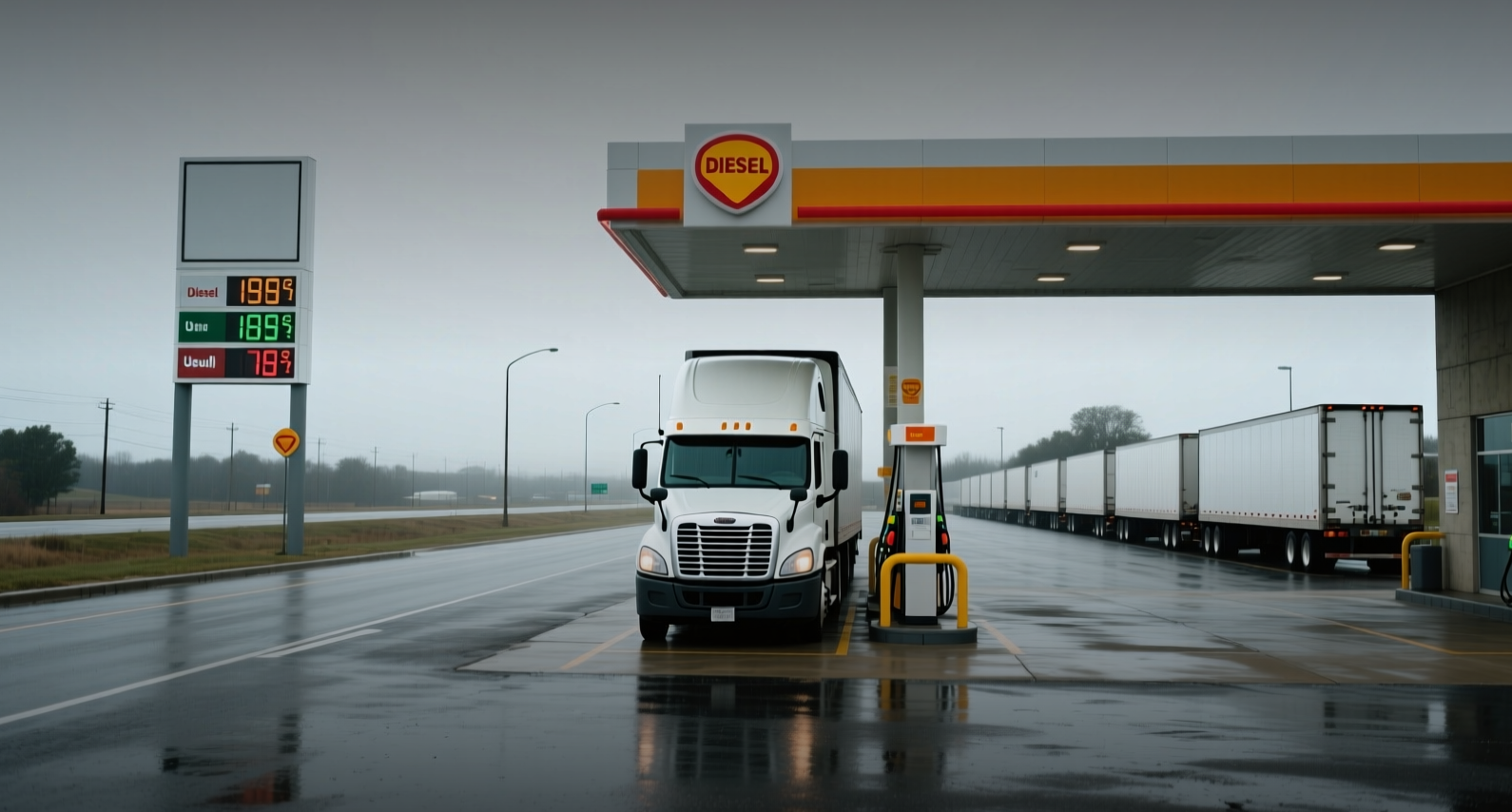
U.S. diesel prices hit a record $5.85 a gallon Friday as Brent crude topped $95 a barrel, with the Iran war and Ukrainian refinery strikes squeezing a fifth of global seaborne diesel supply.
"All sectors of the economy are affected by diesel. This is one of the reasons why the government bond yields in the United States are so high, it's the expectation that inflation will continue to go up," said Claudio Galimberti, chief economist at Rystad Energy.
The national average climbed from $5.78 a day earlier and $5.61 a week earlier, surpassing the prior record of $5.82 set June 17, 2022, after Russia's invasion of Ukraine, according to AAA and GasBuddy. Diesel has held above $5 a gallon since July 15, putting 2026 on track to become the most expensive year for the fuel in U.S. history, said Patrick De Haan, head of petroleum analysis at GasBuddy.
Diesel powers much of the country's trucking, freight, farming and delivery networks, so higher fuel costs raise transportation expenses across a long list of everyday goods. Fuel accounts for roughly 15 percent to 30 percent of the total cost of food, according to the Independent Grocers Alliance, and Amazon, UPS, FedEx and the U.S. Postal Service have added fuel surcharges since the war began. With midterm elections in November and two-thirds of U.S. adults disapproving of President Donald Trump's handling of the economy, per AP-NORC polling, the spike carries political weight as well.
Before the U.S. and Israel launched attacks against Iran in late February, the national average for a gallon of diesel stood at about $3.76, according to AAA — meaning prices have climbed nearly 56 percent in six months. Brent crude, the international benchmark, was trading above $95 a barrel Friday, up from roughly $70 before the war, after oil prices cooled during summer hopes for peace before resuming their climb as fighting escalated. Oil was on course to gain more than 6 percent for the week.
Traffic through the Strait of Hormuz remains well below normal. Just four commodity vessels transited the key waterway Thursday, compared with a 10-day average of about 15, preliminary shipping data showed. Before the war, around 900,000 barrels per day of diesel and 350,000 barrels per day of jet fuel moved through the Persian Gulf, equivalent to roughly 10 percent and 20 percent of global seaborne supply, respectively, according to cargo-tracking firm Vortexa.
Systematic Ukrainian drone attacks on Russian oil refineries have added another squeeze. Russia is a major exporter of refined fuels, and damage to its refining system has tightened a market already strained by the Middle East conflict. "Combined disruptions are equivalent to around 20 percent of global seaborne diesel trade," ING analysts said in a recent note. "With little spare refining capacity, meaningful relief requires a recovery in Persian Gulf and/or Russian flows."
The strain shows up in refining markets. The U.S. diesel crack spread — the difference between crude and diesel prices — surged to a record intraday high of $108.02 a barrel Wednesday before easing after government data showed a modest increase in distillate inventories. U.S. distillate stocks, which include diesel and heating oil, averaged their lowest August levels for this time of year since 1982, according to Energy Information Administration data. U.S. refiners have pushed operating rates to multi-year highs to boost diesel output, but disruptions elsewhere continue to constrain global supplies, said Giovanni Staunovo, an analyst at UBS.
"We're entering a key period for diesel consumption with the lowest inventories on record for early September," said David Russell, global head of market strategy at TradeStation. "Farmers and truckers typically use more diesel in the autumn, which raises the stakes for the current crisis and increases the risk of sharper price increases."
Diesel is integral to every part of the food supply chain — it powers farm equipment and fishing boats as well as the trains and trucks headed to grocery stores. Items that need refrigeration while transported are often the first to see price increases, according to David Ortega, a professor of food economics and policy at Michigan State University. In July, overall U.S. grocery prices were up 2.7 percent from a year earlier, but seafood prices rose 7 percent and fresh fruit 4.9 percent.
"Early on, much of the cost increase gets absorbed along the supply chain through existing freight contracts and retailer margins," Ortega said. "But as contracts reprice and fuel surcharges take hold, more of that cost makes its way to the grocery store."
The ripple extends beyond food. Amazon rolled out a temporary 3.5 percent fuel and logistics surcharge on some third-party sellers in April, while UPS, FedEx and the U.S. Postal Service added fees on packages citing higher fuel costs. Trucking and transportation can adapt to rising diesel prices, but there is a limit, said Ajesh Kapoor, CEO of trucking technology company SemiCab. "Diesel price has a very, very direct impact on everything that moves on pretty much any mode," Kapoor said.
The pain is global. Diesel prices in Nigeria have surged 90 percent since late February, followed by nearly 87 percent in Indonesia and 77 percent in Lebanon, according to Global Petrol Prices. Hong Kong carries the highest sticker price at $17.73 a gallon. Neil Atkinson, energy analyst and senior fellow at the National Center for Energy Analytics, said products like diesel are becoming more expensive while physical stocks dwindle. "This cannot go on forever," he said.
Adjusted for inflation, today's prices remain below past peaks — diesel hit about $4.74 a gallon ahead of the 2008 financial crisis, equivalent to $7.20 in 2026 dollars, and 2022's record would be about $6.56 this year. But the current spike is already feeding into gasoline, which averaged $4.15 a gallon Friday, up from $2.98 before the war and $3.20 a year earlier.
This article is for informational purposes only and does not constitute investment advice.
