
Unitree Robotics lost 200 billion yuan in four sessions as a 219-times earnings valuation met a research-heavy revenue mix.
Unitree Robotics lost 200 billion yuan in four sessions as a 219-times earnings valuation met a research-heavy revenue mix.
Unitree Robotics lost roughly 200 billion yuan in four sessions of its STAR Market debut, as a 219-times earnings valuation met a revenue mix still dominated by research orders.
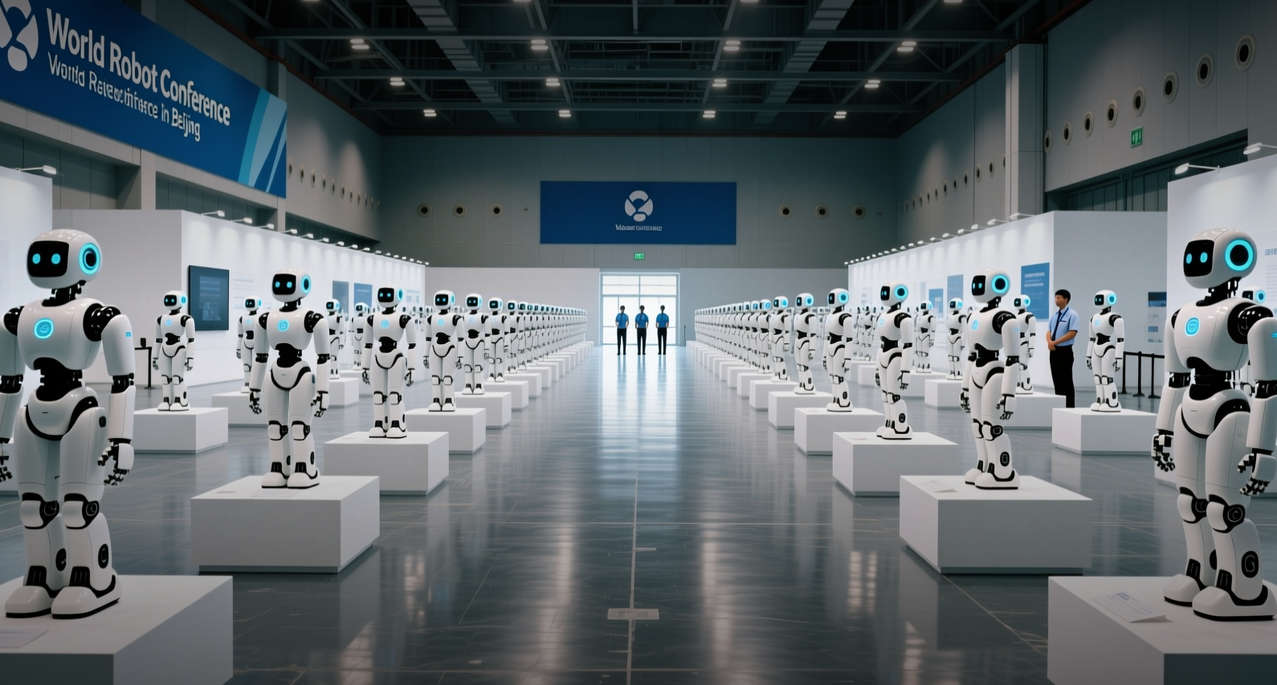
"The biggest bottleneck currently is insufficient generalization capability," Wang Xingxing, founder of Unitree, said at the World Robot Conference in Beijing on Aug. 20, the day after the listing. He extended his timeline for the embodied-AI "ChatGPT moment" to as soon as two to three years and at most five to 10 years, from a prior forecast of one to two years at the earliest.
Unitree opened at 1,100 yuan on Aug. 19, a 629 percent surge from its 150.80 yuan offer price, briefly valuing the company at 444.9 billion yuan. The stock fell 18.7 percent the next session and closed Aug. 24 at 603.08 yuan, down 10.3 percent, trimming market value to about 243.9 billion yuan. Humanoid robots generated 868 million yuan of 2025 revenue, but research and education accounted for 73.6 percent of that, with industrial applications at just 9.01 percent.
The correction matters beyond one stock: nearly 50 robotics companies are preparing IPOs in China, and Unitree's sliding valuation could reset fundraising and pricing for the sector. The company raised 5.92 billion yuan in net proceeds, earmarked largely for robot model development, and must convert research and developer orders into scaled industrial applications before capital-market patience runs out.
The debut-day frenzy was a function of scarcity as much as fundamentals. Only 30.09 million shares, or 7.44 percent of total share capital, were freely tradable at listing, and the online retail tranche drew about 9.78 million subscription accounts with an oversubscription ratio of 8,288 times and a lottery win rate of 0.018 percent. Combined with the STAR Market's rule waiving price limits for the first five trading days, limited float and heavy capital inflows pushed the stock to extreme levels.
The retreat has exposed a gap between market pricing and the company's financial trajectory. Unitree's 2025 revenue grew 332 percent to 1.7 billion yuan with net profit of 278 million yuan and a core gross margin of 60.13 percent, making it the only scaled profitable humanoid robot maker in the industry. But in the first quarter of 2026, revenue rose 68.49 percent year over year to 423 million yuan while adjusted net profit fell 52.55 percent and operating cash flow dropped 85.65 percent. The company projects first-half adjusted net profit will decline 6.43 percent to 21.97 percent year over year.
Nomura set a pre-IPO target price of 370 yuan, based on a 25 times forward price-to-sales multiple for 2027, projecting revenue of 2.69 billion yuan, 5.4 billion yuan, and 13.18 billion yuan for 2026 through 2028. Market participants put Unitree's reasonable valuation between 100 billion and 150 billion yuan, well below the debut-day peak. The last time a Chinese robotics name carried a comparable premium, UBTECH's Hong Kong-listed shares traded at a market cap of about HK$42.23 billion against 2025 revenue of 2 billion yuan and a net loss of 703 million yuan — a reminder that profitability alone does not anchor a valuation.
Early investors entered at valuations far below today's levels. HSG invested 15 million yuan in 2019 for roughly 10 percent equity, implying a post-money valuation of just 150 million yuan; Shunwei Capital invested 38.7 million yuan in 2021 at a post-money valuation of about 380 million yuan. At the debut-day peak of 444.9 billion yuan, Meituan-affiliated holdings were briefly worth nearly 38.6 billion yuan, Matrix Partners China's stake about 21.8 billion yuan, and Shunwei's roughly 17.7 billion yuan. These remain paper gains under lock-up, but for early backers the outcome was decided long before the bell rang.
Retail investors who chased the opening price have fared differently. Lottery winners who sold at the 1,100 yuan opening could have pocketed 474,600 yuan per lot of 500 shares, but those who bought at that level have suffered drawdowns exceeding 45 percent.
Unitree's listing gives the embodied-AI sector its first public-market benchmark, and the direction of that anchor matters. About 10 hardware manufacturers aim to file for IPOs within the year, and leading unlisted embodied-AI companies are already valued at 20 billion to 30 billion yuan. One fund manager said Unitree "will certainly become a reference point, but a reference point is not a pricing methodology." A robotics chief executive valued at over 10 billion yuan drew a parallel to NIO's prolonged post-IPO decline hampering XPeng's later fundraising.
Unitree's differentiated path — electric drive over the hydraulic approach championed by Boston Dynamics, obsessive cost control that cut its first humanoid robot from 650,000 yuan in 2023 to 39,000 yuan two years later, and an open-source ecosystem that has made its machines a standard experimental platform for researchers including Nvidia — has secured roughly 30 percent of the 20,000 humanoid robots shipped globally in 2025. The company also brought in DeepSeek as a strategic investor, allocating 933,400 shares worth about 141 million yuan with a 36-month lockup, to bolster its cognitive decision-making layer.
Whether that hardware advantage translates into industrial productivity remains the open question. Wang has acknowledged that robot work efficiency still lags human labor and that new tasks typically require re-collecting data and retraining. Valuation cooling is only the first step; the next test is whether revenue growth, profit delivery, and commercialization progress can support the premium the market has left behind.
This article is for informational purposes only and does not constitute investment advice.
