
Key Takeaways:
- Unitree closed up 460 percent at 845 yuan in its Shanghai STAR Market debut.
- China's embodied intelligence sector raised 93.5 billion yuan in H1 2026, up fivefold.
- More than 20 robotics companies have reported IPO plans for 2026.
Key Takeaways:
Unitree Robotics closed its first day on Shanghai's STAR Market up 460 percent at 845 yuan, the loudest debut of the year for China's robotics sector, which raised 93.5 billion yuan in the first half.
"Unitree's IPO is considered a key milestone for the humanoid robotics industry and could serve as a benchmark for other upcoming IPOs," Ethan Qi, an analyst at Counterpoint Research, said.
The Hangzhou-based maker of humanoid and quadruped robots raised 6.1 billion yuan ($905 million), with demand exceeding shares offered by more than 8,000 times, a record for the STAR Market, China's Nasdaq-style board. The stock opened near 1,100 yuan, briefly valuing the company at about $66 billion before settling toward $50 billion at the close. Founder Wang Xingxing's paper stake passed $12 billion.
The listing makes Unitree the first humanoid robot manufacturer to trade on a mainland Chinese exchange, ahead of peers UBTECH and Dobot, which list in Hong Kong, and Agibot, which is preparing a Hong Kong IPO. Unitree generated nearly 1.7 billion yuan ($252 million) in 2025 revenue, up more than tenfold over two years, with net profit of 278 million yuan, one of the few profitable companies in the segment. It shipped more than 5,500 humanoid robots last year, with research and education institutions the main buyers and industrial use accounting for less than 10 percent of sales in the first three quarters.
The shift from demos to orders
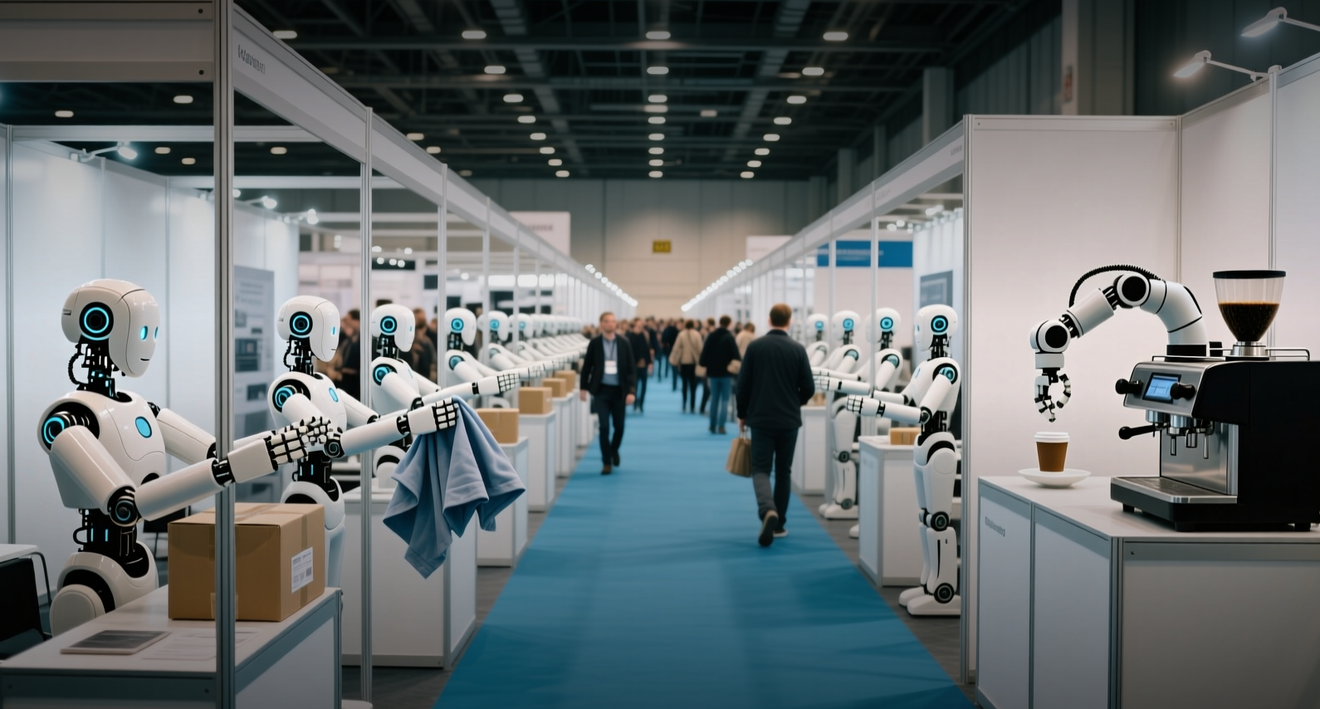
The debut caps a year in which China's embodied intelligence sector crossed from demonstration to deployment. Financing reached 93.5 billion yuan in the first half of 2026, five times the year-earlier level, according to IT Juzi, and more than 20 companies have reported IPO plans. At the World Robot Conference in Beijing this month, more than 300 exhibitors from 26 countries showed robots sorting parcels, folding clothes and making coffee, with logistics, retail and factory handling the most crowded scenarios.
Companies now face customers who calculate return on investment rather than fund proof-of-concept work at any cost, executives said. Xingyuan Intelligence founder Liu Dong said the industry is shifting from the research stage to deployment, with robots expected to total about 70,000 units shipped this year. Wujian Power, which is negotiating with South Korean coffee chains, targets hundreds of units in 2026, while Xingdong Epoch has verified product-market fit in logistics.
US restrictions cloud the outlook
Unitree's international expansion faces headwinds. Washington added the company to a military-related list in June, barring it from Pentagon business, and last month banned imports of new foreign humanoid and quadruped robots on national security grounds. Unitree acknowledged in its prospectus that further US restrictions could curb overseas sales, which account for more than 40 percent of revenue.
The company plans to use IPO proceeds to develop embodied AI models, robotics hardware and production capacity, and is collaborating with Nvidia on research. Chinese manufacturers have already surpassed Tesla, Figure AI and Boston Dynamics in global humanoid sales volumes, but bipedal machines still face software and hardware limits that keep broad industrial and household use years away.
"Unitree has demonstrated strong technology and commercial potential, but the transition from demonstrations and early deployments to broad industrial use will take time," Kangyuxiao Li, an analyst at Morningstar, said.
This article is for informational purposes only and does not constitute investment advice.
