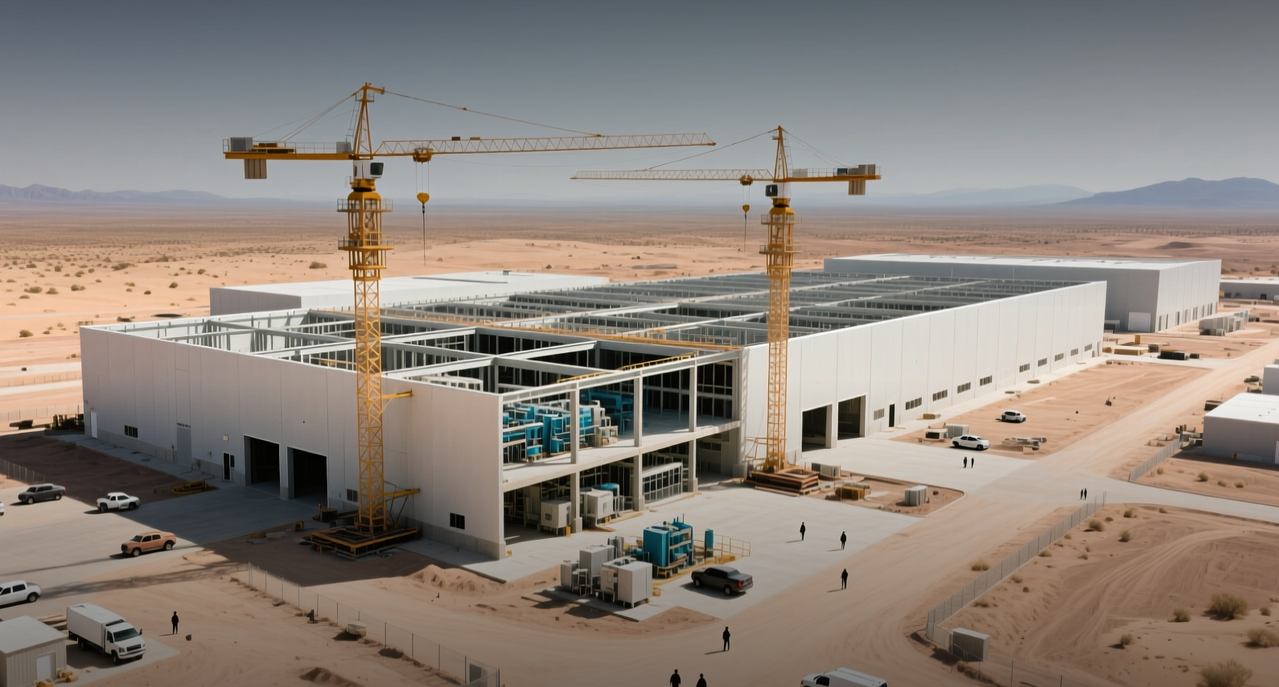
TSMC's $100 billion Arizona expansion will test whether the world's dominant chip foundry can preserve margins while overseas manufacturing costs run 2 to 4 percentage points higher. The company lifted its full-year 2026 revenue growth forecast to slightly above 40 percent year over year in U.S. dollar terms, up from a prior outlook of above 30 percent, as AI demand for advanced nodes accelerates.
"Management projects gross margin dilution from overseas fab ramp-up to range from 2 to 3 percent initially, rising to 3 to 4 percent at later stages," TSMC said in its latest guidance. The steep ramp of 2-nanometer (N2) technology — the node that packs more transistors per square millimeter for better performance per watt — is expected to dilute gross margins by 3 to 4 percentage points in the second half of 2026.
The additional $100 billion commitment brings TSMC's total Arizona investment to $265 billion, funding multiple leading-edge logic wafer fabs for N2 and below technologies plus advanced packaging facilities. Beyond the United States, the company is building 13 leading-edge and advanced packaging fabs in Taiwan, expanding mature-node capacity through JASM Fab 1 in Japan for CMOS image sensor applications, and constructing European Semiconductor Manufacturing Company in Germany for automotive and industrial chips.
The Margin Math Behind Geographic Diversification
Overseas fabs carry higher labor, construction, and operating costs than Taiwan's mature cluster, where TSMC has spent decades optimizing supply chains and yield rates. Management has framed the dilution as a near-term cost of geographic diversification demanded by U.S. customers and policymakers, rather than a structural erosion of its cost advantage over Samsung Foundry and other rivals.
The margin pressure arrives as TSMC scales production across three continents simultaneously. Each percentage point of gross margin dilution compounds across a revenue base that management expects to grow more than 40 percent in 2026, meaning the company is betting that AI-driven volume growth will more than offset the cost of building outside Taiwan.
The AI demand side of the equation remains strong. TSMC's leading-edge capacity is effectively sold out as hyperscalers and AI chip designers compete for N2 and advanced packaging slots. The company is using its manufacturing capabilities to generate more wafer output and drive greater capacity optimization across nodes to support profitability.
Broadcom's VMware Private AI Cloud and Qualcomm's new Dragonwing Q-2390 and IQ-2390 edge processors illustrate the breadth of AI compute demand flowing through the semiconductor supply chain, from data center accelerators to intelligent edge devices. Both companies depend on advanced foundry capacity to produce their silicon, placing TSMC's expansion at the center of the broader AI infrastructure buildout.
For investors, the tension is between growth and margin. TSMC's raised guidance implies revenue acceleration even as overseas expansion and N2 ramp costs compress near-term profitability. The question is whether the 40 percent growth trajectory can outpace the 3 to 4 percentage point margin drag, and whether TSMC's technology lead — the reason leading U.S. chip designers route their most advanced work through its fabs — justifies the geographic premium it is now paying. TSM ADR holders will watch quarterly margin prints through 2026 as the clearest signal of whether the expansion strategy is paying off.
This article is for informational purposes only and does not constitute investment advice.