
A 50% tariff on Canadian vehicles and parts would sever the most integrated supply chain in North American manufacturing, and Detroit's Big Three would feel it first.
A 50% tariff on Canadian vehicles and parts would sever the most integrated supply chain in North American manufacturing, and Detroit's Big Three would feel it first.
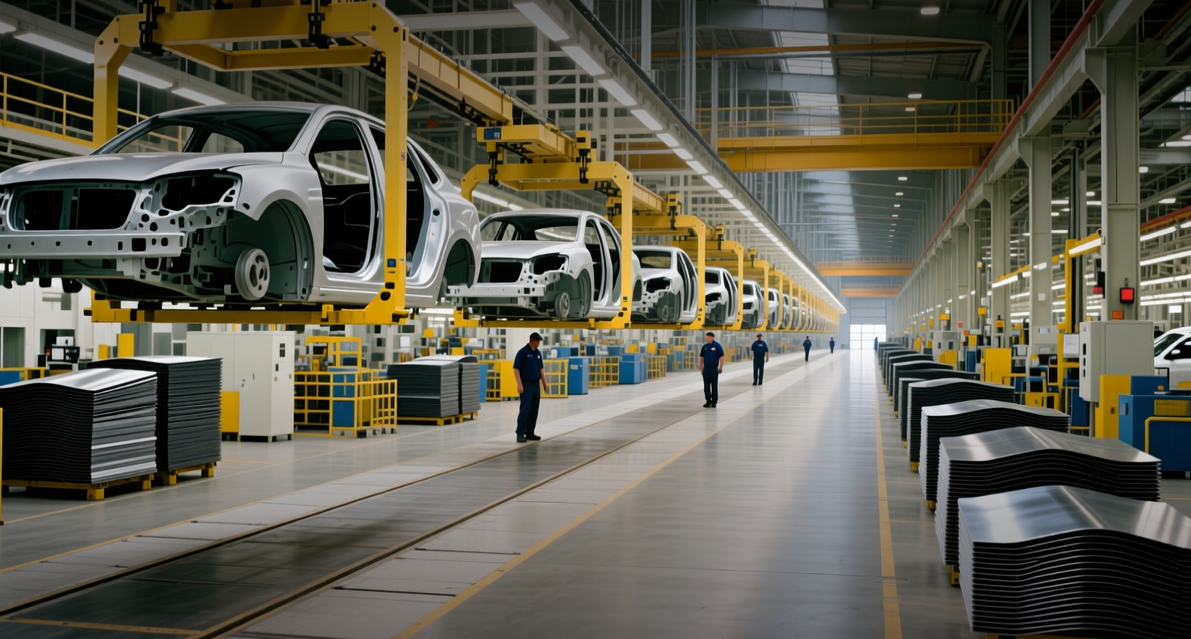
Trump's threat to raise tariffs on Canadian vehicles and steel to 50% from Jan. 1 would hit Detroit's Big Three hardest, exposing a supply chain that moves parts across the border multiple times before assembly.
"Sweaters, honey and hockey sticks are not a trade war. What the president just threatened this morning is a trade war," said Patrick Anderson, CEO of Anderson Economic Group, a Michigan-based consulting firm. "It would be a body blow to the auto industry. We would see plants closing on both sides of the border."
The U.S. imported $24.5 billion of Canadian vehicles and parts in the first six months of 2026, while Canada bought $30.4 billion from the U.S., according to Commerce Department data — a nearly $1 billion monthly U.S. surplus in autos. Canadians purchased about 663,000 cars built at U.S. assembly plants last year and spent more than three times as much on heavy trucks, buses and special-purpose vehicles than American buyers.
The threat came hours after 50% tariffs on roughly $20 billion of Canadian imports — furniture, dairy, wine, clothing and cement — took effect Saturday following the collapse of last-minute negotiations. Prime Minister Mark Carney suspended talks, accusing Washington of a last-minute "power play," and pledged to match the new duties "dollar for dollar," with retaliation set to take effect Sept. 8.
The Auto Supply Chain Is the Real Target
Since the North American Free Trade Agreement took effect in the 1990s, and then the USMCA during Trump's first term, automakers have operated as if North America were a single market. Parts and vehicles cross the border freely, often multiple times before assembly. Even last year's universal tariffs on steel, aluminum and autos left Canadian-made parts and vehicles largely tariff-free through carve-outs.
Disrupting that flow would cost U.S. jobs, both at assembly plants and among the more than half a million Americans employed by auto parts suppliers. "The impact of unworkable tariffs would be felt well beyond Canadian assembly plants," said Erin Keating, executive analyst with Cox Automotive.
The White House has exempted inputs the U.S. depends on too heavily to tariff — crude oil, potash, nickel, cobalt and lithium. Canadian crude accounts for 63 percent of U.S. crude oil imports, and Canada's estimated 1.1 billion metric tons of potash reserves, about one-third of the world's total, dwarf the 220 million in the U.S. Just 5.2 percent of Canadian exports to the U.S. are affected by the current 50 percent round, according to Marcos Carias, North American economist at trade credit insurer Coface.
Legal and Political Risks Mount
Trump invoked section 338 of the 1930 Tariff Act, the Depression-era Smoot-Hawley law, for the first time to justify the tariffs — a measure requiring a finding of unreasonable or discriminatory practices by a trading partner. Coface said the action's legality is likely to be tested in court, following the Supreme Court's rejection earlier this year of the International Emergency Economic Powers Act as tariff authority.
"The whole tariff story doesn't end the day they go in and are collected," Carias said. "You have to wait for them to be validated legally. With all of these actions coming, the path of these instruments in court is as important to follow as when and if they get applied."
Canada has taken a harder line than Mexico, which has struck a conciliatory tone and concluded three rounds of bilateral talks. In 2025, Canada was the only country other than China to impose retaliatory tariffs against the U.S., an action it later reversed but which was seen as highly symbolic. Carney's message, Carias said, is that "we're ready to negotiate, but we're not coming to this as pushovers."
The USMCA remains in effect until 2036, with provisions for annual review, even though Trump has refused to engage in formal talks for a 16-year renewal. If the 50 percent auto tariffs take effect as threatened, the cost would ripple through an industry that employs more than half a million Americans in parts alone — and through the roughly 663,000 Canadian buyers of U.S.-built vehicles who would face sharply higher prices.
This article is for informational purposes only and does not constitute investment advice.
