SpaceX signed an AI compute hosting contract worth about $1.11 billion a month, billings from Dec. 1, giving Chief Financial Officer Bret Johnsen what he called increased confidence the company reaches a $100 billion annual recurring revenue run rate by year-end.
"Based on annualizing December revenue, we have more confidence in the $100 billion ARR target," Johnsen said at the Goldman Sachs Communacopia + Technology Conference on Sept. 10. He did not name the counterparty.
The deal is the fourth major AI infrastructure contract SpaceX has disclosed in under a year, and it stacks on top of roughly $28 billion in annualized compute revenue already under contract. Anthropic pays about $1.25 billion a month through May 2029, a three-year commitment totaling roughly $45 billion that carries access to more than 220,000 Nvidia GPUs and over 300 megawatts of dedicated power. Alphabet's Google Cloud pays about $920 million a month from October 2026 through June 2029 for roughly 110,000 Nvidia GPUs plus associated CPU, memory and networking capacity, a contract reported to exceed $30 billion in total value. Reflection AI pays $150 million a month from July 1, 2026 through the end of 2029, a $6.3 billion agreement for Nvidia GB300 chips inside SpaceX's Colossus 2 data center.
Add the new December contract and the four agreements bill more than $3.4 billion a month, or about $41.1 billion annualized, once all are running simultaneously. That is comparable in scale to Starlink's reported annualized revenue run rate and puts AI compute alongside launch services and satellite broadband as one of SpaceX's largest revenue lines.
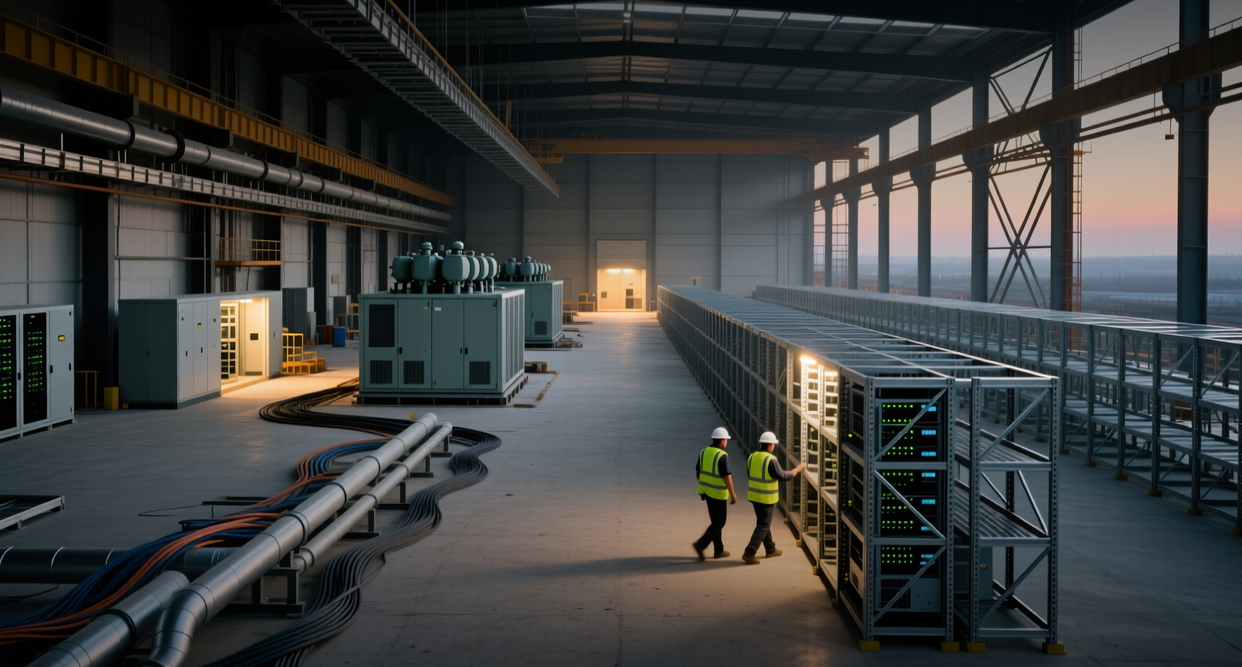
The capacity to serve it is the constraint. SpaceX had 1.4 gigawatts of installed computing capacity as of June 30, 2026, expects to cross 2 GW by year-end and is targeting close to 10 GW by the end of 2027 — a seven-fold increase in 18 months. Johnsen has told investors the AI compute spending carries a payback period of under one year, an economics profile that only works if racks fill almost immediately on coming online.
A $13.3B contract that either side can walk away from
The revenue is less locked than the headline suggests. Johnsen said most of SpaceX's compute contracts are not fully committed and nearly all allow either party to terminate after a few months' notice. The reason is internal demand: SpaceX's own AI products need the same capacity, and the company does not want long-term third-party rentals to cap its own expansion. Musk has publicly described the Anthropic arrangement as short-term with a 90-day termination clause on either side.
A separate report from The Information on Sept. 10 said SpaceX is changing how it builds data centers, adding backup systems, cooling and pre-operational testing. That approach could slow the buildout and delay signing new tenants, which would push AI-related revenue growth behind current projections. SpaceX shares rose 1.6% in morning trading on the day of the report.
The competitive logic runs on time-to-power rather than price. AI training clusters are limited less by GPUs than by electricity, permitting and construction schedules, and SpaceX has brought gigawatt-scale capacity online faster than conventional hyperscalers including Amazon Web Services, Microsoft Azure and Oracle. SpaceX has committed to building exclusively on Nvidia hardware, with Johnsen citing the Vera Rubin architecture and the Nvidia partnership as strategic advantages — for labs that want the newest silicon first, queue position is itself the product.
Starship's first paying flight and compute in orbit
Starship's 14th flight, expected later in September 2026, is set to be the first revenue-generating mission, carrying production V3 Starlink satellites. SpaceX aims to recover both the booster and the upper stage later this year, then raise reuse rates in 2027. Lower launch costs are the mechanism behind the company's longer bet: Johnsen said the first orbital compute satellites launch next year, with scale-up around 2028, and that falling launch, satellite and solar costs could bring space-based compute to an economic crossover with ground data centers around 2027. Terrestrial data centers face rising power, cooling and land costs; the orbital case assumes those curves diverge.
Next-generation direct-to-cell satellites begin launching in 2027, with service targeted for the first half of 2028 and an upgrade from today's texting and light voice capability to what Johnsen described as full 5G quality.
For investors, the read-through is twofold. Nvidia's position as the sole silicon supplier to a customer scaling from 1.4 GW to a targeted 10 GW is the clearest beneficiary, and the cancellable structure means SpaceX is effectively running a merchant compute business with hyperscaler-scale revenue and startup-scale contract duration. SpaceX trades at a reported $2 trillion market cap with a forward P/E above 1,000 and revenue growth of 33.24% year over year, per Seeking Alpha data — a multiple that requires the compute ramp to hold. The counterparty on the December contract remains undisclosed, and the first month of billings lands in Q4 2026 numbers.
This article is for informational purposes only and does not constitute investment advice.